




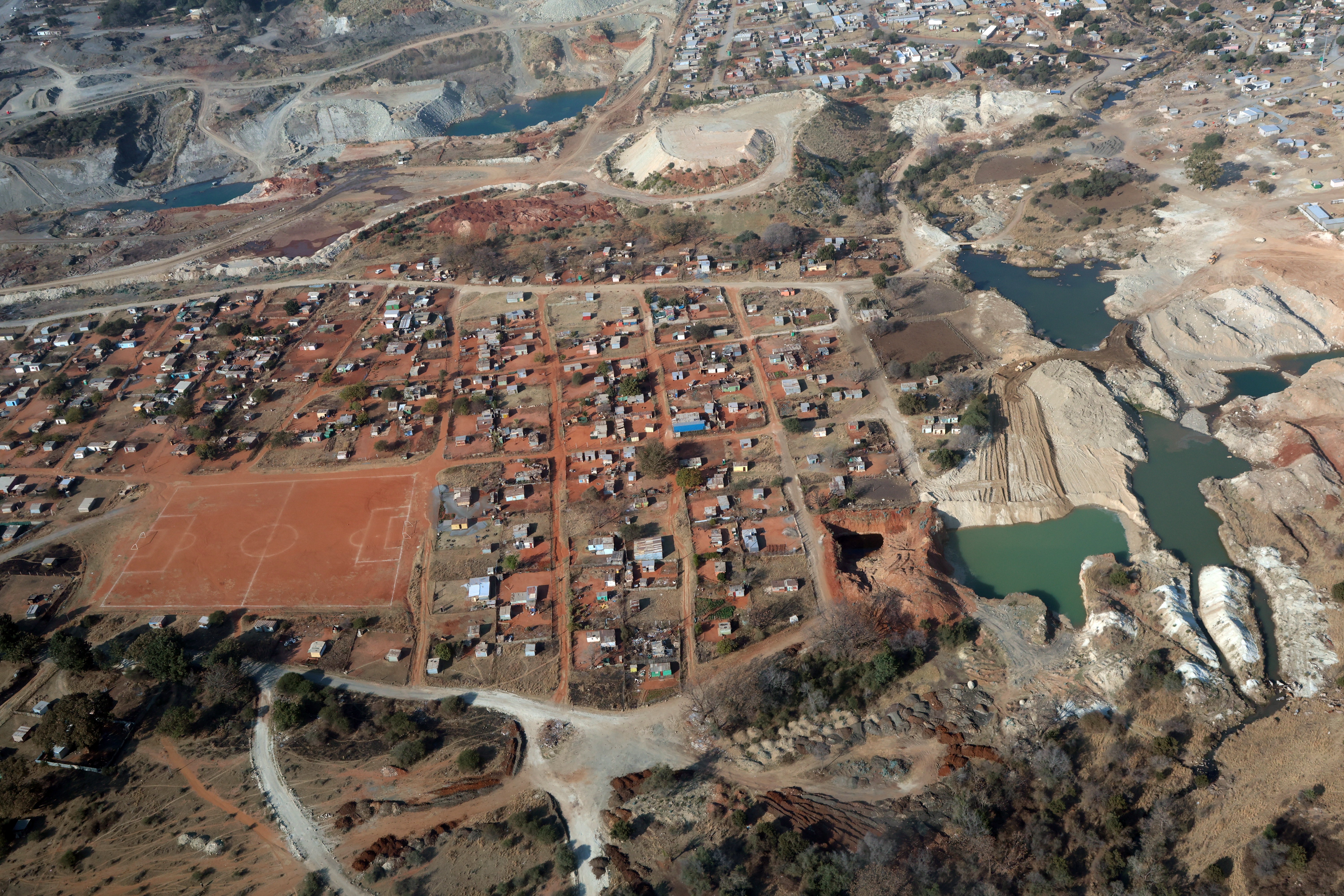
 The sprawl of out-of-control chrome operations in North West meets the sprawl of an informal settlement. (Photo: Felix Dlangamandla)
The chrome produced from the illicit and unregulated mines and washing plants scarring South Africa’s landscape have a market, and the main one is China.
Chrome ore is smelted into ferrochrome, the key ingredient for stainless steel, which has wide industrial uses. And these global supply and production chains are tainted by South Africa’s dirty chrome.
Over two decades ago, the issue of “blood diamonds” became the focus of global campaigns to halt the illicit trade in gems that exploited artisanal labour while funding conflicts in countries such as Sierra Leone and Angola. In 2003, the Kimberley Process was launched to exclude conflict diamonds from legitimate trade.
Surging sales in lab-grown diamonds since have probably done as much as anything else to stifle the trade in diamonds from conflict zones.
There are also mounting concerns about illicit gold – including the stuff extracted by zama zamas (illegal miners) in South Africa – being laundered into international markets through hubs such as Dubai.
Chrome can be added to this list, and its end uses are more wide ranging. A diamond typically winds up someone’s finger, while gold is a store of wealth also used for jewellery with some – and growing – industrial applications.
But stainless steel is ubiquitous. It is used for cutlery, cookware, kettles, fridges and sinks. It is also used for buildings and bridges, in automobile exhaust lines, in surgical tools and implants, in power stations, firearms and spacecraft.
And while odourless, at least some of it carries the stench of crime, environmental and community degradation and ruthless exploitation. Like diamonds and gold, the vast majority of the world’s chrome supplies are legitimate, and the clean producers do not want to see supply chains sullied by the dirty stuff.
“Greater scrutiny is needed across the value chain over transporters, buyers, processors and exporters to ensure illegally mined chrome cannot be laundered into legitimate markets. Action is often limited to the Tier 1 (on-the-ground illegal miner) versus tier 4 (the buyer of the finished product) criminal who was arrested in the operation,” Sibanye-Stillwater CEO Richard Stewart told Daily Maverick.
“We seldom see any linkage to the enablers of these crimes along the full value chain, to the buyers. Most critically, these products only have value if they are able to leave South Africa’s shores to fulfil the international demand.”
Precisely how much of South Africa’s exported chrome is illicit is impossible to pin down, but there is faint spoor on the trail that gives at least some indication.
In 2024 – the latest year for which comparative data is available – South Africa’s global chrome exports amounted to R84.6-billion, according to data compiled by the Minerals Council SA. Of that, R40.8-billion went to China, which (based on the average rand exchange rate for that year) was around $2.2-billion.
But China’s imports of South African chrome that year, according to Trading Economics based on UN trade data, were valued at $4.7-billion.
That is a massive discrepancy – but it’s not the full picture.
Mozambique was the second-biggest destination for South African chrome, but that is not its final destination – the vast majority goes through the port of Maputo to China. Adding that to the mix brings South Africa’s chrome exports that year to China to around $4-billion based on Daily Maverick’s calculations of the rand exchange rate.
That leaves a gap of around $700-million – about 15% – of South Africa’s total chrome exports to China. This estimate is just that, but it points to the sheer scale of the illegal enterprise – and the fact that this is big business.
/file/attachments/orphans/WFD_9606_718106.jpg "The sprawl of out-of-control chrome operations in North West meets the sprawl of an informal settlement on 31 July 2026. (Photo: Felix Dlangammandla)")
/file/attachments/orphans/WFD_9709_854459.jpg "The sprawl of out-of-control chrome operations in North West meets the sprawl of an informal settlement on 31 July 2026. (Photo: Felix Dlangammandla)")
Pit to port
Chrome should not, at first glance, be easy to pillage and launder. Unlike diamonds or gold, it is a bulk commodity, priced in tonnes rather than carats or ounces. It moves by truck to ports and is then shipped out on cargo vessels.
But its tracks can be concealed nonetheless.
“Chrome does not have a DNA like gold, it cannot be traced back to its origins,” a mining security consultant told Daily Maverick.
Documents can also easily be forged, including weigh-bridge slips and the like.
“The industry would benefit from stronger traceability and due-diligence mechanisms to improve confidence regarding the lawful origin of exported chrome,” Sibanye’s Stewart said.
And on the road, the details of the load do not need to be subjected to scrutiny.
“The transport legislation doesn’t say that you must have details of that load unless it is hazardous material,” Gavin Kelly, CEO of the Road Freight Association, told Daily Maverick.
In 2024, a contractor for a major PGM producer suspected that chrome was being siphoned from its trucks and alerted the mining company’s security. They uncovered the fact that using forged documents, employees for the contractor were diverting truckloads of chrome to illegal sources such as washing plants – a total of 70 truckloads of 34 tonnes each in the space of a fortnight.
Security sources and executives from a number of mining companies told Daily Maverick that small rather than large and legitimate transport companies are used, and the load generally has a lower chrome content.
Chrome concentrate from legitimate sources is typically around 42% and currently fetches around $310 a tonne. But the illicit stuff can be 30% or less and can go for as little as $100 a tonne on the black market, a senior mining executive told Daily Maverick.
Precisely how it gets through the ports at the end points to corruption and an evasion of customs compliance. The South African Revenue Service did not respond to Daily Maverick’s requests for comment on this issue.
This is all unfolding against the backdrop of proposals to impose an export tax on chrome to boost domestic “beneficiation” – a questionable policy to say the least.
The domestic ferrochrome industry has collapsed under the weight of surging power prices, which have blazed South Africa’s trail to deindustrialisation and handed processing and manufacturing to the Chinese on a stainless steel platter.
And such a tax would also possibly give the illicit exporters a competitive advantage over licit producers and exporters, as the bad eggs are clearly avoiding customs scrutiny.
“A chrome export tax will have no impact on illegal chrome operations but will reduce the value of legitimate chrome operations. This will undermine investment in legitimate chrome projects that support significant employment, without solving the issue they are intended to address,” Sibanye’s Stewart told Daily Maverick.
/file/attachments/orphans/WFD_9682_635810.jpg "The spoor of illicit and unregulated chrome mining: gouges in the Earth on 31 July 2026. (Photo: Felix Dlangammandla)")
/file/attachments/orphans/WFD_9589_711723.jpg "Small-scale chrome operations in an unregulated and grey environment are popping up along busy roads in plain sight along busy roads between Rustenburg and Brits. on 31 July 2026. (Photo: Felix Dlangammandla)")
International Minerals Agency
Are there templates for tracking and tracing the routes taken by South Africa’s criminal chrome?
Daily Maverick asked Adam Matthews, the chief responsible investment officer for the Church of England’s Pension Board, about this issue. Matthews is also the chair of the Global Investor Commission on Mining 2030, which is crafting a vision for a socially and environmentally responsible global mining sector by 2030
“One of the key areas we are looking at is how can we address illicit mineral flows. As investors, having illicit mineral flows undermines the responsible mining industry,” he said in an interview.
“We’ve been looking at illicit flows in a range of countries including from DRC and the conflict environment there linked to Rwandan-backed M23 rebels, and we’ve mapped the flows of coltan and gold from that region into global markets and the finance back the other way.”
At a macro level, the organisation has proposed a global agency to monitor such flows.
“What we’re keen to see ultimately is an independent international minerals agency or organisation that can actually track illicit flows across all of the different illicit mining activities and do the kind of work that we have tested in DRC, where you can identify all the actors along a chain from the sort of actual mining of the material through to the international markets.”
This would be applied widely and could include South Africa’s criminal chrome. And it is investor-driven, underscoring the concerns among institutions that commit capital to the mining sector about such issues.
It is surely possible to track and trace the financial flows linked to South Africa’s criminal chrome.
Daily Maverick is aware of a couple of the alleged chrome kingpins – but cannot reveal their identities for legal reasons as they have yet to appear in court to face charges linked to such activities. They are well known among mining security circles and community activists and must be on the radar screen of the police.
And like the illicit chrome operations, one is hiding in plain sight. He is known for flaunting his wealth with ostentatious displays on social media – wealth that cannot be explained by the business he owns as a transparent front. It would surely not be that hard to connect these dots, which throws into sharp relief the fact that the top tier in this criminal enterprise must have powerful backers in the state.
Leading the charge here are the legitimate mining companies and courageous community activists. The latter brought this issue to the Daily Maverick’s attention, and it is their pain-staking work which is revealing the sheer scale of this rampant criminality.
This speaks to the best of South Africa and the enduring spirit of resistance to blatant wrongs.
Criminal chrome is a visible blight on South Africa’s body politic, leaving invisible traces in the world’s supply chains of stainless steel. But the torch of transparency is slowly pulling it out of the shadows. DM
Comments
Scroll down to load comments...