




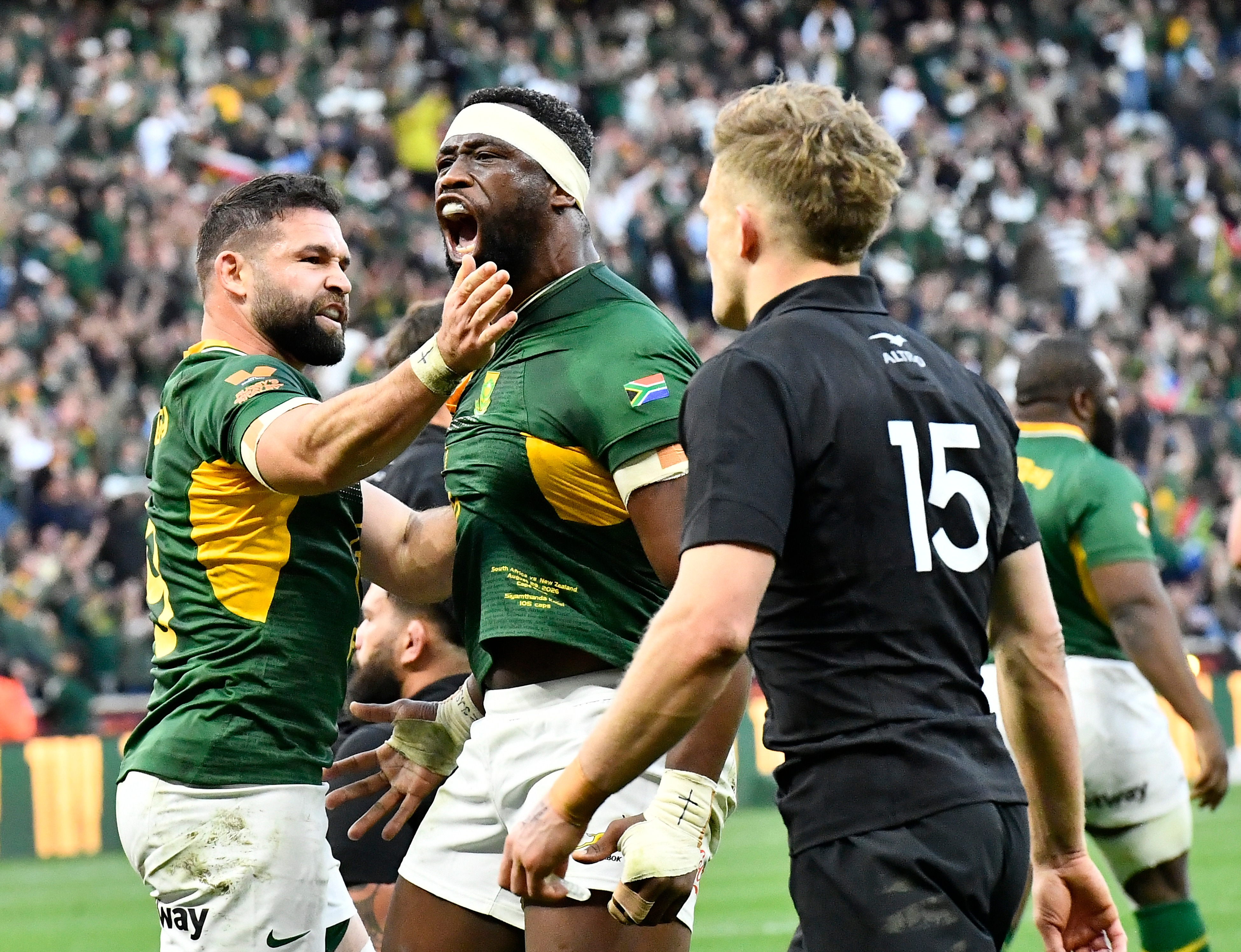
 Springbok captain Siya Kolisi celebrates scoring against New Zealand at DHL Stadium on 29 August, 2026 in Cape Town. (Photo: Ashley Vlotman/Gallo Images)
The greatest sporting rivalries are not best defined by similarities but by contrasts, which is at the heart of heated competition.
The ice-cool baseliner Bjorn Borg was the perfect foil for the fiery serve-and-volleyer John McEnroe in one of tennis’ many great rivalries.
Think of Roger Federer’s lithe elegance against the brute force of Rafa Nadal’s almost pugilistic approach to tennis as another example.
In boxing, it was the brilliant defence and counter-punching of Sugar Ray Leonard against the explosive attack of Tommy Hearns and Roberto Duran.
And there are so many more examples of opposites creating great sporting drama and spectacle.
Yet, even those examples oversimplify it because Sugar Ray could not have been a great if he wasn’t aggressive, or couldn’t take a punch.
Nadal’s style was more muscular, but he still had the soft touch of a feather falling out of a nest when he needed to.
Contrasts are the lifeblood of competitive sport, but they are much more subtle than sometimes seems obvious.
/file/attachments/orphans/TL_2609052_863805.jpg "Scrum during the Castle Double Malt Greatest Rivalry Tour match between South Africa and New Zealand at 10bet Ellis Park on August 22, 2026 in Johannesburg, South Africa. (Photo: Sydney Seshibedi/Gallo Images)")
Rugby’s Greatest Rivalry
Which brings me to the contest unfolding in dramatic fashion between the Springboks and All Blacks in the Greatest Rivalry series. This is a battle of styles and culture, which is as it should be.
And the quality of the rhetoric coming from each camp has matched the rugby they’ve delivered on the field.
The All Blacks arrived in South Africa and immediately set the tone, suggesting that their style was the prototype for rugby and how it should be played. To them, the Boks’ preference for set-piece plays and an aerial kicking battle make rugby slow and boring.
It was smart of All Black coach Dave Rennie and his assistant Tana Umaga, because it immediately created an image that set pieces are an unnecessary side to the game – a fussy waste of time. It’s as if they were saying: “Come on man, just run the ball like us.”
Set pieces, of course, are essentially what makes rugby, rugby [I’ve deliberately not named it rugby union because in South Africa, there is only one rugby].
Take away scrums and lineouts, and you have Rugby League.
/file/attachments/orphans/2292057664_286711.jpg "Pieter-Steph du Toit of South Africa and Patrick Tuipulotu of New Zealand in the line out during the Castle Double Malt Rugby's Greatest Rivalry, 2nd Test match between South Africa and New Zealand at DHL Stadium on August 29, 2026 in Cape Town, South Africa. (Photo: Grant Pitcher/Gallo Images/Getty Images)")
And make no mistake, New Zealand Rugby (NZR) is facing an existential threat from the Australia-based National Rugby League (NRL).
New Zealand has one team in the Trans-Tasman competition – the Warriors – which isn’t enough to bleed the NZR dry of playing resources.
But ambitious NRL teams from Australia are recruiting more and more young New Zealand rugby players with attractive offers to switch codes.
Coupled with the NZR’s unflinching rule about selecting only locally based players for the All Blacks, it’s clear it’s a sport needing to confront some big issues.
What is strange, though, is the narrative via the All Blacks and commentators from New Zealand is that the only way to save rugby is to make it more like Rugby League.
Rugby’s identity
Surely the best way to keep rugby’s identity is to embrace aspects such as the scrum, the lineout and the rolling maul, which define it and make it unique?
These are the variations and facets of the game that force teams to decide which aspects and skills to focus on in relation to the type of athletes and systems they have.
It’s a sport that allows coaches and players to place greater emphasis on what suits their culture and athlete profile best, but still demands that they pay enough attention to all aspects of the game to be competitive.
Rugby is far less homogeneous than League and requires a wider range of athletes to create a balanced team.
And that is truly part of its fascination. How many times have we seen a team that has great backs but poor forwards and therefore is only mediocre?
Or a team that boasts a powerful scrum, but no pace and guile. It also doesn’t go very far. Finding the blend of power and finesse is what makes a great rugby team.
/file/attachments/orphans/2292654600_532729.jpg "Jett Cleary of the Warriors celebrates with Demitric Vaimauga of the Warriors after winning the round 26 NRL match between New Zealand Warriors and Newcastle Knights at Go Media Stadium, on August 30, 2026, in Auckland, New Zealand. (Photo: Hannah Peters/Getty Images)")
Contrast illusion?
Poised at 1-1 after two Tests, which is no surprise given that these sides have split 112 clashes with 64 New Zealand wins, 44 South Africa victories and four draws, the series is wide open.
What, at first glance, appears clear, though, is that this is a series presenting an obvious contrast in styles.
Broadly put, the narrative is that it’s the dashing, free-flowing All Blacks, full of running and skip passes, against the belligerent, punishingly physical, set-piece-oriented Boks.
It’s not the full picture, though and reduces the teams to stereotypes rather than what they really are – two excellent rugby teams that are highly competent at all facets of the game.
Rennie is no fool, and he knows that a world champion team requires great set piece strength in addition to flair and intelligence.
He has openly questioned the legality of the Boks’ scrum and the style of South African play (aerial kicking game/ball in play time) because he understands those are areas where the Boks are better.
If he can somehow negate them by influencing officials via the media, he’s doing his job.
Rennie doesn’t want to remove set pieces from the sport of rugby, but at this moment in time, he’s trying to use all means necessary to depower the Boks’ set piece. It’s a very specific and targeted campaign.
/file/attachments/orphans/TL_2613246_182576.jpg "Leroy Carter of New Zealand scores a try during the Castle Double Malt Rugby's Greatest Rivalry, 2nd Test match between South Africa and New Zealand at DHL Stadium on August 29, 2026 in Cape Town, South Africa. (Photo: Ashley Vlotman/Gallo Images)")
The Boks have countered the narrative by emphasising how productive their set pieces are and how they base their gameplan on suiting their strengths.
They’ve also questioned the All Blacks’ legality around rucks because that’s where New Zealand generate quick ball to launch attacks. It’s obviously an area that worried the Boks, so coach Rassie Erasmus has publicly mused about it.
The Boks have also defended their love of scrums and their success in that facet over six years as a counter to the All Blacks’ narrative that the Boks scrum illegally.
“If you say we’re walking around, then we’ve been walking around for the past six years, ever since I’ve been part of Springbok rugby. I’ve never coached that, because we want to go forward. Walking around is not ideal for us. We don’t want to do it,” Bok scrum guru Daan Human said this week.
Maximise strengths
Obviously, each team has its strengths and weaknesses, and both nations want a game to maximise their best attributes and minimise their worst. That’s just common sense.
But Rennie’s All Blacks would not be level in the series if they couldn’t defend or do the basics of rugby well.
How the All Blacks held the Boks at bay in the 20 minutes either side of halftime in the first Test at Ellis Park, was key to their 33-16 victory. They tackled ferociously and despite struggling in the scrum for an hour, shored up the set piece in the last 20 minutes, winning a crucial scrum penalty, which was the foundation of their win.
And despite the All Blacks scoring four tries in the second Test, the Boks cut holes through the All Blacks defence in the first half, using quick ruck ball and intelligent, direct attack to set up their 33-26 win at DHL Stadium.
Centre Jesse Kriel’s opening try was a clear example. The Boks started the move from a rolling maul and then launched into attack mode, using big forwards running hard on to the ball from three quick rucks. It showed their attacking strengths too.
/file/attachments/orphans/TL_2613116_953427.jpg "Siya Kolisi of South Africa scores a try during the Castle Double Malt Rugby's Greatest Rivalry, 2nd Test match between South Africa and New Zealand at DHL Stadium on August 29, 2026 in Cape Town, South Africa. (Photo: Ashley Vlotman/Gallo Images)")
Between those two examples, each side had their moments of superiority in various aspects of both games.
It’s a contrast of styles, yes, but styles are a matter of emphasis, not exclusivity.
Borg never won on ice alone – he could match McEnroe’s touch when the point demanded it. Sugar Ray Leonard’s counter-punching only worked because he could trade when cornered.
The Boks and All Blacks operate the same way. Each has spent a century building a reputation on one half of the game, while quietly staying dangerous in the other.
It’s why 112 Tests haven’t settled the argument, and why the third Test at FNB Stadium won’t either.
Whoever lifts the trophy at the end of the series will have won by playing and excelling at more of the other team’s game than pundits like to admit.
Despite the rhetoric, these are two fantastic rugby teams showing high quality in all of the sport’s unique facets.
It’s the best possible advert for the game and New Zealand’s best way to keep its public invested in rugby and the All Blacks. DM
Comments
Scroll down to load comments...