



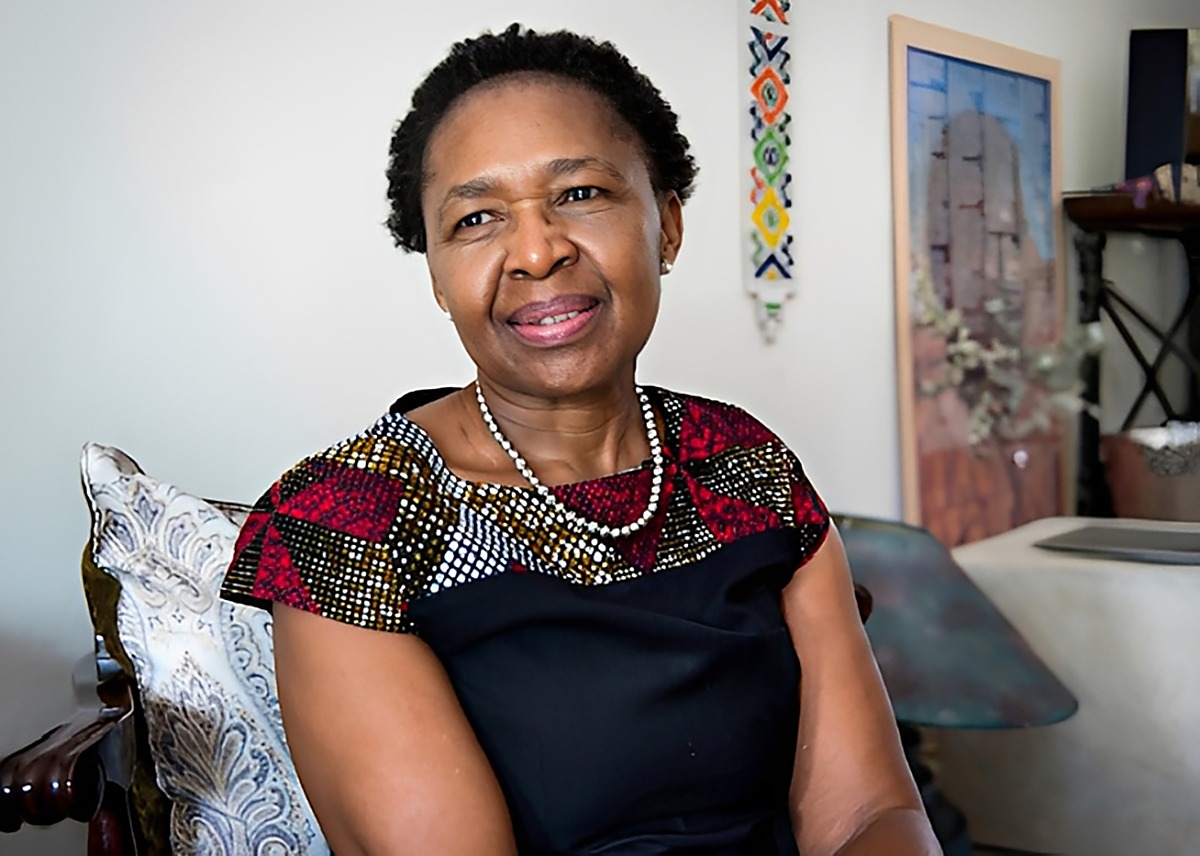
 Ntjantja Ned has been a lifelong advocate for early childhood development and an innovator in social development services. (Photo: Ntjantja Ned)
Early childhood development (ECD) advocate and social development services innovator Ntjantja Ned began her career as a social worker in QwaQwa, Free State, in 1978. While conducting community work and family visits in the former apartheid homeland, she witnessed first-hand the steep challenges facing young children.
Ned went on to serve as chief director of the Free State Department of Social Welfare, deputy director-general of the national Department of Social Development and CEO of the Hollard Foundation – the corporate social investment arm of Hollard Insurance.
She credits her success as a leader to never forgetting who she once was: “a child from the village”.
“That remembering of who I am, where I come from and what matters in the life of a child ... becomes what matters in the life of a person given responsibility to lead,” Ned told Daily Maverick.
/file/attachments/orphans/WFD_3791_799588.jpg "Learners gather for breakfast at Bulungula Preschool in Xhorha Mouth, Eastern Cape. The morning meal provides vital nutrition, helping young children start the day ready to learn, play and participate in early childhood development activities. (Photo: Felix Dlangamandla)")
Reshaping social service delivery
Upon taking up the role of chief director, and later head of department, in the Free State Department of Social Welfare, Ned recognised that real power stemmed from collective wisdom and surrounded herself with advisers who possessed deep expertise and weren’t afraid to challenge her perspective.
“The strength comes from the diversity of this country, of humans, and we become an ecosystem when we do that. Being appointed to a position does not mean you know it all and you can do it all. It really just means you are serving the people that are around you, so that they go out and serve others better,” she says.
Between 1995 and 1998, Ned was involved in reshaping social service delivery in the province, overseeing progress towards a single social security system ensuring non-racialised, universal access for vulnerable citizens. The pilot system was based on public-private partnerships as a model for more efficient service delivery.
When she took up the position of deputy director-general of the Department of Welfare (later renamed the Department of Social Development) in 1998, part of her mandate was looking at how to replicate this system at a national level.
“The first five, 10 years of democracy were an incredible opportunity for South Africans to turn out and make a contribution to what we had all been saying we wanted – a nonracial South Africa; a country that respects all of its people, that understands and embraces the different cultures and the colourfulness of this country,” said Ned.
Around that time, processes were underway to design and implement the Child Support Grant, an effort led by Francie Lund, then the Chair of the Ministerial Committee of Enquiry into Child and Family Support for South Africa. The Lund Committee produced its report on child and family support in 1996, with the Child Support Grant officially rolled out in 1998.
In her role as deputy director-general, Ned recalled working on the technical implementation of the Child Support Grant, based on the research produced by the Lund Committee. The work included engaging with communities and making presentations in Parliament around the grant.
One of the central concerns was sustainability and how to accommodate a far greater number of children in the social security system.
“We were guided by the view that we should open the safety net, and from that, then we could start deepening as we understood ... the stabilising of our budget as a country, and consolidation of all the different budgets from these [government] departments,” said Ned.
/file/attachments/orphans/Tamsin-ECD-nutrition2_341241.jpg "‘Little to nothing’ done with R330-million budget for ECD pilot nutrition programme since 2024. (Photo: John Moore/Getty Images)")
She recalled presenting the concept of the Child Support Grant to Parliament, and driving the process of integrating into one equitable framework the 18 different payment systems that had spanned different races and areas during apartheid. One of the central concerns was sustainability and how to accommodate a far greater number of children in the social security system.
“We were guided by the view that we should open the safety net, and from that, then we could start deepening as we understood ... the stabilising of our budget as a country, and consolidation of all the different budgets from these [government] departments,” said Ned.
Working with municipalities
In 2006, Ned was invited to become a founding trustee of the Hollard Foundation, with a focus on designing and supporting a programme of work to address the systemic neglect of under-served and vulnerable children in the country.
“As the board of Hollard Trust, we said we really needed to find a way of working in partnership [with municipalities], so that we understood why they were not delivering... We decided up front that our approach in serving children would be to go where the children were. That was our first principle,” explained Ned.
The Hollard Foundation’s strategy, guided by Ned, was to operationalise 60% of its resources at the local government level, ensuring a bottom-up, systemic approach that allowed the organisation to become a key systems-change actor in the ECD sector.
“What really was significant for us, looking back, was that work with local municipalities, helping communities get early childhood development into the Integrated Development Plans of government,” said Ned.
“On our side, we were actually funding and saying to municipalities that they should have a unit of early childhood development that will work with the other [local] departments, like... zoning and land use.”
The right people
In Ned’s view, the challenges facing women in South Africa have always been three-fold: not just race and inequality, but also the patriarchy.
“[Women] were not seen as significant. Child-rearing ... was not sufficiently appreciated. It was not appreciated that this is investing in our own future [and] the Human Development Index of South Africa. It’s intertwined. It’s integrated,” she said.
Women’s voices and potential are still restricted, argued Ned, requiring greater effort on the part of those in public service to pursue partnerships and drive systems change.
Drawing lessons from her own long career in policy-making and reform, she emphasised that money alone was not enough to drive progress.
“Money doesn’t solve problems. People do. Money helps people solve problems… We need the right people,” said Ned. DM
This article was updated on 2 September to acknowledge the work of the Lund Committee in driving the implementation of the Child Support Grant, and differentiating Ntjantja Ned's contributions to social welfare reform at a provincial and national level.
Comments
Scroll down to load comments...