




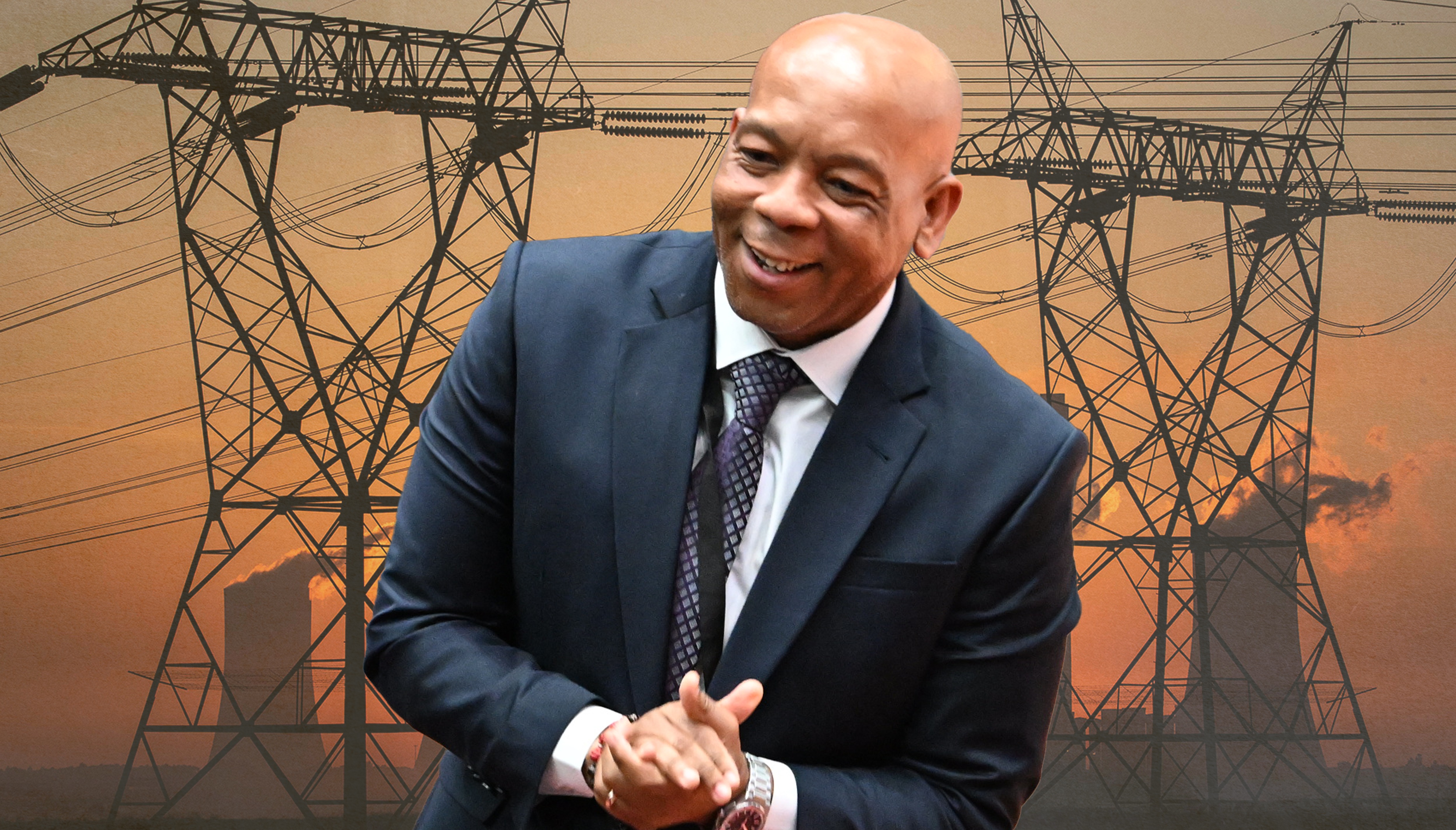
 Illustrative image | Power lines from Eskom’s Lethabo power station in the Free State. (Photo: Kim Ludbrook / EPA) | Electricity Minister Kgosientsho Ramokgopa. (Photo: Lefty Shivambu / Gallo Images)
 The minister of electricity and energy, Dr Kgosientsho Ramokgopa, is done being apologetic about the good work he and the Eskom ensemble have put in to turn the national power utility around.
In November 2025, during a keynote address in Johannesburg at an event organised by the Black Business Council and the Guma Group, he said:
“We must state it publicly that black professionals are driving the turnaround... We’re exceptionally qualified, competent professionals, patriotic, who have taken the mission of resolving the most existential questions of the South African democracy. That’s what we have achieved. We must stand on the rooftop. We are resolving this problem because we’ve got the means to resolve this problem. The colour of our skin should not define who we are. We are exceptionally confident, and that’s why this Eskom story is incomplete; we are going to deliver more and more...”
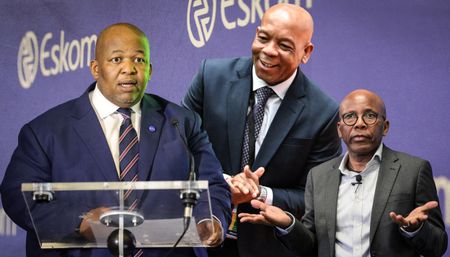
Now that those questions have been cleared up, beneath the tidy headline profit of R30.3-billion the power utility announced for the last financial year lies a series of structural liabilities, governance failures and criminal threats that challenge Eskom’s standalone viability.
Municipalities account for 44% of Eskom’s sales, but payment failure remains a systemic threat. Gross municipal arrear debt grew by R17-billion (17.9%) to R111.6-billion at year-end and continued to escalate to R119.9-billion by June 2026.
The concessions
Outgoing CFO Calib Cassim revealed in his last results presentation that Eskom was forced to exclude R15.8-billion in billed revenue from its income statement due to non-collectability.
Under the National Treasury’s municipal debt relief programme, R3.6-billion was written off during the year, with another R4-billion scheduled for FY2027.
Arrear debt actively blocks the legal separation of the distribution division. Distribution cannot proceed to corporatisation (as the National Electricity Distribution Company of South Africa) because it cannot satisfy the liquidity and solvency tests required for lender consent. Without intervention, municipal arrears are projected to reach R358-billion by FY2031.
But let’s rather talk about the other reforms.
A cornerstone of the electricity supply industry reform under the Electricity Regulation Amendment Act is the unbundling of Eskom’s vertically integrated monopoly into focused subsidiaries and the creation of an independent state-owned Transmission System Operator.
The National Transmission Company South Africa (NTCSA) has been operating as a wholly owned subsidiary of Eskom since 1 July 2024. Unpacking the financial statements, however, reveals major costs, accounting challenges and financial risks associated with this split.
The value of Eskom’s investment in NTCSA increased by R4.2-billion (from R26.3-billion in FY2025 to R30.5-billion in FY2026) as a direct result of the NTCSA portion of government debt relief being converted into equity.
You remind me
Under accounting standards, NTCSA, generation and distribution continue to be classified as a single cash-generating unit. Because NTCSA’s cash inflows are highly dependent on electricity sold to external customers at a single regulated exit tariff approved by SA’s energy regulator, Nersa, it does not generate cash inflows that are independent of other divisions.
In fact, transferring transmission assets carries a major tax gremlin: if de-grouping occurs within six years of the asset transfer, it may trigger a deemed disposal and capital gains tax for Eskom.
Legal separation requires advance lender approval. The transfer of assets triggers lenders’ protection under section 7 of the Eskom Conversion Act, which could severely influence lenders’ willingness to continue providing funding to the Eskom group unless carefully sequenced.
These are only a few of the reasons that the transmission unbundling has been slow, because Ramokgopa has also given the Eskom board a licence to execute according to their fiduciary duty, telling them:
“Your responsibility is to this entity called Eskom and you have the fiduciary responsibility towards Eskom and its shareholders, including myself. Bring to our attention when some of the decisions that we are taking in your collective wisdom are such that they will undermine the interest of Eskom; articulate them... We support the unbundling. We support the transformation, but we want to bring it to your attention that the following areas require attention and resolution for you to achieve the results you have set for yourselves.”
It’s this central tension that can seem like defiance, especially when President Cyril Ramaphosa reiterated the commitment to “establish a fully independent transmission system operator with ownership and control of transmission assets” to ensure a “level playing field” after a meeting with the board last week.
Nice and slow
To that end, the private sector has been a vocal critic of the sluggish pace of reform. But one of the fiercest objectors, Business Leadership South Africa (BLSA), has suddenly changed its tune.
BLSA and Eskom released a joint statement outlining their shared commitment to structural reforms while protecting the national utility:
Even within the private sector, consensus on full market reform remains elusive. Mich Nieuwoudt, executive chairman of Gaia Fund Managers, told Daily Maverick that the government's current approach to public-private partnerships for transmission infrastructure may be flawed.
Nieuwoudt argues that using government bonds to fund infrastructure forces pensioners to hold public debt rather than owning the underlying physical assets that actually drive the economy, and says that government is structurally bad at executing economic projects:
“Government is not an effective mobiliser. If you give it money to build a power station, it takes a long time, and it costs more than it should — and me and you pay for that.”
Because state-led mega-projects are prone to delays and cost overruns, pensioners holding sovereign debt are indirectly financing public sector inefficiency. In contrast, if a private developer’s project runs over time or budget, the taxpayer is entirely shielded from the loss.
Nieuwoudt maintains that strategic national transmission lines must remain under sovereign control or owned by domestic institutions to protect national sovereignty.
Got it bad
His thesis is that pensioners are settling for lower-yielding government debt when they could be earning far higher, inflation-linked returns for comparable operational risks:
“There’s a mispricing between the pricing of a government bond and owning that same piece of infrastructure on an equity basis... Instead of an investor getting a 7-8% yield, they get 12-13% [CPI plus 7%] for essentially the same risk. I still own a power plant.”
And it’s not just an “us thing” – although Eskom will fund its immediate capital expenditure (targeted at R50-billion for FY2027) using internally generated cash and drawdowns on existing, pre-approved development finance institution facilities (DFIs).
A major gremlin in African infrastructure funding, according to Nieuwoudt, is the absolute dominance of DFIs over local private capital. He flags a structural issue unique to the continent:
“We are the only continent where the major funder in most of the infrastructure, or at least renewable energy, are DFIs.”
By stepping in as primary lenders, DFIs artificially suppress yield and distort natural price discovery.
And, as he explained, this over-reliance keeps local pension funds parked in low-yielding government bonds rather than developing the internal expertise to directly price and buy high-quality domestic utility assets.
A generous read on the current perceived rebellion of Eskom towards the Presidency-mandated reforms seems to be a realisation that the recommended method may not be the best one. Ramokgopa then also deserves some applause for shielding the board long enough to find a better way to eat this elephant. DM
Comments
Scroll down to load comments...