



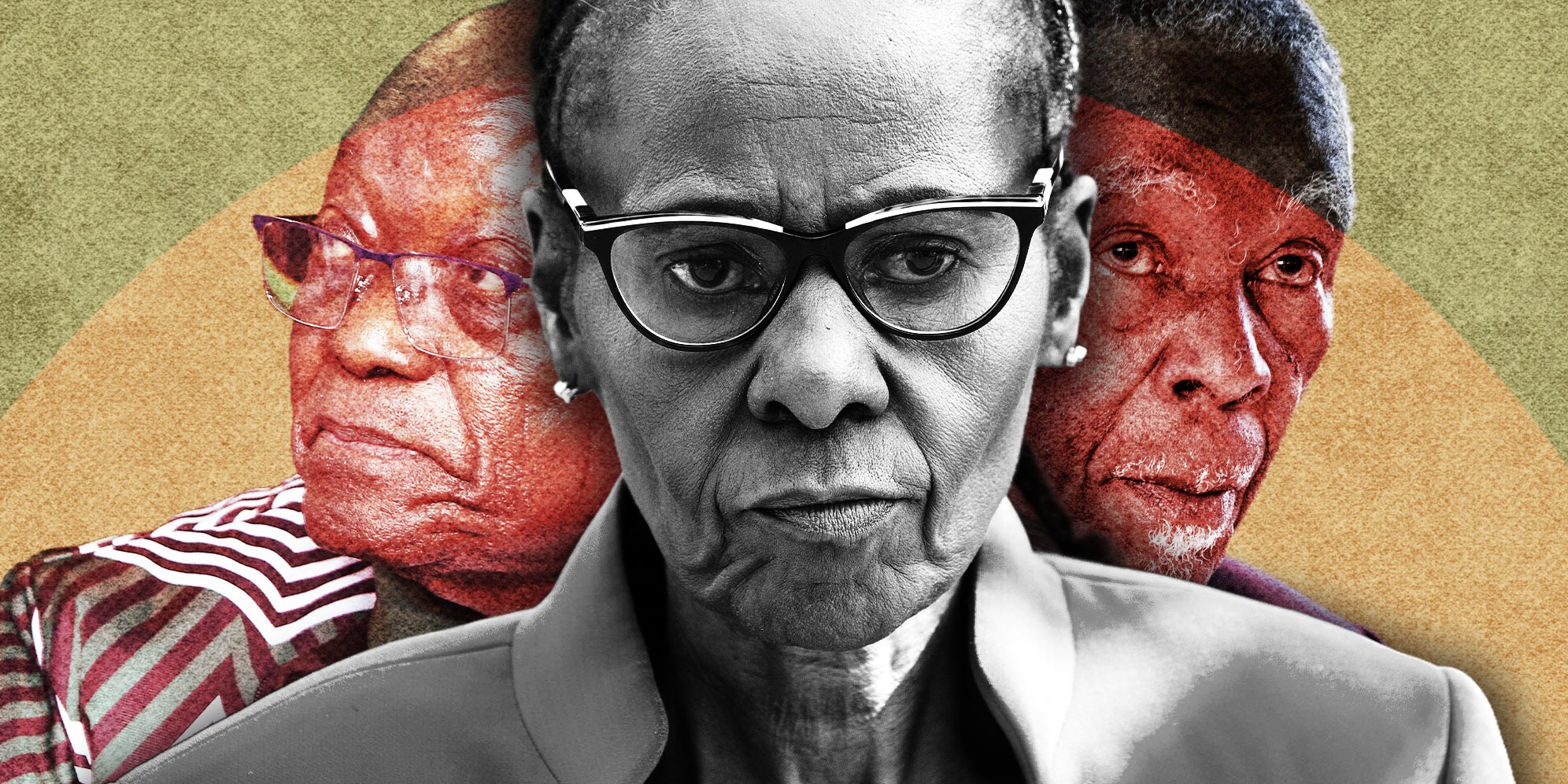
 Illustrative Image: Justice Sisi Khampepe. (Photo: Alet Pretorius / Gallo Images) | Jacob Zuma. (Photo: Siyabonga Sokhela / Gallo Images) | Thabo Mbeki. (Photo: Per-Anders Pettersson / Gallo Images) | (By Daniella Lee Ming Yesca)
This article has been edited and corrected; an explanation appears at the end of the article.
Former presidents Thabo Mbeki and Jacob Zuma will have to appear before retired judge Sisi Khampepe after the Constitutional Court on Monday dismissed their application for her recusal. Khampepe is leading the inquiry into outstanding issues arising from the Truth and Reconciliation Commission (TRC).
Mbeki and Zuma have pushed back against the inquiry since its inception. Now, with the commission wrapping up in December, all eyes are on when the two former heads of state will present their evidence.
The apex court’s decision, read by Justice Leona Theron, was delivered across three separate judgments. The court resolved a preliminary jurisdictional matter but remained split on the merits of whether a “reasonable apprehension of bias” existed due to Khampepe’s legal history.
The court opted to resolve the merits of the recusal directly rather than sending the matter back to the high court. However, the minority judgment authored by Justice Theron, with three judges concurring, held that the recusal should have been granted.
Overlapping roles
Khampepe’s overlapping historical roles at the TRC and the National Prosecuting Authority placed her on both the “referring and receiving end” of TRC cases, leaving her in a position to potentially make adverse findings against her former organisation and colleagues, the judges noted.
The minority judgment added that the 2003 “temporal boundary” Khampepe relied on was irrelevant, given that the commission had already summoned witnesses to testify on events predating that year. Consequently, it concluded that “an objective observer would reasonably apprehend bias”.
The second judgment, dismissed the recusal application after finding that the former presidents failed to establish a reasonable apprehension of bias. Justice Owen Rogers concurred in a third judgment, securing the five-judge majority needed to dismiss the application.
Rogers argued that bias should be treated as “an independent ground of review” under the principle of legality for commissions of inquiry, rather than as a subset of procedural irrationality.
Political interference
The commission, appointed by President Cyril Ramaphosa, consists of Khampepe, retired Northern Cape Judge President Frans Kgomo and advocate Andrea Gabriel, SC.
In a surprise move, Ramaphosa joined the court action alongside his predecessors. He claimed to have been unaware of Khampepe’s history as a TRC commissioner, as well as her roles in the NPA and Constitutional Court, when he appointed her. Both Mbeki and Zuma have denied any political interference in post-TRC prosecutions in their submissions.
Meanwhile, the inquiry has heard highly relevant evidence regarding an alleged “backdoor” amnesty deal struck between old-guard apartheid generals and the incoming democratic government.
/file/attachments/2988/yates-calataInterview_400430.jpg "Lukhanyo Calata has accused the ANC of betraying victims’ families by halting prosecutions due to a ‘secret agreement’ with apartheid-era leaders. (Photo: Supplied)")
Moral obligation
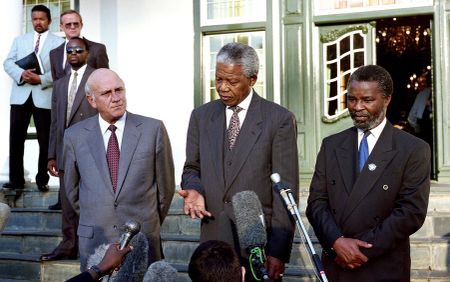
This includes a newly declassified memo from the final apartheid Cabinet meeting held 48 hours before the 27 April 1994 elections. According to the document, then president FW de Klerk informed attendees that Nelson Mandela and the ANC had agreed to grant immunity from prosecution for politically motivated crimes.
In February, when Mbeki and Zuma sought the recusal of evidence leader advocate Ishmael Semenya and later Khampepe, advocate Howard Varney – representing victims’ families – argued that the former presidents were under a “moral obligation” to reveal what they knew about the matters that were being probed.
“We call on them to return to this inquiry,” he said.
Ramaphosa established the judicial inquiry in May 2025 to investigate political interference and obstruction in post-TRC prosecutions of apartheid-era crimes.
He agreed to appoint the commission – stating he sought “closure for the families” – only after facing the threat of legal action. The legal challenge was spearheaded by Lukhanyo Calata, son of Fort Calata, one of the Cradock Four activist leaders murdered by apartheid security police in 1985. DM
On Tuesday, we published this article stating that “Acting” Judge Robert Nugent authored the second judgement in this case and that “Justice Owen Rogers concurred with Nugent’s ruling”. This is incorrect. Judge Nugent was not involved in this case and did not author any ruling related to it. We regret the error and apologise to our readers and Judge Nugent.
Comments
Scroll down to load comments...