




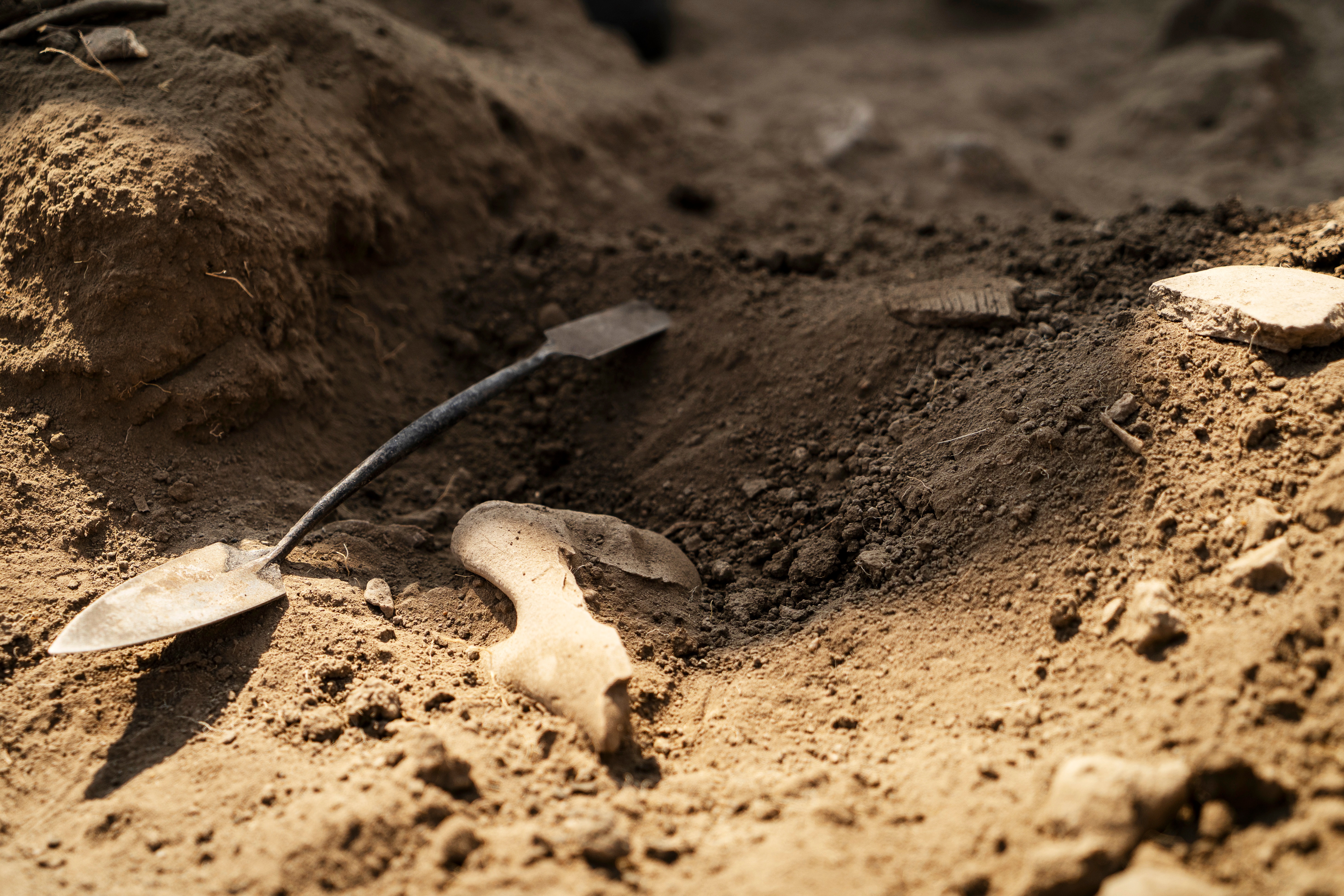
 A fully uncovered bone fragment found in September 2025 at Gwalala Hill in the Kruger National Park's Pafuri region. The precise location of the find is meticulously noted before it is removed, catalogued and carefully stored for further study. (Photo: Hancu Louw)
“Is that what I think it is?” The question rises over the sound of trowels rhythmically scraping away at parched soil. “It might be, but we better call Tim to have a look,” comes the reply as a collection of pottery sherds, stuck in bone-dry earth, is carefully exposed with a soft brush.
“It could all be part of the same pot, but until it’s been fully uncovered we can’t be sure,” says Tim Forssman, as he inspects the cluster of broken pottery that was probably last used six centuries ago.
It’s springtime in the Pafuri region of the northern Kruger National Park and Forssman, an associate professor of archaeology at the University of Mpumalanga, and a team of student archaeologists are busy excavating a site called Gwalala Hill.
The site, which forms part of the Makuleke Contractual Park, was the previous territory of the Makuleke community, whom the apartheid government removed in 1969. The land was returned to the Makuleke in 1998 and is now leased to SANParks and forms part of the Kruger Park. The area is best known as the location of Crook’s Corner, the point where South Africa, Mozambique and Zimbabwe meet. It is also home to Thulamela, a late Iron Age hilltop settlement.
A few kilometers east of Thulamela with its dry-packed stone walls lies Gwalala Hill. Here, where buffalo, elephant and giraffe roam, lie hidden the remnants of a once thriving society, which is yielding important evidence of well-established precolonial trade networks that played a crucial role in the rise of larger settlement complexes in the region.
/file/attachments/2997/36Thulamela_Archaeological_Research_Field_Trip_Sept_2025_004_363153.jpg "Professor Tim Forssman with visiting academic Professor Suresh Muthukrishnan, a geographic information system and remote-sensing expert from Furman University in the US, at Gwalala Hill in September 2025 during one of the digs. Photo: Hancu Louw")
“What we’re really trying to understand is how the people who inhabited this area lived and contributed to local and regional trade networks,” Forssman explains of an unassuming stretch of veld located on a small hill, close to the confluence of the Limpopo and Luvuvhu rivers.
The 200m-by-70m site, ringed by centuries-old baobab trees, was identified in 2022 and excavations began in 2025, concluding in May this year. Despite the relatively little time Forssman and his team have spent working at Gwalala, what they have found has far surpassed their expectations.
“To be honest, we never anticipated the site to be as productive as it has been,” Forssman says of the variety and number of artefacts uncovered during four week-long excavation sessions. Of particular significance are the thousands of glass beads the team found.
According to Forssman, there is no evidence of glass bead making on the African continent during the time of occupation at Gwalala Hill. Chemical analyses have shown that these beads were primarily produced in Southeast Asia. They found their way to Gwalala by way of East African trade networks, which stretched to the coast of modern-day Mozambique, and were brought into the Limpopo Valley as trade goods.
“The presence of beads like these, which were a coveted form of wealth and commonly traded, serves as an indication of interaction between the people who inhabited the region and outsiders,” Forssman says, cradling in his palm a blue bead barely larger than the head of a pin.
Metal slag and a considerable number of ceramics, including spindle whorls used for the production of cotton thread, are some of the other commonly occurring unearthed artefacts. Faunal remains, in particular those of large game animals, have also been uncovered. “We had a lot of elephant bones coming up, which we expected, but it confirms our suspicion that ivory was being sourced and traded in the region,” he adds.
/file/attachments/2997/36Thulamela_Archaeological_Research_Field_Trip_Sept_2025_038_924823.jpg "Professor Tim Forssman and Chanté Barnard work carefully using trowels, dustpans and brushes to uncover the artefacts. Photo: Hancu Louw")
Technology tells a story
Uncovering the remains of a society buried for centuries requires painstaking, backbreaking work.
“Field surveys, mapping, digging and sifting masses of soil to find tiny beads, bone fragments, charcoal or pottery sherds is by no means glamorous,” Forssman admits of the hours spent toiling away in this remote part of the Kruger under the watchful eye of an armed game ranger.
In addition to the physical work of excavating, the team used ground-penetrating radar, aerial surveys and light-detection and ranging surveys to further analyse Gwalala Hill. The results indicate evidence of at least two large middens, a number of preserved hut floors, grain bin foundations, stone platforms and possible agricultural terracing on the northern end of the site.
“Radiocarbon dating, which was done on samples of charcoal uncovered in 2025, indicate the peak of occupation from roughly 1300 to around the early 1400s,” he says. The chronology also points to periods of earlier occupation, with some artefacts dating to the 1200s.
This combination of technologies allowed Forssman and his team to compile a comprehensive data set, which helped to deepen their understanding of the settlement patterns and trade dynamics of the region between 800 and 600 years ago.
Because the site is located along the confluence of two rivers, the geography of the area allowed Gwalala to operate within what Forssman calls a “strategic corridor of exchange”.
“All the evidence points to a site that saw prolonged periods of settlement with overlapping phases of occupation.” This is significant as it indicates the existence of a society able to generate wealth through production and trade.
/file/attachments/2997/36Thulamela_Archaeological_Research_Field_Trip_Sept_2025_059_530260.jpg "One of the many hundreds of tiny beads that suggest the site was a trading centre. Photo: Hancu Louw")
“What we’re trying to understand are the roots of the apparent wealth which was generated in this region, because we suspect that access to and control over wealth is what led to the formation of elite communities. You can’t become a king or a queen if you don’t have control over highly valued resources. So what you see in these communities is that having access to traded items such as glass beads was a great source of power and status, like owning a superyacht would be today,” he explains.
This has led Forssman and his team to theorise that Gwalala Hill was used as a resource base for elite communities to generate wealth and in the process differentiate themselves. “What’s been amazing about our work at Gwalala is that our findings are allowing us to develop a nuanced understanding of how trade networks might have contributed to the emergence of larger and more complex societies like Thulamela.”
Forssman and his team have shifted their research focus to this possible connection between Gwalala Hill and Thulamela. This is in an attempt to find the evidence to start building a more complete picture of how these sites relate to each other and fit into the history of occupation and trade in the Limpopo Valley.
But in a country where socioeconomic crises abound, why does the precolonial history of trade in the middle Limpopo Valley half a millennia ago matter?
Walking in the footsteps
For Kholekha Makhubu, a second-year master’s student at the University of Mpumalanga, archaeology – specifically her work at Gwalala Hill – has had a profound impact on the way she thinks about history.
“Some of the things we uncover during excavations, I have them at home. The ceramics we’re finding. My mother makes similar pots, just like my grandmother did. So when I see a sherd in the dust at Gwalala it feels as if I’m, in a way, connected to the artefacts,” she says.
“These pots are things which I have lived with, but at the same time it’s something which people have been using and living with for centuries. It’s like I’m following in the footsteps of my ancestors.”
/file/attachments/2997/36Thulamela_Archaeological_Research_Field_Trip_Sept_2025_025_155518.jpg "From left: Student archaeologists Chanté Barnard, Justine van Heerden, Kholekha Makhubu and Zario Masina sift painstakingly through the soil, searching for artefacts. Photo: Hancu Louw")
Makhubu admits that working away in often harsh conditions is exhausting, but the reward of finding and studying familiar artefacts brings her great joy.
“There’s nothing that brings me peace and happiness like finding things during a dig that we are still using at home. My history as a black woman is repeating itself every time I uncover a piece of pottery on site,” she says.
Through this research, Forssman and his team are trying to understand the experiences and history of the people who inhabited the Limpopo Valley before the first colonialists rounded the Cape.
“As South Africans, we’re still quite disconnected from our past,” says Forssman. He places much of the blame on the history of colonialism and land dispossession that played out across southern Africa.
Add to that a traditionally Eurocentric approach to archaeology, and what you have is what Forssman refers to as a disconnect between what is understood as history – everything that happened after the arrival of colonialists in southern Africa – and “prehistory”.
“What this means is that the complex histories of people like those who inhabited Gwalala Hill and Thulamela have largely been neglected, misunderstood and at worst completely disregarded,” he says.
/file/attachments/2997/36Thulamela_Archaeological_Research_Field_Trip_Sept_2025_012_563453.jpg "An example of the remnants of faunal remains at Gwalala Hill. Photo: Hancu Louw")
And this is what Forssman is trying to address. “I think that if we can illustrate the threads that extend between what we consider prehistory and history, it connects us to our past and presumably leads to people thinking differently about the histories, contexts and backgrounds of their fellow South Africans.”
The research at Thulamela presents the perfect opportunity to pursue this goal. “What makes Thulamela so remarkable is that we’re looking at a history which is relatively recent, 1400 to 1600, so everything we find during our excavations and research refracts into the present,” he explains.
Societies like Thulamela developed distinct political economies, tapped into international trade networks and played a part in shaping the rise of the Zulu, Pedi and Venda kingdoms we still recognise today.
“There’s history that can be traced from Thulamela to that of the Makuleke who were forcibly removed from their land. It’s a history that still shapes who they are, but also who we as South Africans are.
So, by looking at the contemporary past, we are trying to contribute to a change in the way we see ourselves – and one another,” Forssman says. DM
This story first appeared in our weekly DM168 newspaper, available countrywide for R35.
/file/attachments/2997/DM-280826-001_918232.jpg)
Comments
Scroll down to load comments...