



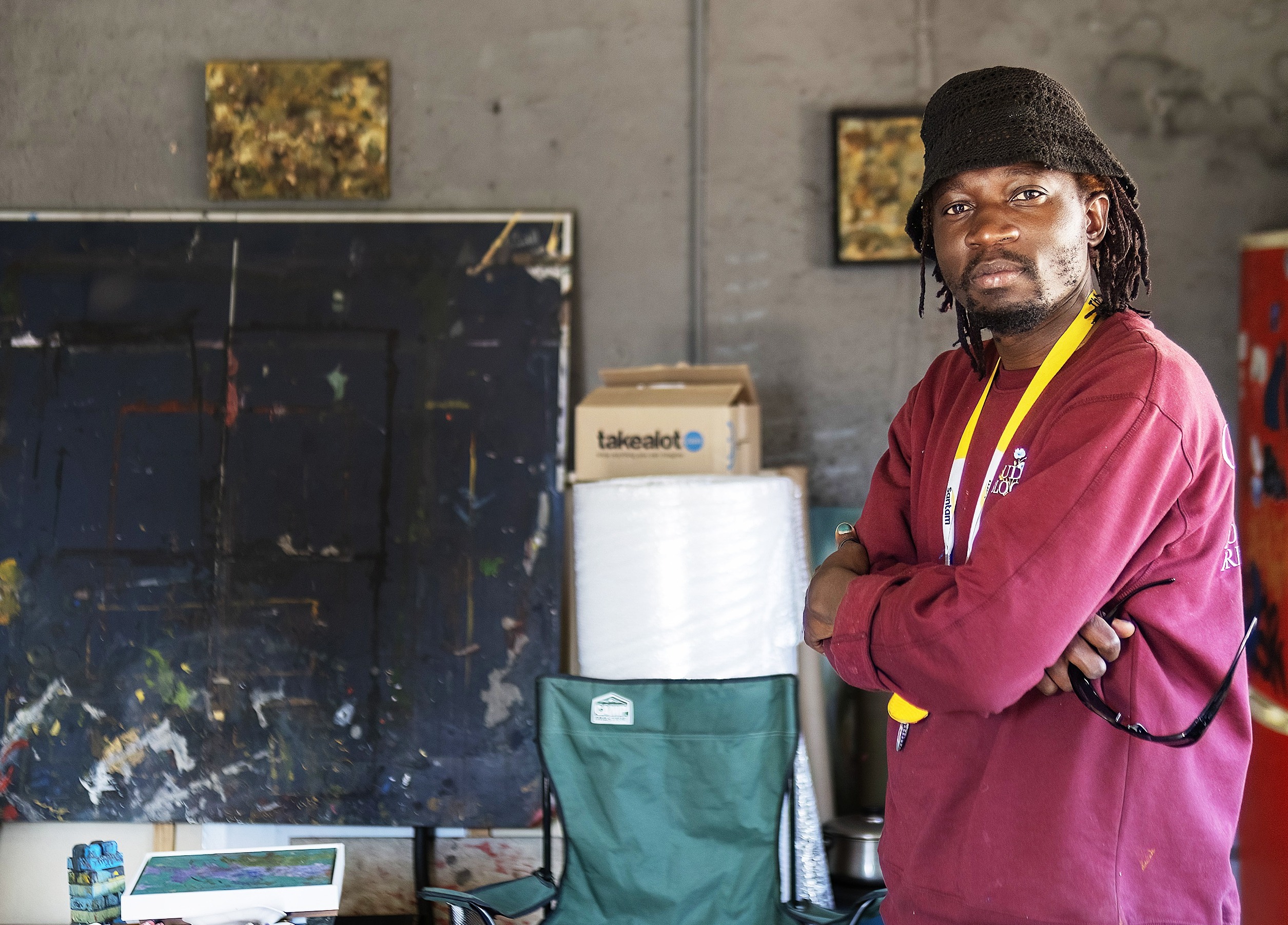
 Bekezela Nkomo Mabena inside his August House studio, where migration, identity and belonging continue to shape his evolving practice. (Photo: Ryan Enslin)
From Bekezela Nkomo Mabena’s rooftop art studio at August House, Johannesburg feels unusually close. I sense the city pressing against the edge of the building. He tells me what happened here on 30 June – the date that had come to carry the threat of exclusion for foreign nationals, as xenophobic mobilisation gathered around calls for them to leave.
When marchers moved through the streets below, artists came upstairs. South Africans sat with documented and undocumented foreigners. Bekezela kept working on his printing blocks.
He tells me about the threats. They came from inside the building too, indirect enough that he could not always tell what was being implied.
“You stay here and you are alone,” someone told him, in a way that hovered uneasily between concern and threat. He began asking whether he was safe, unable to read who supported the march.
The roof had brought people together, but proximity had not answered the question of who among them he could trust. Before Contra.Joburg turned difference into a theme, August House had already been forced to live with the question.
On 29 and 30 August 2026, August House will become one of the stops on the fifth Contra.Joburg, a city-wide arts festival drawing visitors into inner-city studios under the theme Different Is Good.
/file/attachments/orphans/VisitorsviewingartonexhibitionduringContraJoburg_RyanEnslin_789546.jpg "Visitors viewing art on exhibition during Contra.Joburg. (Photo: Ryan Enslin)")
After 30 June, the phrase “Different Is Good” feels less settled to me than it might have before. I begin to wonder which kinds of difference I am prepared to call good, who taught me to make that distinction, and what someone must become before I recognise theirs as welcome.
Bekezela was 11 when he crossed the Limpopo from Zimbabwe with his brother, following a man through the river in darkness. He remembers the sound of the water and not knowing what was in it.
Now, he thinks of the crossing as a kind of baptism, the river carrying him into a new life before any document could say who he was within it.
Years later, Bulgarian-born, Vienna-based artist Daria Tchapanova crosses the Limpopo too, only her crossing happens in the air. Her entry is simple; she needs no visa. “I just enter the country,” she tells me.
After 30 June, the word “foreigner” no longer seemed to describe everyone it claimed to. Why did “foreigner” seem so often to mean Black African? Daria’s answer makes visible what the word conceals. She can arrive white and European and be read almost immediately as possibility: money, access, opportunity.
Someone from Zimbabwe or Malawi may work here, build a life here and create far more for the people around them than she ever could during a short stay, yet still be imagined as pressure on the same resources.
Daria’s foreignness arrives carrying an assumption of value; Bekezela’s has repeatedly required him to prove that he is not a threat.
The Limpopo carried Bekezela across a border. Paper later decided whether that crossing counted. His mother obtained South African documents for him that were not legally valid, enough to carry him through childhood until matric required an identity document he did not have.
He wrote on an affidavit. The identity those papers created made life possible while dividing it: was he the person they named, or the Zimbabwean boy who had crossed the river?
In May, he returned to Zimbabwe to regularise his papers, allowing the South African identity he had lived under to collapse. “I lost everything,” he says. Yet he talks about freedom in knowing who he is.
He has since become a father, which makes home harder to confine to birthplace. When I ask Bekezela where home sits for him now, he begins to describe it as a house with different rooms: Zimbabwe is the bedroom, where he returns to rest; Johannesburg his working office; Cape Town perhaps the sitting room.
Then he says something that changes the ground between us. “Somehow we needed that 30 June deadline to really understand why we are here and where we are going.”
By the time I sit with Bekezela, 30 June has already become part of the country’s wider language of threat and exclusion. What he gives it is a human scale.
I keep trying to place that fear beside the word needed, and the two refuse to sit easily together. Yet Bekezela is not granting the hostility any moral usefulness. He is doing something more defiant, taking a moment designed to make his presence uncertain and using it to make his own identity less so.
“It allowed me to explore myself as a Zimbabwean,” he says. The country’s demand that he account for his presence arrived as he decided which identity he could live inside.
/file/attachments/orphans/FromtheAugustHouserooftopBekezelaNkomoMabenaworksintothecitytestingcoloursurfaceandexposureunderJohannesburgssky_RyanEnslin_382303.jpg "From the August House rooftop, Bekezela Nkomo Mabena works into the city, testing colour, surface and exposure under Johannesburg’s sky. (Photo: Ryan Enslin)")
The shift is visible in his practice. Bekezela washes a canvas before he begins and hoses it down again once the work is made – water first entered his story at a border, while here he gives it permission to change the surface rather than determine which side of a line he belongs on.
Some works are left outside for sun and rain to alter. His process makes room for something less fixed, allowing water, weather and time to alter what his own hand has begun.
The change has reached his palette too. Dark blues and reds are giving way to yellows. “The works become lighter and lighter,” he says. He talks about joy, about feeling like a child now that his papers are in order. The crisis outside his studio and the one unfolding within him have entered the work as light.
When I ask what art might do in a country pushing people apart, his answer is startlingly open. “Art includes everyone,” he says. It can bring people together through different ways of seeing.
That generosity matters coming from someone repeatedly asked to prove where he belongs. Yet his rooftop at August House refuses sentiment. People can share a room and still carry suspicion into it.
/file/attachments/orphans/VisitorsmovethroughContraJoburgsstudiosandexhibitionspacesencounteringartistsartworksandoneanotheracrossJohannesburgsinner-cityculturalfestivalweekend_RyanEnslin_116935.jpg "Visitors move through Contra.Joburg’s studios and exhibition spaces, encountering artists, artworks and one another across Johannesburg’s inner-city cultural festival weekend. (Photo: Ryan Enslin)")
Daria knows August House from another direction. She has spent time there before and returns this week through her film The Building: A Gritty Fairy Tale, rooted in the building. She calls the community she found there “very powerful”.
That sense of community does not make her romantic about the art world. In cultural programmes she knows across Europe, Daria has watched the language of exchange narrow into a preferred kind of African artist: Black, educated, with a background institutions can readily understand.
Complicated documentation can be enough for someone to fall away before travelling. “The system is made for exclusion,” she says. Having previously been a Unesco fellow, she later challenged the gap between its language of mobility and processes that still determine who can participate.
The border has moved, this time into an application form, but someone is still deciding who gets through. The language is now exchange and opportunity, which makes the sorting easier to overlook.
I sit with the thought for a while, until I begin to see my own part in it. I have kept asking what art can do about xenophobia, perhaps because art gives me somewhere comfortable from which to ask. I know how to enter August House, sit opposite an artist and turn a complicated life into something legible.
Bekezela is here, in this ink, because he is an artist, because migration runs through his work, because his story answers my question. The uncomfortable recognition is that my curiosity has an admissions process too.
Culture has given me reasons to look closely at him. What happens to that curiosity when no artwork, studio door or cultural frame invites me closer?
/file/attachments/orphans/ContraJoburgfounderSaraHallattreflectsonartaccessandtheencountersthatemergewhenJohannesburgsstudiosopentothepublic_RyanEnslin_280575.jpg "Contra.Joburg founder Sara Hallatt reflects on art, access and the encounters that emerge when Johannesburg’s studios open to the public. (Photo: Ryan Enslin)")
Daria’s point about diversity becoming visible through art stays with me, but visibility still allows distance. I think back to a conversation with Contra founder Sara Hallatt about the artist often being absent from a conventional gallery. That absence feels less neutral now. It leaves us free to complete the person ourselves, drawing on whatever assumptions we brought into the room.
Contra changes that equation by placing the maker beside what has been made. A studio door opens, and the category we arrived with has to make room for the person standing in front of us. That is a smaller claim than asking art to settle what xenophobia has forced me to notice, and perhaps a more useful one.
Being brought closer does not guarantee recognition, but it can make abstraction harder to maintain. Contra repeats that possibility in studios and on shuttles where strangers briefly find themselves beside one another.
For several hours, difference might become ordinary rather than exceptional, neither celebrated nor feared, simply encountered.
Bekezela tells me that with his papers aligned with the person he knows himself to be, he can now “really be present in spaces”. DM
Contra.Joburg takes place on 29 and 30 August.
Comments
Scroll down to load comments...