




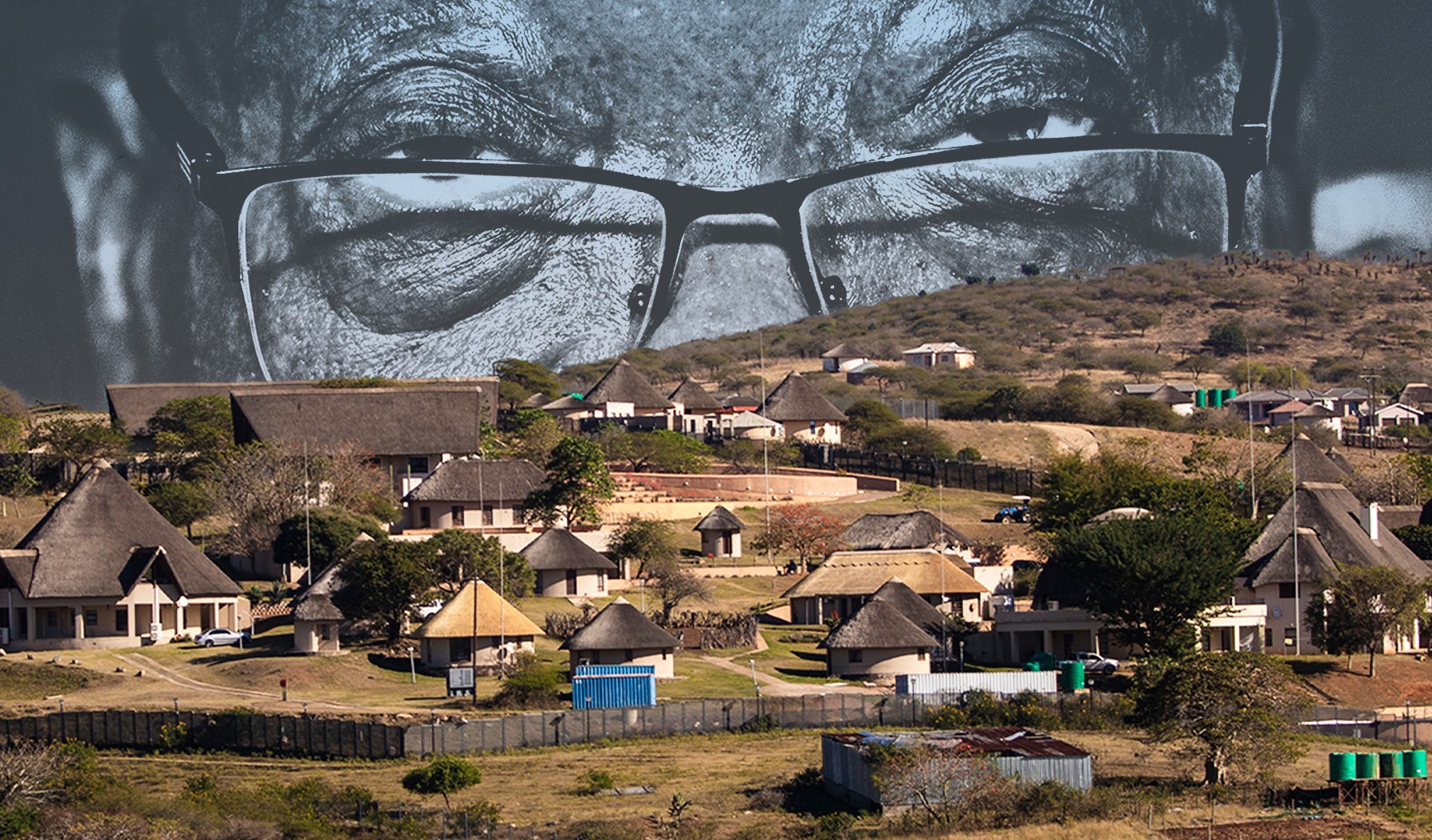
 Illustrative image: A view of former president Jacob Zuma’s Nkandla homestead in KwaZulu-Natal. (Photo: Leila Dougan) | Former president Jacob Zuma. (Photo: Leila Dougan)
More than a decade after the controversial upgrades at former president Jacob Zuma’s Nkandla homestead became a national scandal, the architect appointed to oversee the project has been ordered to repay more than R147-million to the state.
Minenhle Makhanya, who served as the architect and principal agent for the project, was found liable for R147,269,444.06 following civil action brought by the Special Investigating Unit (SIU).
In a judgment handed down on Thursday, 27 August 2026, the Special Tribunal found that Makhanya’s conduct contributed to big financial losses suffered by the Department of Public Works (DPW), including payments for over-designed buildings, above-market construction costs and professional fees that were allegedly improperly certified.
The SIU had instituted action against Makhanya and the National Department of Public Works, which did not oppose the application. The tribunal, however, found that Makhanya was not the only person responsible for the escalation of the project’s cost.
“It is regrettable that the first defendant stands alone as the person against whom the Special Investigating Unit has launched action, as he clearly did not act alone in allowing the costs of the upgrade at Nkandla to balloon.
“However, as architect and principal agent, he bore the responsibility to ensure that the second defendant did not incur fruitless and wasteful expenditure,” Judge Karin Pillay said.
In December 2013, the SIU was authorised to investigate how the Department of Public Works handled the contracts and spending for the Nkandla security upgrades between 2008 and 2013.
The investigation looked at whether the contracts were awarded properly, fairly and transparently, and whether the government got value for money. It also aimed to recover any money the state had lost because of illegal or improper conduct.
From R27.8m to over R216m
When Zuma became president, he was entitled to security and protection for himself, his family and his private residence at state expense, in accordance with a Cabinet memorandum adopted in 2003.
SAPS conducted an assessment of the security measures required at the private residence, while the South African National Defence Force (SANDF) also became involved in assessing the necessary installations.
The assessments were submitted to DPW, which was responsible for determining the cost of the required security measures. The process required approvals from SAPS, the SANDF, the relevant minister and Zuma before DPW could implement the work.
After these processes had been completed, DPW determined the cost of the security measures at R27,893,067.46.
The amount was authorised and the budget secured by DPW’s Planned Maintenance Budget Committee on 11 August 2009.
DPW was then required to procure goods and services in accordance with section 217 of the Constitution, the Public Finance Management Act and its own supply chain management policies.
It was during this implementation phase that Makhanya became key to the project. DJ Rindel, who had been designated project manager, appointed Makhanya as the principal agent on 27 August 2009.
His responsibilities included designing the construction work, procuring contractors and security service providers, overseeing the progress of the project and certifying payments to service providers.
The SIU challenged his appointment, arguing that it was unlawful and invalid because it had not complied with the constitutional and legislative requirements governing public procurement.
Over-designed buildings
One of the main allegations against Makhanya concerned the design of buildings beyond the specifications identified by the security authorities.
Three guardhouses, for example, had been assessed at 20.4 square metres each. Instead, one was designed at 33.13 square metres, while the other two measured 23.62 square metres each.
That additional cost, authorised and certified by Makhanya, was calculated at R498,520.72.
The control room was another example. “The control room was assessed by the SAPS to be 40 square metres, yet the first defendant designed and approved a control room of 114 square metres, being 74 square metres in excess,” the judgment reads.
The additional 74 square metres resulted in an alleged excess cost of R2,505,764.08, including professional fees and VAT.
Makhanya also authorised a 320-square-metre clinic, while the assessed requirement was 289 square metres. The SIU calculated the excess payment at R787,909.31.
Twenty additional accommodation units were also allegedly authorised, resulting in additional expenditure of R1,624,894.23.
Makhanya further authorised 14 staff houses, at 43 square metres each, despite SAPS requiring units of 30 square metres.
The cost of the houses increased from an assessed R5.43-million to R7.78-million, resulting in an alleged excess payment of R2,353,854.37.
Above-market costs
The SIU also challenged payments that it said were substantially higher than market-related construction costs.
The crew pavilion was certified at R14,045.89 per square metre, while the market-related rate was R9,000. The alleged loss was R448,584.80.
Guardhouses 2 and 3 were certified at R31,407.72 per square metre against a market-related rate of R21,000, resulting in an alleged loss of R663,063.43.
The clinic was certified at R18,846.25 per square metre, compared with a market-related cost of R13,500.
The difference between the amount actually certified and what should have been certified was calculated at R2,307,219.09.
The SIU further alleged that Makhanya failed to exercise reasonable care when certifying payments for concrete pillars. The amount certified was R2,064,232.67, compared with R1,548,798.91, resulting in an alleged loss of R515,433.75.
Millions in professional fees
The tribunal also considered claims relating to professional fees paid to Makhanya and other consultants.
The SIU alleged that Makhanya himself was overpaid R5,624,541.90 for professional services.
Ilangalethu Consulting CC, trading as R&G Consultants, which acted as quantity surveyors, was allegedly overpaid R6,297,925.58.
Ibongo Consulting, which provided civil and structural engineering services, was allegedly overpaid R255,681.51.
Mustapha & Cachalia Engineering, which provided mechanical engineering services, was allegedly overpaid R1,407,418.73.
Igoda Projects, which provided electrical engineering services, was allegedly overpaid R88,943.78.
The total overpayment allegedly authorised and certified by Makhanya under this claim was R13,674,511.50.
R60m of questionable payments
Another substantial claim related to payments made to Moneymine Investments 310 CC and Bonelena 12 Construction and Projects.
Makhanya allegedly authorised payments totalling R54,825,513 despite DPW allegedly being unable to establish what specific work had been undertaken or whether it had actually been completed.
The SIU said the payments were certified without sufficient breakdowns showing how the amounts had been calculated.
The unit sought an order requiring Makhanya to account for the certificates or, alternatively, to repay the money. A further R5,347,999 was allegedly paid to Igoda Projects in similar circumstances.
The total alleged loss under this claim was R60,173,512.
Payments for work allegedly not done
The SIU also challenged a payment of almost R1.2-million to Bonelena for work allegedly not done on the outer perimeter fence.
“It is alleged that the above amount was certified by the first defendant to be paid in the absence of any proof that the work was done. The plaintiff accordingly claims repayment of the aforesaid sum,” the judgment says.
A further R82,143.22 was allegedly paid to Betafence Projects South Africa for standing time that was not due and payable.
Makhanya’s defence
The judgment also deals with Makhanya’s reliance on “oral instructions” and approvals allegedly given to him by officials involved in the project.
But several of those officials, including Brigadier Adendorff, Mr Crafford, Ms Paisely and Colonel Linde, disputed these claims.
“The first defendant has not materially challenged the figures furnished by the plaintiff's witnesses or led evidence contradicting it.”
The court said this left it reliant on the figures presented by the SIU in determining what would constitute just and equitable relief.
The SIU also accepted that the amount claimed should be reduced by R7.8-million because Zuma had already paid that amount towards the cost of the non-security-related upgrades.
The tribunal found that Makhanya’s appointment was invalid and found the contract between him and DPW to be “invalid and of no force and effect”.
It ordered him to pay National Treasury R147,269,444.06 for the financial losses suffered by DPW as a result of his “unlawful, wrongful and negligent conduct”.
He was also ordered to pay interest at 11.25% a year from the date of judgment until payment, as well as the costs of the case, including the costs of two counsel and the preparation of heads of argument. DM
Comments
Scroll down to load comments...