




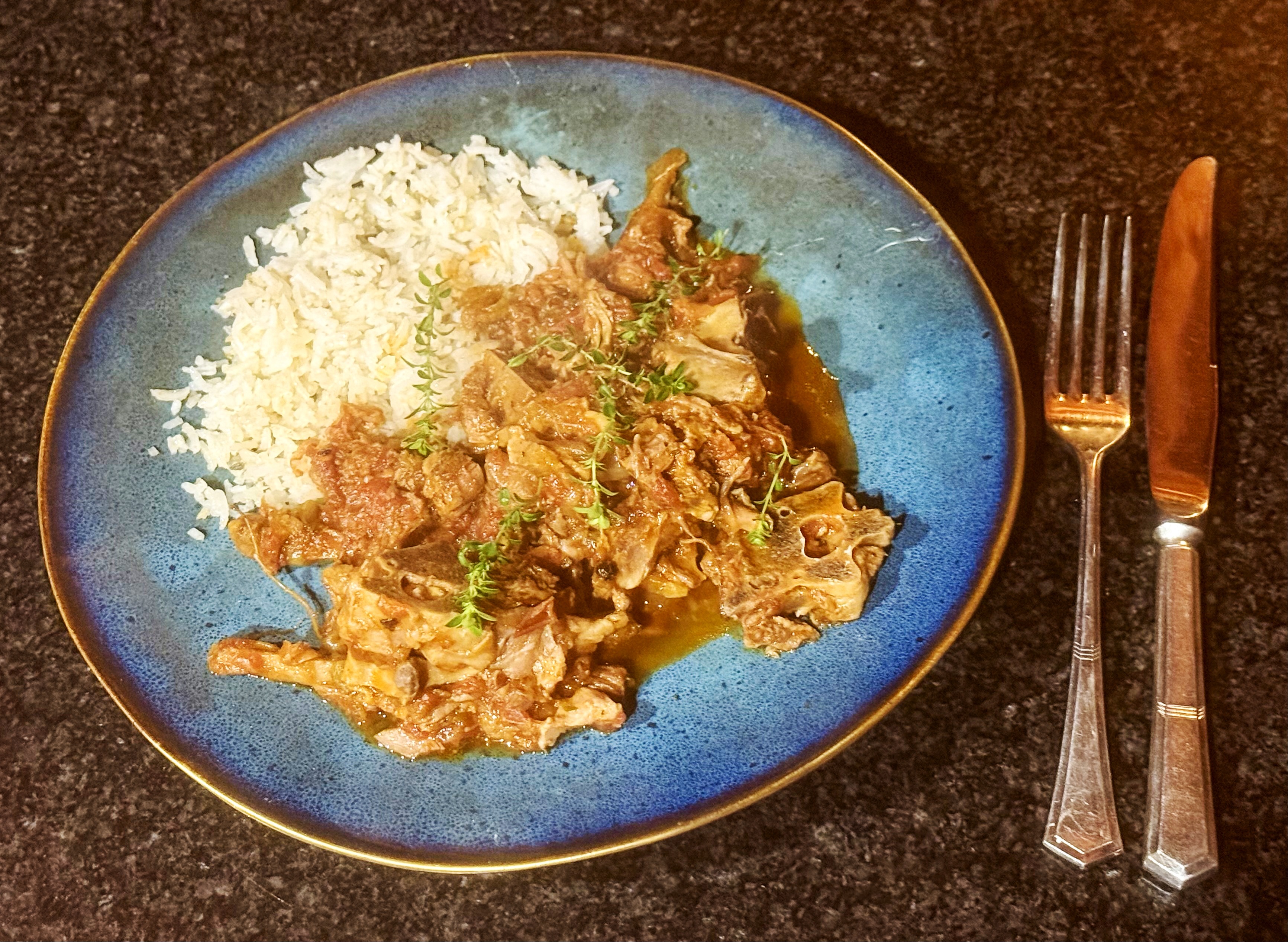
 Tony Jackman’s tomato bredie, updated (again). (Photo: Tony Jackman)
In the old Cape kitchens, tomato bredie was one of those dishes that every self-respecting cook had their recipe for, and all would swear by their version. A tomato bredie, in its essence, is a stew of fatty mutton and tomatoes simmered for hours. But there’s more to it than that, especially if approached in the way of C Louis Leipoldt. If your first 21st century thought is, well, we’ll ditch the fat for starters, rather find another recipe. Fatty mutton is as much what a tomato bredie is all about as the tomatoes themselves.
So, you want mutton rib. Mutton because it’s richer in flavour than lamb, and rib because it has both bones and layers of fat. But first let’s go back a century and more...
Before writing this recipe in 2022, I delved into Renata Coetzee’s classic The South African Culinary Tradition, but found her tomato bredie recipe rather plain. In search of something more robust, I found C Louis Leipoldt’s recipe for it in Leipoldt’s Food & Wine, to discover that his version is cheese to Coetzee’s chalk. This with respect to Coetzee, whose book is a favourite of mine; but it simply sets out a basic formula for your ubiquitous tomato bredie. Hers has mutton (fatty), onion, chilli, 12 tomatoes, a little sugar, salt and pepper, and of course water. That’s it.
But veer over to Leipoldt’s Food & Wine and the story is very different. Instead of Coetzee’s eight ingredients (if you include the salt and pepper and the water, so just five without them), Leipoldt lists 18. Then, being Leipoldt, he adds a final “glass of wine” which frankly he seemed to put into everything. So: Leipoldt 19, Coetzee 8. Not that the quality of every dish rests on its number of individual ingredients, but in this case I have no doubt Leipoldt’s is in a higher league altogether; having made something approximating it and have it turn out truly delicious.
Now: in 2026, I’ve adapted it again. Instead of only mutton rib, last weekend I used lamb neck and lamb “skenkels”, or shanks sliced into smaller chunks, bone-in of course.
Because somebody was coming to dinner who avoids chillies, I decided to go a gentler route and added a teaspoon of pimentón, the Spanish smoked paprika, to the tomato mix. I also used cans of chopped tomatoes instead of whole fresh ones, but don’t take this as gospel – use fresh by all means. I just wasn’t happy with the ripeness of the tomatoes available to me.
Another small adaptation was to use some passata, the strained tomatoes available in bottles or cartons. I did not add any wine, even for Leipoldt, this time around.
Tony’s tomato bredie
(Makes 6-8 portions)
Ingredients
1kg mutton rib cut into small pieces
2 large onions, sliced
3 leeks, sliced
1 heaped Tbsp flour
1 Tbsp butter (optional, explained below)
2 x 400g can of chopped tomatoes
200ml passata
3cm piece fresh ginger, peeled and chopped
8 cardamom pods
1 tsp each fennel seeds and coriander seeds
A few peppercorns, whole
3 or 4 thyme sprigs
1 tsp pimentón or other smoked paprika
Salt to taste (be generous)
Method
Put all the mutton and lamb into a heavy pot and add the sliced onions and leeks. Sprinkle the flour over and stir over a moderate heat with a wooden spoon, to coat.
Throw in a heaped tablespoon of butter (unless your meat has sufficient fat), give it a stir, and let it cook for 10 to 15 minutes, stirring often, to get the mutton’s own fats working to create some pleasing fattiness in the burgeoning stew. Don’t be shy of the fat. Eventually, the fat on top of the dish will be spooned off, but by then it will have given the stew a lovely luxurious depth of flavour.
(Note: Leipoldt does not add butter but calls for sheep fat. If you use nicely fatty mutton ribs, this process will happen in the pot and you may not need extra fat. But help it along with a little butter, as I did, if you like.)
Now start adding most of the other ingredients, but not the tomatoes or the salt: add the ginger, cardamom seeds, coriander seeds, peppercorns and fennel seeds, as well as a few sprigs of thyme (Leipoldt calls for marjoram too, if you have some), and pimentón. Braise everything in the pot, stirring now and then, for 10 to 15 minutes, then add all the chopped tomatoes and the passata, stir, and cook covered on a very low heat for what Leipoldt calls “a few hours”. I’d make that about two.
I did not use the following step: my previous version called for adding a tablespoon of chutney, and a tablespoon of brown sugar, and letting it simmer for what Leipoldt calls “another couple of hours”. It did continue cooking for about three hours, but I added neither chutney nor sugar.
I served the tomato bredie with plain white rice. It needs nothing else. DM
Comments
Scroll down to load comments...