





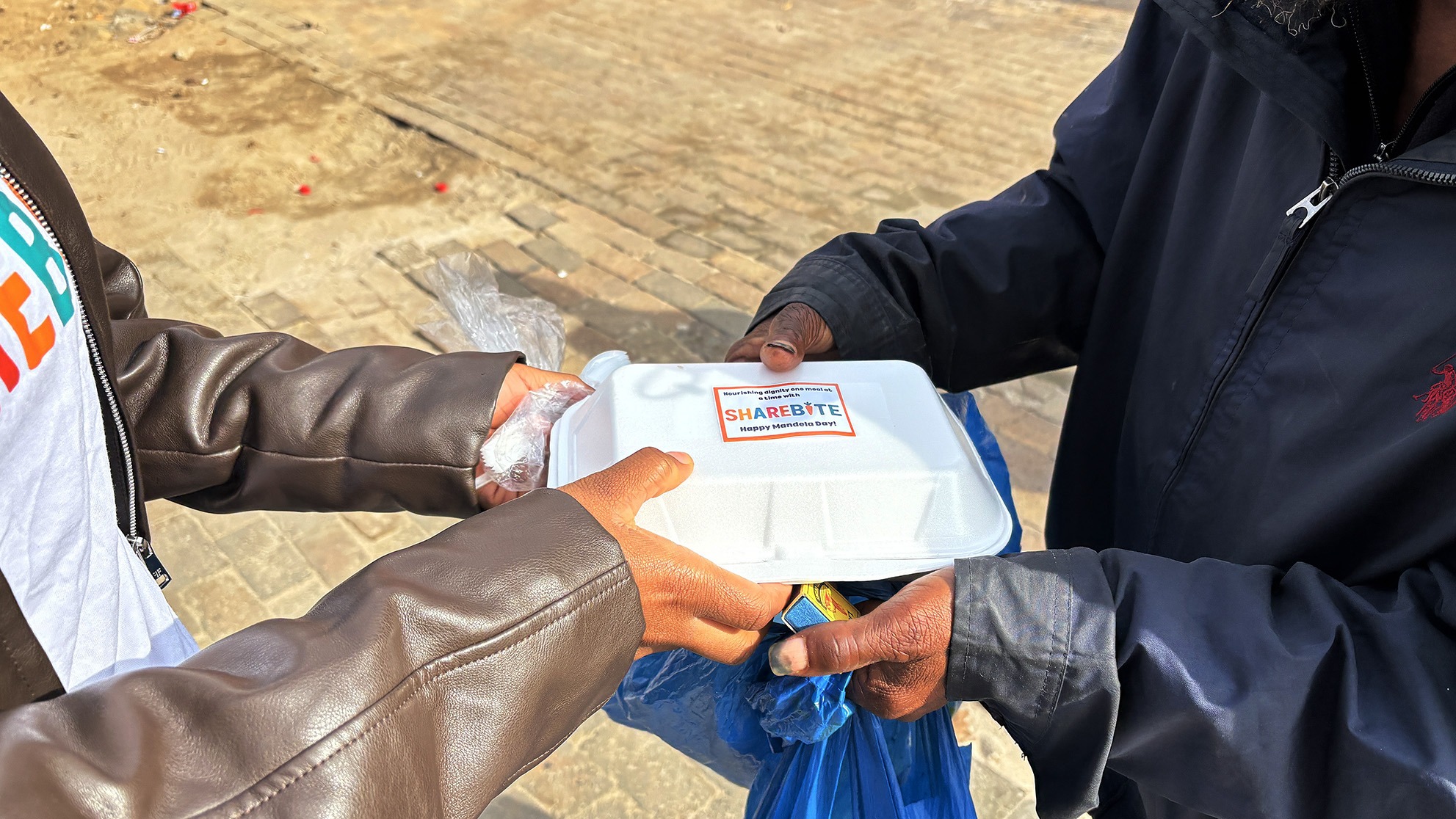
 Student-led initiative ShareBite delivered food parcels in Stellenbosch central on Mandela Day. (Photo: Supplied / Bulela Sikithi)
 Research by the University of the Western Cape indicates that hunger among students across South African universities ranges from 30% to 65% - this means that up to one in three or more than half of students at times go hungry.
This was highlighted in the Union Against Hunger (UAH)’s recent submission to the South African Human Rights Commission (SAHRC)’s inquiry into South Africa’s food systems in March.
And while there is great focus on developing a skilled workforce, the journey to the qualification is often overlooked, said UAH member and University of Pretoria (UP) master’s student in Development Studies Nthuseng Mokoena.
“People struggle; you can’t go to class if you’re hungry. You can’t focus in class if you’re hungry. It becomes a very big problem for you to just function daily,” Mokoena said in an interview with Daily Maverick.
/file/dailymaverick/wp-content/uploads/2025/03/Screenshot-2025-03-06-at-18.55.12.png "Screenshot 2025-03-06 at 18.55.12")
Student hunger undermines Section 27 of the Constitution, because although everyone has the right to food, this right is “forever threatened”, said Oscar Sithole, who is also a UAH member and PhD candidate in development studies at UP and an affiliate of the DSTI-NRF Centre of Excellence in Food Security.
Sithole added that hunger is hidden in institutions of higher learning. Students hesitate to share the status of their hunger or food insecurity, because of the misconception that students are part of an elite group in society, he said.
Daily Maverick spoke to two university students who were willing to share their experiences of hunger.
Empty plates
A student at Stellenbosch University (SU), who asked to remain anonymous, said he had struggled to afford food from the beginning of April until the middle of June of this year. During this period, he had not received his R1,716 monthly allowance from the National Student Financial Aid Scheme (NSFAS).
The student added that he did not approach his family for help because of their financial difficulties.
“Life is hard for them back home. I know their struggles – no one is working at the moment. So that’s why I did not want to put pressure on them. They’d end up making loans which they will struggle to pay back,” the student said.
Instead, he asked friends for food before approaching the university for assistance, he said. The university then provided him with groceries for a few weeks before the matter was resolved on 18 June.
/file/attachments/orphans/IMG_9126_514968.jpeg "Cape Peninsula University of Technology students sleeping outside after they housing request status have not been accepted. 27 January 2026. (Photo: Siyabonga Goni)")
While the SU student is no longer struggling, another NSFAS recipient from the University of the Western Cape (UWC) described her difficulties as an “ongoing cycle”.
The UWC student (who also asked to remain anonymous) said she is confronted with financial difficulty almost every two weeks. Her monthly expenses include sanitary pads and toiletries. She added that she occasionally has unexpected academic expenses as well, such as printing costs, books and stationery. She often also had medical expenses, since she regularly visited the doctor and had blood tests.
These expenses forced her to make trade-offs – and food was often the compromise. She often did not buy meat and vegetables because they were the most expensive.
She says she frequently spends a full week without food.
“[I] can go an entire week and I mean the full seven days without having anything to eat. Not even rice,” she said.

Addressing student hunger
In his written submission to the SAHRC in March, Sithole acknowledged university initiatives to address student hunger.
Sithole said he is aware of initiatives, such as UP’s Student Nutrition and Progress Programme (Snapp), which offers emergency nutrition support to students, and UWC’s partnership with Rise Against Hunger to pack meals for food-insecure students.
However, universities are not playing meaningful roles in addressing hunger, he said. Elaborating, he said universities often offer food that is unaffordable to the average student.
SU Student Representative Council (SRC) member Liyema Langa noted that at SU, students often face many issues simultaneously, such as accommodation and registration issues along with food insecurity, which is further complicated by the high prices of food offered at SU’s Neelsie Student Centre.
/file/attachments/orphans/Iman-studenthunger4_591180.jpg "The Neelsie Student Centre at Stellenbosch University. (Photo: Iman Allie)")
Mokoena presented several recommendations to the SAHRC in March at the inquiry into South Africa’s food systems to address food insecurity among higher education institutions:
First, students in higher education must be recognised as a distinct and vulnerable group when analysing hunger and food insecurity.
Second, an annual campus-wide food (in)security survey (aligned with national metrics such as Statistics SA methodologies) to generate institutional data must be introduced.
Third, food security indicators must be integrated into university performance dashboards and annual reports.
Sithole further argued that food and nutrition councils for students should be established within existing university structures, such as SRCs.
According to Sithole, NSFAS allowances must be increased to align with the prices of students’ most commonly bought foodstuffs and products.
More public-private partnerships are needed to address food insecurity, such as Tiger Brands’ involvement in UP’s Snapp, he said. In 2025, Tiger Brands donated R2.19-million worth of non-perishable food items, helping to stock the Snapp pantry and sustain the food parcel programme.
In the long-term, the government should create a solid food and nutrition programme for higher education institution students that will function similarly to the National School Nutrition Programme (NSNP), Sithole said. The NSNP offers one meal a day to students at poorer primary, secondary and tertiary public schools. Sithole imagines this programme would require the government and private sector to work together.
/file/attachments/orphans/Iman-studenthunger3_173529.jpeg "Student-led initiative ShareBite delivered food parcels in Stellenbosch central on Mandela Day. (Photo: Supplied / Bulela Sikithi)")
By students for students
At Nelson Mandela University (NMU) the SRC runs the Meal-A-Day campaign, where students are provided with one meal per day at select residences during exam periods, said NMU SRC president Somila Komani. This initiative was started in 2025 by students in the NMU’s Democratic Alliance Student Organisation, she added.
In the same year, nonprofit company ShareBite was founded by students at SU. ShareBite aims to alleviate student hunger through activities, such as soup kitchens and donating food parcels, said ShareBite founder and chief executive Francisca Darkoh.
Although Darkoh feels that SU is doing the best it can to address food insecurity among students, she acknowledged that there is a gap in food assistance. ShareBite aims to fill this gap.
ShareBite’s most recent activities include collecting foods such as maize meal, noodles, rice and canned items (and monetary donations) to create food packs which will be distributed to 100 SU students. DM
Comments
Scroll down to load comments...