




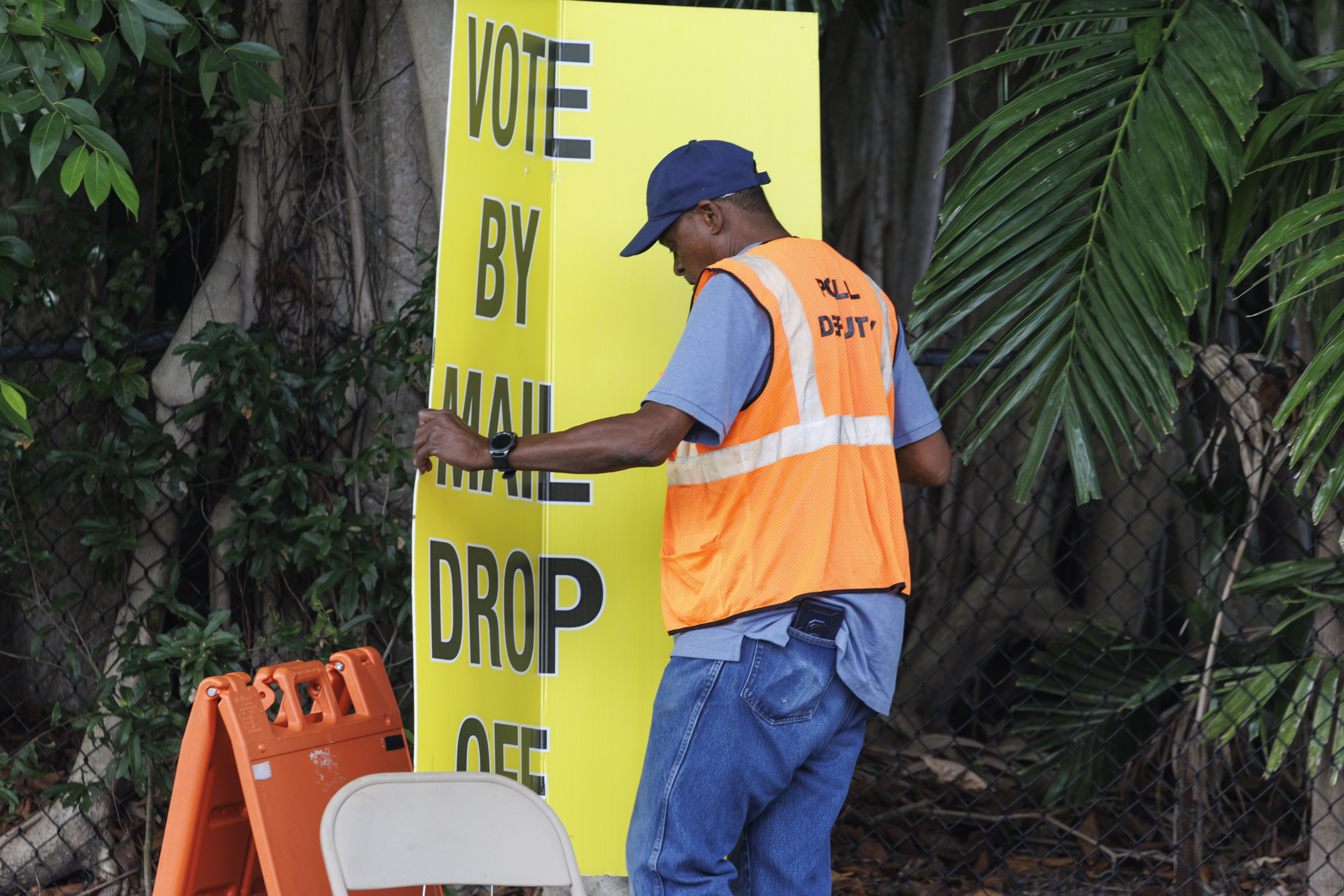
 A Poll Deputy places a vote by mail sign on the first day of early voting for the 2026 Florida Primary Election, in Miami, Florida, USA, 03 August 2026. Florida's primary elections will take place on 18 August, determining each party's nominees for statewide and congressional races heading into the November 2026 general election. EPA/CRISTOBAL HERRERA-ULASHKEVICH
By Andrew Chung
But the fate of Trump's order remains uncertain, as a separate injunction blocking a key part of the plan remains in place.
Republicans are locked in a tight battle to retain control of Congress in the midterms. Restricting mail-in ballots would stand to disproportionately benefit Republicans given that Democratic voters traditionally have been more likely to use mail-in ballots.
Monday's ruling from the Supreme Court's 6-3 conservative majority applied to a June injunction from Boston-based U.S. District Judge Indira Talwani.
A coalition of 23 mostly Democratic-governed states and the District of Columbia had sued to stop the executive order over mail-in ballots. The Supreme Court on Monday said it was too soon for the states to challenge the order but left the door open for them to sue again as the midterm contest approaches.
TRUMP'S MARCH EXECUTIVE ORDER
Trump's executive order, issued in March, directed the Department of Homeland Security to compile and transmit to the states a list of U.S. citizens eligible to vote in each state, and the Justice Department to prioritize investigating and prosecuting state and local election officials who issue ballots to people deemed "not eligible" to vote in federal elections.
It also required the U.S. Postal Service to deliver ballots only to voters on each state's approved mail-in ballot list.
Trump has vowed to end the use of mail-in ballots nationwide before the midterms, and has long cast doubt on the security of such ballots, although evidence of voter fraud is rare.
The court on Monday did not act on another injunction from Talwani that blocked the USPS nationwide from enforcing the directive's tighter rules for voting by mail. The judge issued that order on August 11 in a separate lawsuit filed by voting-rights groups.
JUDGE RULED TRUMP LACKED AUTHORITY
Trump's executive order is part of his wider efforts to make fundamental changes in U.S. elections. Trump, who has made false claims of widespread fraud in U.S. elections including his 2020 loss to former Democratic President Joe Biden, has pressed the Republican-controlled Congress to pass a contentious package of voting restrictions called the SAVE America Act.
In June, Talwani ruled that the president lacked the authority to order changes in how states administer federal elections, noting that under the U.S. Constitution, states have the role of determining voter-eligibility requirements. The judge also noted that federal agencies lack the ability to compile accurate citizen lists for each state.
Despite Talwani's action, USPS on Friday released a finalized rule to implement Trump's order, which would require states to provide it with lists of voters who received mailed ballots, as well as unique barcodes on outbound and return ballot mail envelopes.
In Monday's decision, the conservative majority agreed with the Justice Department that the lawsuit challenging Trump's directive was premature and that the states did not have the required legal standing at this stage to sue.
The agencies have not yet taken concrete actions that impact the states and so any harm they allege is speculative, the court said. Trump's order itself "does not harm the states," the court added.
California Governor Gavin Newsom, a Democrat, said on Monday: “The Supreme Court just let the Trump administration move ahead (for now) with its plan to disenfranchise voters across the country. California will be suing AGAIN to block these Orwellian rules from being implemented.”
The White House did not immediately respond to a request for comment. The USPS declined to comment.
Justice Sonia Sotomayor, joined by fellow liberal Justice Elena Kagan, said that the states should not have to wait to challenge the order.
"Today’s decision does not address whether the president’s attempts to interfere with states' administration of the November 2026 elections are lawful," Sotomayor wrote. Justice Ketanji Brown Jackson also wrote a separate dissent.
The states contend that their claims are not hypothetical and that the administration's "rushed effort to change the rules of mail voting on the eve of the November midterms risks disenfranchising a substantial number of voters."
“This decision is a painful setback, but it will not be the final word," New York Attorney General Letitia James said in a statement. "The right to vote is sacred, and no administration should be allowed to put that right in jeopardy by making it harder for eligible voters to cast their ballots."
In her June ruling, Talwani rejected the administration's arguments, finding that the lawsuit was not filed too soon and that the states had legal standing because they would face election administration disruption, compliance costs and a credible threat of criminal prosecution.
(Reporting by Andrew Chung in New York; Additional reporting by John Kruzel, Nate Raymond and David Shepardson; Editing by Noeleen Walder, Will Dunham and Matthew Lewis)
Comments
Scroll down to load comments...