




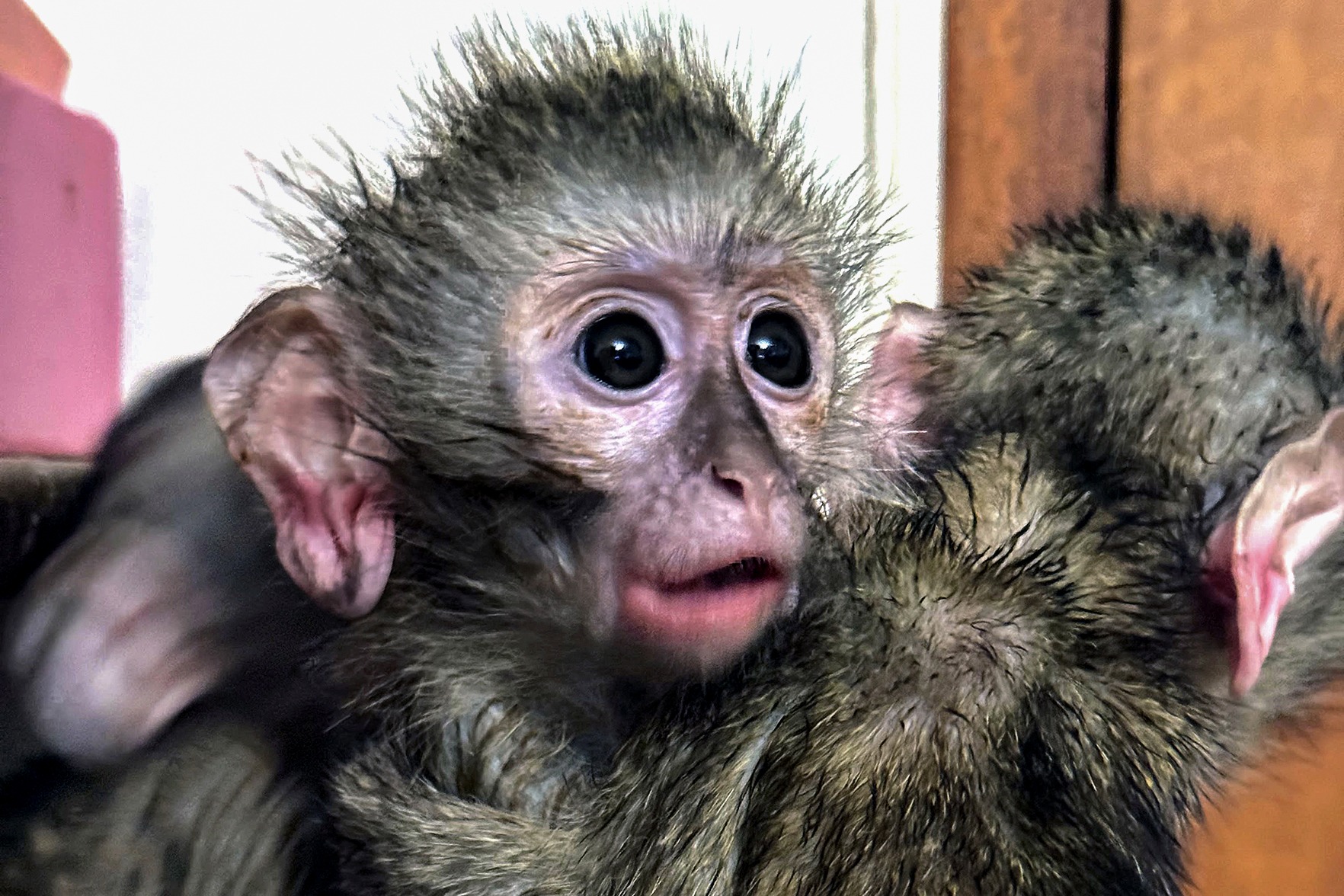
 The international trade reduces socially complex animals to trophies, specimens and commercial commodities. (Photo: Monkey Helpline / www.monkey helpline.com)
Government records reveal a substantial international trade in South Africa’s wild chacma baboons and vervet monkeys. Thousands of trophies and more than 1,000 skulls were authorised for export in just two years. Behind the statistics lies a largely unscrutinised system in which indigenous primates are converted into trophies, commercial products and international commodities.
An examination of the Department of Forestry, Fisheries and the Environment’s (DFFE) electronic export records for 2023 and 2024 reveals 1,867 chacma baboon trophy items and 1,279 vervet monkey trophies authorised for export. Alongside them were 681 chacma baboon skulls and 590 vervet skulls. Combined, that is 4,417 items in two years.
And almost all of it is derived from wild primates.
/file/attachments/orphans/unnamed_641615.png)
Killing for trophies
In only two years, South Africa authorised more than 3,100 chacma baboon and vervet monkey trophy items for international export.
The ethical poverty of this is difficult to overstate.
Baboons and vervets are cognitively sophisticated, emotionally responsive and intensely social animals. They live within complex communities, form long-term relationships, recognise individuals, learn from one another, maintain alliances and hierarchies, care for offspring and respond behaviourally to the loss of troop members.
The death of an individual is consequently not simply the subtraction of one interchangeable biological unit from a population. Trophy hunting nevertheless requires precisely this moral reduction. A living, experiencing animal becomes a target. Its death becomes a macabre achievement. Its body becomes evidence of that achievement and ultimately a possession.
/file/attachments/orphans/BaboonfamilyDonPinnock_979007.jpg "A family huddle on a cold winter morning. (Photo: Don Pinnock)")
The latest parliamentary records demonstrate that the trade has continued at considerable scale. Whatever arguments are advanced about the supposed conservation benefits of trophy hunting more generally, it is particularly difficult to identify a compelling conservation necessity for killing thousands of indigenous primates so that their bodies or body parts can be exported as relics.
That figures also reinforce an important policy context: the DFFE said in 2023 that it had no plans for a unified national policy governing the hunting of chacma baboons and vervet monkeys. That becomes rather more consequential when set beside the scale of the trophy hunting stats.
Yet trophy hunting is only part of it. The skull records reveal an additional alarming scale of death.
/file/dailymaverick/wp-content/uploads/2023/10/Vervet-monkey.jpeg "In late October, a vervet monkey tries to satisfy its thirst during a simmering afternoon at Pretoriuskop rest camp, Kruger National Park. (Photo: Tiara Walters)")
From trophy to commodity
Of the 1,271 chacma and vervet skulls authorised for export during 2023 and 2024, at least 1,106 – about 87% – were recorded specifically for commercial purposes.
An individual hunter exporting the skull of an animal he has killed represents one transaction. An exporter shipping 50, 100 or 180 wild primate skulls for commercial purposes represents something quite different. It requires supply, aggregation, processing and a buyer capable of absorbing inventory.
The records contain 105 wild vervet skulls destined commercially for the US in one transaction. Another involves 99. Others contain 69, 60 and 50. For chacma baboons, there is the remarkable 180-skull US single consignment, alongside shipments of 90, 50 and numerous smaller quantities.
So where do hundreds of wild primate skulls go? The answer is surprisingly easy to find.
/file/attachments/orphans/unnamed_521358.jpg "A baboon skull mounted as a hunting trophy — a wild primate transformed into a souvenir.
<br>(Photo: Tennants Auctioneers)")
The international market
There is an enormous established online market – mainly in the US – in genuine animal skulls and skeletons encompassing specialist osteology suppliers, taxidermists, natural-history dealers, artists, collectors and the increasingly fashionable world of “oddities” and curiosity cabinets.
Primates are openly part of it. US-based Skulls Unlimited sells genuine vervet monkey skulls alongside a large catalogue of osteological material, marketing specimens for comparative anatomy, education and collecting.
Other businesses are more revealing still. Worldwide Wildlife Products advertises genuine chacma baboon and vervet monkey skulls imported from South Africa. The specimens are sorted and marketed according to characteristics familiar to any conventional commodity business: male or female; juvenile or adult; size; condition; dentition; grade.
/file/dailymaverick/wp-content/uploads/2023/03/Pinnock-SA-primates8.jpg "Pinnock-SA primates")
Adult male chacmas, with their large skulls and formidable canine teeth, command higher prices. Individual skulls can retail for several hundred dollars while wholesale packages are available.
Authenticity itself forms part of the product’s appeal. Sellers emphasise that these are genuine animal remains rather than replicas and, in some instances, advertise their CITES provenance as reassurance of legal acquisition.
The massive retail market helps explain the otherwise puzzling scale of some South African consignments. A shipment of 100 skulls does not imply 100 foreign consumers placing simultaneous orders. It requires a wholesaler or importer purchasing inventory.
/file/attachments/orphans/unnamed1_414507.jpg "An adult vervet monkey. South Africa authorises hundreds of vervet trophies and skulls for export each year.
<br>(Photo: Monkey Helpline / www.monkey helpline.com)")
The probable chain is straightforward: an animal is killed. Its remains are acquired by a trader, taxidermist or other intermediary; the skull is removed and cleaned; specimens are accumulated; a commercial exporter assembles a consignment; a foreign wholesaler imports it and subsequently sells the skulls individually to collectors, educational buyers, artists, oddity dealers or other retailers.
Where do hundreds of skulls come from?
Baboons and vervets occupy an uncomfortable position within South African wildlife governance. They are indigenous primates, but they may simultaneously be treated as trophy animals, agricultural pests, “problem animals” or “damage-causing animals”. In some circumstances they are subjected to lethal responses arising from population-management decisions.
/file/dailymaverick/wp-content/uploads/2024/10/baboon2-Pinnock-pic.jpg "bag limits")
The commercial trade therefore raises an obvious investigative question: do animals killed under ostensibly non-commercial management or damage-control regimes subsequently enter commercial wildlife supply chains?
One US retailer selling South African vervet skulls states that the species can cause agricultural damage and represents its specimens as often originating through regulated population-management programmes. This points directly towards a question South African authorities should be capable of answering.
If a baboon or vervet is killed because it has supposedly become a “problem”, what happens to its body? Is it destroyed? Is it given away? Is it sold? Can a taxidermist acquire it? Can a wildlife dealer purchase it? Can its skull subsequently be exported commercially? And if so, who profits?
Follow the animals backwards
There is also an uncomfortable irony in the transparency of this trade. A foreign consumer can sometimes inspect photographs of an individual baboon skull online, determine its measurements, sex, condition and price, and read assurances concerning its CITES documentation.
Yet South Africans looking at information supplied by their own government to Parliament cannot determine where that baboon lived or why he or she died.
/file/attachments/orphans/unnamed2_933503.jpg "Vervet monkeys are intensely social primates, living within complex and interconnected troop structures.
<br>(Photo: Monkey Helpline / www.monkey helpline.com)")
The DFFE itself cautions that the spreadsheets record permits issued rather than proof that every authorised export occurred. It also acknowledges that some biodiversity permitting remains outside the national electronic system and continues through provincial or transitional processes.
So, these figures are not the final answer. The next task is to follow the animals backwards – from the foreign retailer to the supplier to the hunter, landowner or management authority and finally back to the individual animal and the permit, decision or circumstance under which they were killed.
The public should be able to know whether a baboon was shot for recreation, killed because it supposedly threatened crops, destroyed during a management intervention, or killed for some other reason before its body entered international commerce.
The moral question
The question, then, is not merely whether the paperwork allowing these bodies to cross international borders is technically in order. It is what that paperwork has allowed us not to see. Behind every trophy, every skull and every coded entry marked “W – wild” was once a living animal: a sentient, socially embedded individual whose life had value before we assigned a price to its death.
That is the ethical failure at the centre of this trade. We have constructed a system in which some of our closest wild relatives can be transformed from autonomous living beings into targets, trophies, specimens and commercial inventory, while the language of “sustainable use”, “offtake” and legal trade sanitises what has actually occurred. Legality may determine whether a skull can cross a border. It cannot determine whether the killing that produced it was necessary, defensible or morally acceptable.
Of equal importance, the scale of this killing and trade is even more difficult to justify against a fundamental evidentiary vacuum: South Africa has no comprehensive national census establishing how many chacma baboons or vervet monkeys remain in the wild, yet thousands of trophies and body parts continue to be authorised for export.
Chacma baboons are also listed on CITES Appendix II – a category explicitly intended for species that, although not necessarily currently threatened with extinction, may become so unless international trade is strictly regulated to prevent exploitation incompatible with their survival. The obvious question is how the state can confidently determine that this level of extraction is sustainable when it does not appear to know, with any national precision, the population from which that extraction is occurring.
So, before another baboon becomes a trophy on somebody’s wall, or another vervet becomes a numbered skull in a wholesaler’s warehouse, we should be asking a much more fundamental question: what gave us the moral authority to turn their lives into commodities in the first place?
The real measure of our relationship with wild primates is whether we can recognise that their lives should never have been commodities at all. DM
Comments
Scroll down to load comments...