




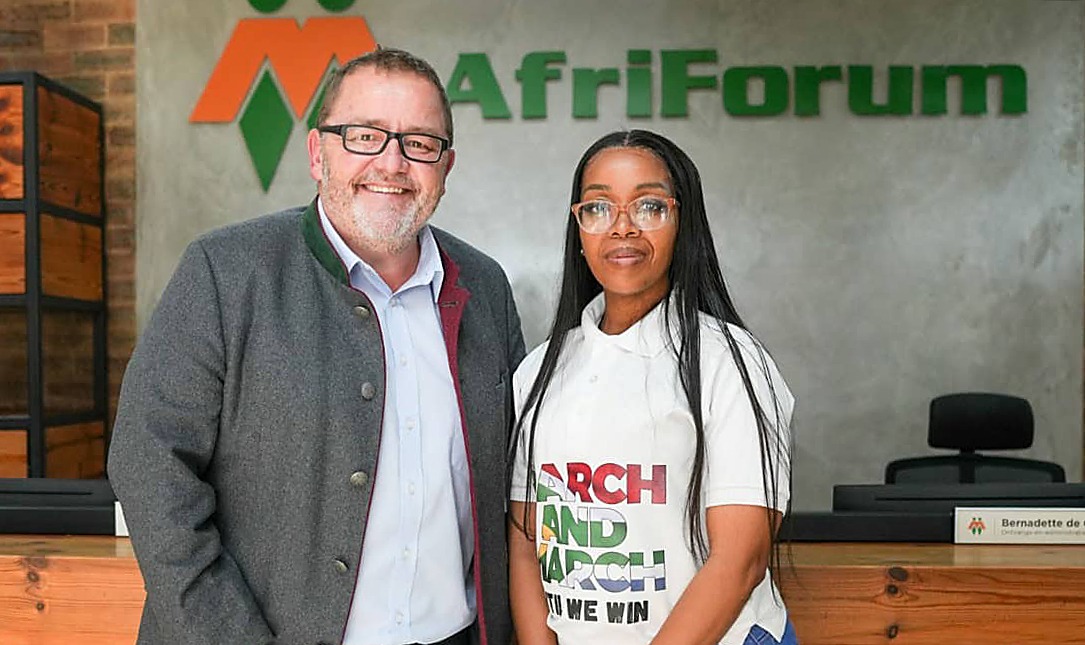
 AfriForum CEO Kallie Kriel and March and March founder Jacinta Ngobese-Zuma. (Photo: AfriForum)
Last week, two organisations that look like political opposites sat down together for a photoshoot and announced a strategic alliance. AfriForum, South Africa’s premier Afrikaner rights lobby, and the anti-immigrant movement March and March officially resolved to work together on border control, crime, “illegal migration” and the rule of law. After the latter’s Jacinta Ngobese-Zuma “suspended” ubuntu earlier this year, it’s now supposedly back on as the two organisations join forces.
As a white minority rights group and a black-led xenophobic group, they know they look like an odd couple. Both organisations are at pains to counter this perception, emphasising how much “common ground” they have beyond “differences on specific matters”. This is technically correct, but not in the way that Afriforum’s Kallie Kriel and Ngobese-Zuma present it to the South African public. Their supposed commitment to South Africa and joint condemnation of “illegal immigration” obscures what both of their efforts essentially amount to: preserving the racial order built by apartheid to serve only the people at the top of it. In doing so, both organisations deliberately weaponise nationalism with all the inherent dangers that this presents to a constitutional democracy.
Different politics, same outcome
To understand this better, let’s look beyond the current rhetoric. Who do these organisations each speak for – or claim to speak for – and what do they work towards?
AfriForum organises around Afrikaner resistance and “self-determination”, farm murders and staunchly opposes affirmative action and land reform. Right-wing networks in the US and Europe have eagerly jumped on their bandwagon to support the narrative that Afrikaner communities are targets of racially motivated hate crime. March and March, a much younger black nationalist group, has a significantly less-diverse portfolio. With a virtually singular focus on “irregular migration”, they frame a lack of border policing as the government’s most egregious and harmful failing. To spread this message they rely heavily on coordinated disinformation campaigns and paid bots on social media to exploit real grievances among South Africa’s poor working class.
Yet, when we look at what kind of future each organisation helps to shape, both campaigns have the same impact: no change for those South Africans who had, and continue to have, the least. Everything these two organisations stand for prevents meaningful social and racial justice. Instead, as they join forces to deflect blame onto those furthest down the ladder, they ossify South Africa as it has always been. In other words, neither movement touches the actual architecture of inequality but directs anger and attention away from addressing it. The organisations’ agendas are, in fact, not separate at all.
Déjà vu
Of course, South Africa has seen this mechanism at work before. White supremacy, in South Africa and elsewhere, has always invited, co-opted or pressured black partners into its structures – a small concession to ensure that inequality remains largely undisturbed. Apartheid did not run on white power alone. Instead, it reproduced and self-policed through co-opting black partners in exchange for a slice of the pie. Mangosuthu Buthelezi’s collaboration with the security apparatus of apartheid is well documented. Homeland leaders like Kaiser Matanzima in Transkei, Lucas Mangope in Bophuthatswana or Lennox Sebe in Ciskei all played their part in the fiction that “self-government” was a win-win solution for everyone and empowering for black South Africans.
AfriForum’s language of “self-dependence”, “peaceful coexistence” and “mutual recognition and respect between different communities” is a direct descendant of that same logic of “neighbourliness” that trussed up segregation as development policy. They don’t need every black South African entirely locked out. They only need enough to be persuaded or willing to promote that the real threat is other black people – the Somali shopkeeper, the Zimbabwean domestic worker, the Mozambican street trader.
For AfriForum, the alliance with March and March provides a makeover to bolster its claims that it’s not a white nationalist, racist organisation but genuinely works for the benefit of all South Africans. Having built its brand for years on the “white genocide” narrative that Washington was happy to make Afrikaners into refugees for, this image upgrade is much needed domestically.
Meanwhile, tapping into AfriForum’s legal and lobbying infrastructure, March and March gets to elevate its game beyond the street, learning valuable lessons in how to use rather than defy the law to legitimise and normalise anti-black discrimination. More fundamentally perhaps, March and March gets a foot in the door. Set against their stereotype of the lawbreaking “illegal” migrant from the rest of the continent, March and March can prove themselves a reliable and respectable black partner. This secures their own ticket; but they betray the people they supposedly speak for most spectacularly.
A marriage made in hell
This is a marriage made in hell. As March and March disqualify migrants from being the people referenced in ubuntu, they should also ask themselves what they get, in the end, from an ally that has spent its entire existence resisting every policy designed to redistribute what apartheid so unfairly sequestered. After all, AfriForum is part of the privileged minority that did and does the dispossessing of the dispossessed majority that March and March claims to represent.
AfriForum, meanwhile, doesn’t need to ask itself such a question. It already has what matters – land, capital, institutional power, two decades of litigation to protect all three – and the backing of a global network of like-minded racist, fascist allies. It has weighed what it stood to lose by making the alignment with March and March visible, and decided the risk was well worth it. That is a self-interested calculation, not a real commitment to a better future for everyone.
Ultimately, when these two are done, inequality and racial hierarchy will still be here. And if push comes to shove, AfriForum will make sure March and March get bantustans, not South Africa. Ahead of local government elections, as the poor in South Africa bear the brunt of everyday corruption, unemployment and the collapse of basic services, we need to focus less on what these two organisations agree on than on what they collectively conspire to deny and ignore. DM
Dr Rebecca Walker is a research consultant at the African Centre for Migration & Society, University of Witwatersrand. Iriann Freemantle is an associate researcher with the African Centre for Migration & Society at the University of the Witwatersrand. Sharon Ekambaram a member of Kopanang Africa Against Xenophobia.
Comments
Scroll down to load comments...