




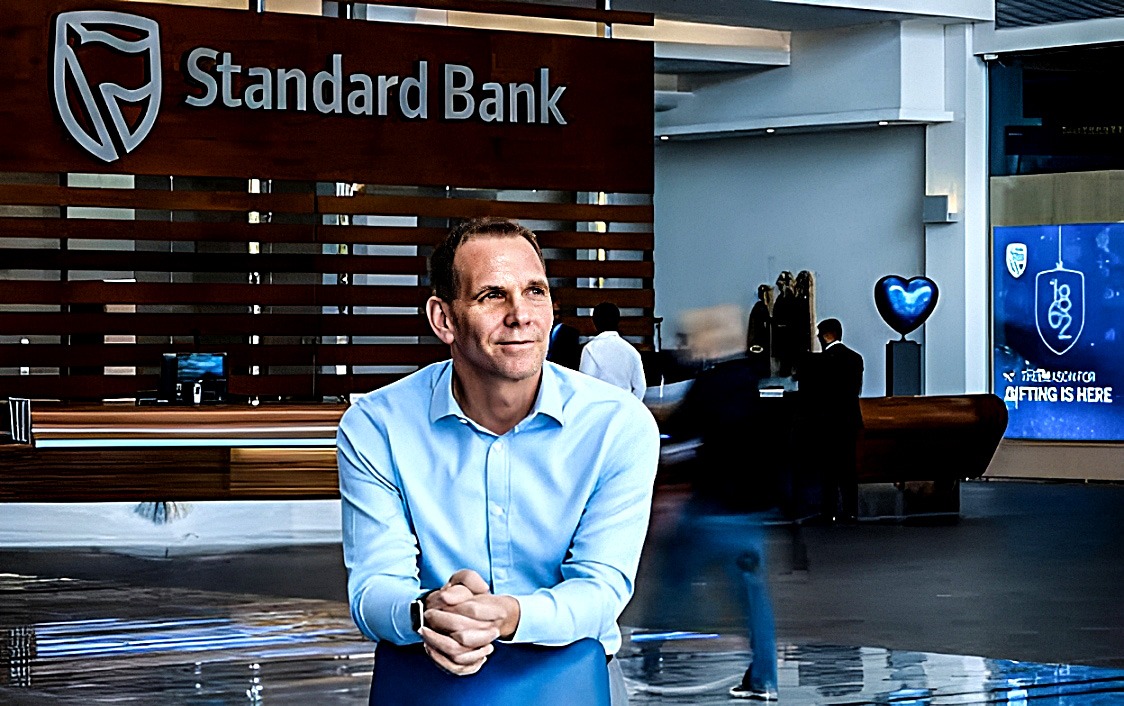
 Jörg Fischer, Standard Bank group chief information officer. (Photo: CIO South Africa / Wikipedia)
Before getting into the details of Standard Bank Chief Information Officer (CIO) Jörg Fischer’s responses to previous Daily Maverick reporting about the Rootboy hack and the group’s investments in AI hardware through the Stanlib infrastructure fund, we need to unpack his thoughts on AI token budgeting – because it kind of solves many of the problems of using AI in a post-tokenmaxing era.
Fischer said during an interview with Daily Maverick at AWS Summit Johannesburg – which moved to Gallagher last week from its traditional home (and good coffee) of Sandton Convention Centre – that he puts the Standard Bank token spend into three buckets.
Some backstory
Corporates pay for their generative AI use through a mix of methods, but the really intense code building is mostly billed by the token.
An overly simplistic way to quantify a token is to think of it as fraction of a word in the AI prompt (read: the instruction you give the AI model). Always remember that large language models (LLMs) are word calculators that count the probability of certain words appearing after others – learned through the training data – and those words are made up of different scores
First there’s the staff and productivity tools for general administrative tasks that are licence-based rather than metred by the token. This is where you’ll find the consumer-grade stuff you’re used to, like Microsoft Copilot, Perplexity and Claude.
Instead of restricting access, Fischer manages this via soft targets. This allows employees to freely experiment and upskill without administrative bottlenecks:
“All we’re doing is we’re protecting the organsation, but we’re not being bureaucratic about it”
Then there’s the software engineering bucket where he isolates developer tools like Cursor, GitHub Copilot and Claude Code because these are billed by the token.
“I take software engineering out of the first bucket... because your biggest consumption from tokens will come in software engineering.”
Every developer is registered with a standalone, individual account with enforced soft caps. This is designed to prevent runaway bills: “What we don’t want to do is that if something horrible goes wrong and then we end up with a massive token budget.
“If an engineer can prove why they need more tokens, they get the tokens.”
On the cutting edge
Fischer rejects the simplistic metric that high usage equates to high capability.
“The thing is we’ve gone very much away from this idea, because many organisations also went wrong whereby they thought the best people are the people that burn the most tokens... we look at it slightly different by saying what is the output?”
Which brings us neatly to the third and final bucket of his framework, and the one that keeps Standard Bank competitive.
Bespoke AI applications are built internally on the Amazon Bedrock platform (including models showcased by other bank executives from FNB on stage at the summit).
To manage these metered, high-volume workloads, Standard Bank’s architectural secret sauce is complete partitioning:
“The way we built our platform is that every single use case has a standalone account… If I can be arrogant enough – which I don’t want to – [the] majority of people haven’t built it like that.”
This is very clever because if a use case’s commercials prove unviable, the bank retains the operational flexibility to swap the underlying model to a cheaper one, or turn off the project instantly.
“I still would argue there’s a huge financial hygiene behind it – and remember I’m the ex finance person so so it comes naturally... For me it’s not about the cost, for me it’s the value. What value are you getting out of it? So I look at most things from a value creation perspective not from a cost perspective.”
Reframing the narrative
Remember that 1.2TB of Standard Bank group data that threat actor Rootboy was holding to ransom in April? Fischer immediately corrected the framing of the attack, insisting that Daily Maverick understand it as nothing more than a data breach.

He confirmed that the core banking infrastructure remained uncompromised:
“I guess the lucky thing was there was never a breach to our banking transaction systems… that was your typical sort of the unstructured data which was in our Microsoft SharePoint environment.”
After throwing his Microsoft services under the bus, he pointed out that unstructured files were uniquely difficult to govern. “I guess the difficulty was because it's totally unstructured data, PDF files, Excel sheets and all of that which gets used by staff.”
He also diminished the scale of the leak by calling it, “it was like, I think, less than 1% of our whole data estate”… and went on to explain that the bank had been in consultation with the information regulator and the incident had triggered deeper and more proactive engagement with state institutions to help protect customers.
Cool.
Not investing in hardware
What did emerge from this candid chat was that Fischer is a cloud-first guy. But in November 2025, Daily Maverick reported on a massive AI gamble on African soil.
African tech billionaire Strive Masiyiwa announced that Cassava Technologies would deploy 12,000 Nvidia GPUs to build physical AI factories on the continent. This multimillion-dollar infrastructure plan was supported by an undisclosed strategic equity investment from Stanlib Infrastructure Investments into Cassava’s data centre subsidiary, Africa Data Centres (ADC), aimed at building out space, power and liquid/wall cooling systems in Johannesburg and Cape Town.

Stanlib’s co-head Andy Louw confirmed that this investment was funded using South African pension fund capital, exposing local retirees’ long-dated liabilities to a highly speculative global hardware market.
When asked about these headlines, the CIO took a sharp, protective stance, clearly delineating Standard Bank’s corporate technology strategy from the investment fund’s activities.
“Stanlib is invested in Cassava... and you’ve got to be very careful about what that means. It was a serious question I put to my bosses after I read in the newspaper… I said, ‘What the hell is happenening?’ ”
He stated clearly that this was not a corporate play by Standard Bank, but rather a ring-fenced fund:
“In actual fact, they [Stanlib] got an infrastructure fund. It’s not Standard Bank invested in Cassava... they haven’t got majority shareholdings... It’s a fund. It’s not a shareholding from Standard Bank/Stanlib itself.”
Reflecting his background as a chartered accountant, Fischer strongly rejects buying depreciating tech assets like GPUs that become less productive over time.
Instead, his strategy is cloud first, which is driven by a desire to convert heavy capital expenditure into modular, flexible operating costs.
This CA turned technology strategy lead is nothing if not pragmatic and value-first oriented, which is a fresh breeze in this very frothy AI market. DM
Comments
Scroll down to load comments...