




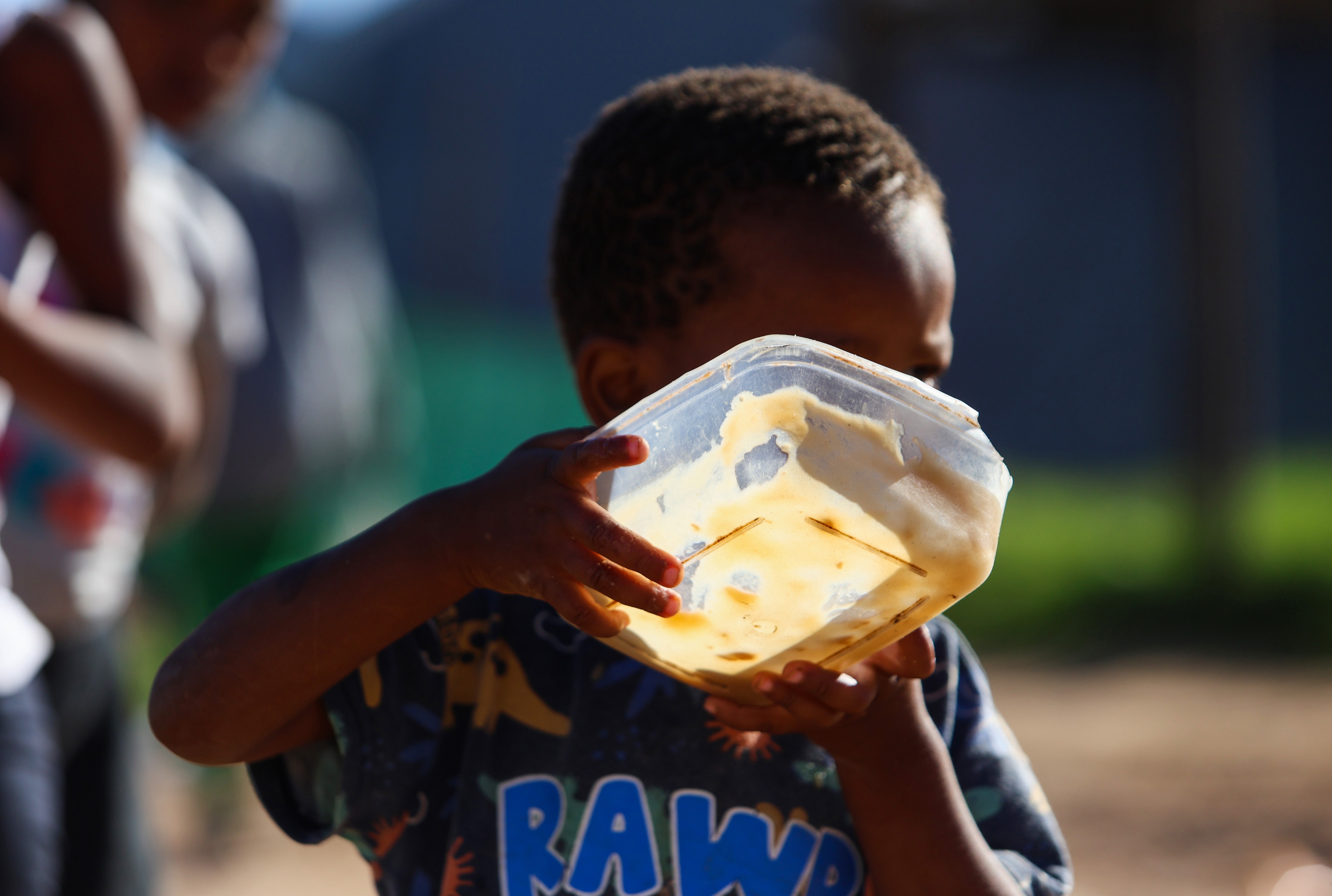
 As part of an eight-part series about food insecurity in South Africa, Health-e News is looking at the difficult choices families make when there is not enough money for food, with community journalists going into vulnerable homes across the country to find out how people keep food on the table. (Photo: Felix Dlangamandla)
/file/attachments/2996/1HungerSeriesLogo_753382.jpg)
For some children at a Nyakallong school in the Free State, the school term means at least one guaranteed meal a day.
When caregivers at the We Care Daycare centre, based at SA Mokgothu Primary School, realised that children’s need for food extended beyond the school term, they decided to keep the kitchen open during school holidays.
The centre, established in 2001 to support families affected by HIV, orphans and other vulnerable children, feeds up to 200 children a day during the first week of school break.
“We realised there is a need for us at We Care Daycare to provide a plate to these kids beyond the school term,” says Rebecca Ndaba, one of seven caregivers at the centre. “Because of high unemployment in Nyakallong, many families struggle to provide even one meal a day.”
/file/attachments/orphans/72FoodHall_577628.png "We Care Daycare staff feed up to 200 children at S.A Mokhothu Primary School. (Photo: Thabang Thembani)")
Hunger doesn’t take a holiday
During the school term, learners at SA Mokgothu Primary School receive meals through the National School Nutrition Programme.
The programme, a government-funded initiative available at primary and secondary public schools, provides learners with a nutritious meal at school to support concentration, attendance and overall wellbeing.
In communities like Nyakallong, the government’s feeding scheme has become a lifeline for households that are unable to provide food for their children every day.
Mantoa Mthombeni, a School-Based Support Team coordinator and a foundation phase teacher, says feeding learners is important for their ability to learn.
“As the School-Based Support Team, our main concern is that learners must be able to learn. But a hungry child cannot concentrate,” she said. “When a child has eaten, they are alert in class. That’s the whole point of the policy, to support learning and the wellbeing of learners.”
/file/attachments/orphans/71GettingFood_342442.png "Children collect meals during school break from We Care Day Care Centre at S.A Mokhothu Primary School in the Free State as part of the government’s National School Nutrition Programme. (Photo: Thabang Thembani)")
But when schools close for the holidays, children no longer have access to their daily school meal through the government’s feeding scheme.
We Care continues feeding children during the break. They also provide meals to children from other schools.
“We do not only give food to SA Mokgothu learners, but also other kids from other schools like Dihwai Primary School and Tshireletso Primary School,” said Ndaba.
“We can feed more than 200 learners over school recess, but others visit their relatives in other places.”
The centre receives funding support from the Free State Department of Social Development.
/file/attachments/orphans/73FoodPots_909109.jpg "Meals are prepared by We Care Day Care Centre for children in Nyakallong during the school holidays. (Photo: Thabang Thembani)")
What’s in the pots?
Annah Lekgetho, one of the cooks and caregivers at We Care, says the centre provides a variety of food to children throughout the year, including after school during the school term.
She says meals include pap and cabbage; rice with chicken and pumpkin, tinned fish and potatoes, pap and beans or samp and beans.
“We cook the whole year, during school term and holidays,” says Lekgetho. “We even give them snacks and fruit.”
For some families, the meals provided to children also help relieve hunger at home.
Masabata Mofokeng, a parent and School Governing Body member at SA Mokgothu Primary School, said many parents in Nyakallong were unemployed, worked casual jobs or depended on social grants.
“One mother came to me and said We Care really helped her because her son gave her a plate he saved for her because there was not enough for her and her son,” Mofokeng told Health-e News. “When schools close most parents worry about food. But here at We Care children get a plate and they also learn.”
/file/attachments/orphans/6I1A9903_740443.jpg "As part if an eight-part series about food insecurity in South Africa, Health-e news is looking at the difficult choices families make when there is not enough money for food, with community journalists going into vulnerable homes across the country to find out how people keep food on the table. (Photo: Felix Dlangamandla)")
Unemployment deepens hunger
Ndaba said unemployment remained a major problem in Nyakallong. She said the area, situated near Welkom, had a long history of families depending on jobs in the mining industry.
She said about 300 unemployed people regularly attended a local unemployment forum on Thursdays, hoping to find work at the mines.
Ndaba said unemployment had changed the community since she grew up in Nyakallong.
“As caregivers, we grew up in Nyakallong during the time almost every household had someone working in the mines, and food insecurity was not an issue in the household,” she said.
Now, with fewer employment opportunities, many parents relied on social grants and casual work to provide food for their children.
Community groups bridge holiday hunger gap
Free State Department of Social Development spokesperson Paballo Khamadi, who also grew up in Nyakallong, acknowledged the gap when children lose access to school meals during the holidays.
“The department recognises the critical role that community-based organisations like We Care play, especially during school holidays when children do not have access to the National School Nutrition Programme,” he said.
“We need to understand hunger plays a very important role in shaping the behaviour of a child. And as social development we prioritise organisations such as We Care Daycare that are combatting hunger.”
Mthombeni says the partnership between SA Mokgothu Primary School and We Care goes beyond providing food. Caregivers also visit the homes of children who show signs of distress or stop attending school, and involve social workers where necessary. DM
First published by Health-e News in an eight-part series about food insecurity in South Africa.
Comments
Scroll down to load comments...