



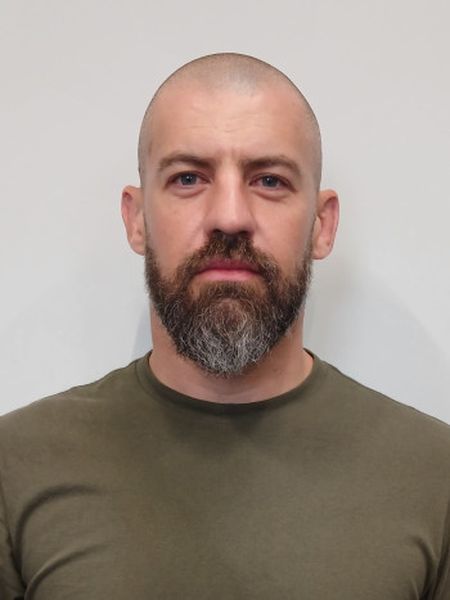
 Three of the accused, Siyabulela Mbane, Ntobeko Msome and Xolelwa Msome are still in custody after they were denied bail. Their co-accused, Unathi Peter, who was granted bail, was not in the dock yet. (Photo : Deon Ferreira)
“So you are telling me a person can be walking around with a bullseye on his back without knowing it? And there is nothing they can do about it?”
This was the incredulous question that came from acting judge Dan Ngoqo, the presiding officer in a case where four people are facing a laundry list of charges for allegedly murdering unsuspecting victims to profit from funeral policies.
The State witness before court, a forensic services manager for one of the country’s biggest insurance providers, confirmed the judge’s question.
The simple truth is, anyone who is willing to lie about being your relative can take out a funeral policy in your name and potentially benefit from your death without you having any knowledge that the policy exists.
Legislation does not require that the subject of the funeral policy be notified of its existence.
There is no central database, no simple way of verifying policies in your name. You have to contact every funeral policy provider individually and request that they check their records.
And if your name does appear on their system as an insured life? Unless you opt to take legal action, the only person who can remove your name or alter the policy is the person who initiated it.
Sitting in the judge’s seat in the Eastern Cape Division of the High Court in Gqeberha, Ngoqo’s eyes widened as he shook his head in disbelief at the evidence before the court.
/file/attachments/orphans/MFM8_634070.jpg "Accused number 1, Siyabulela Mbane, made no attempt to hide his face from the media and often had an amused expression on his face throughout proceedings. (Photo : Deon Ferreira)")
While this evidence does not prove that any of the four accused before him are guilty of a crime, it is at the root of a sinister trend that led to the establishment of the police’s Murder for Money task team (MFM), based in Nelson Mandela Bay, which has been marked as a “hotbed” of life insurance and funeral policy killings in South Africa.
Sitting in the dock this week, Siyabulela Mbane, husband and wife Ntobeko and Xolelwa Msome, and Unathi Peter, face a string of charges, including murder, fraud, racketeering and money laundering after the police allegedly linked them to a series of deaths and payouts on fraudulent insurance policies.

This is just one of several cases before court after the MFM was established in December 2024, when the police ministry identified insurance-related murders as one of the priority crimes plaguing the Eastern Cape.
While similar incidents have been reported across the country, Nelson Mandela Bay in particular was branded as a hotspot for these greed-driven crimes.
Mbane, the Msomes and Peter are believed to be among the first alleged syndicates identified by the police for operating an organised Murder for Money scheme.
/file/attachments/orphans/MFM7_589504.jpg "Accused number 2, Ntobeko Msome. (Photo : Deon Ferreira)")
The charge sheet links the accused to a total of nine murders, where six of the victims had numerous funeral policies in their names registered to one or more of those in the dock.
A total of 29 funeral policies, across multiple insurance companies, are under investigation. It is alleged that the accused profited by more than R1.7-million, while payouts to the tune of R770,000 were repudiated after being flagged for possible irregularities.
/file/attachments/orphans/MFM6_551699.jpg "Accused number 3, Xolelwa Msome. (Photo : Deon Ferreira)")
One of the victims, Ayanda Mvemve, had eight funeral policies in his name, while another victim, Tumo Sali, had five.
The State’s first witness, forensic services manager for Sanlam, Nigel Meier, provided evidence on the process behind registering a funeral policy and how potential MFM cases were flagged and investigated.
He told the court that when one person’s life was covered by multiple people, it raised a red flag and could prompt an investigation. It was also suspicious when a person died of unnatural causes within six months of a policy being activated, or if the policy was altered to increase the payout shortly before an unnatural death occurred.
/file/attachments/orphans/MFM1_894458.jpg "Accused number 4, Unathi Peter, tried to hide her face as she left the High Court in Gqeberha on Thursday. (Photo : Deon Ferreira)")
Another red flag was when a murder occurred with no clear reason or motive, raising suspicion that the death was solely for the purpose of claiming a funeral policy.
Meier also unpacked some funeral policies and how they paid out, particularly those provided by Sanlam and Capitec before October 2024 (Sanlam and Capitec had a joint funeral policy venture, which came to an end in October 2024).
Deadly scam explained
He explained that Capitec’s funeral policies required the account holder to take out a policy in their own name, after which they could insure multiple other people. These policies came with an automatic double payout should the person die from unnatural causes.
The court heard that Mbane had taken out three separate policies on one of the victims, Malibongwe Vena, about a month before his untimely death in August 2021. One of the policies was with Capitec, and the murder took place before Mbane had paid one of his R123.50 premiums.
With Sanlam, a policyholder did not have to insure him or herself before they could insure another person. For an additional fee, Sanlam policies came with certain benefits, which included double, and even triple, payouts to the policyholder should the subject of the policy die from unnatural causes.
Meier further explained that if a policy were activated today, and the subject died tomorrow, before any premiums were paid, the policyholder was still eligible for the full payout, as well as any double and triple benefits.
This testimony left the judge with a deep frown, leading him to ask about the “bullseye” on an unsuspecting victim’s back, to which Meier responded that there was no legislation that required the subject of a policy to be contacted.
He explained that a person could insure a relative only within the clear parameters set out by the policy’s terms and conditions. Traditional “clan relations” that were not blood relatives did not qualify.
In a case where a red flag was raised, the insurance company employed a third-party investigator to verify the details provided at the initiation of the policy. If a person was listed as “wider family” or “distant relative”, the nature of the relationship would have to be verified.
A policy could then be paid out or repudiated, depending on the investigator’s recommendations.
On Thursday, Meier was cross-examined by defence attorney for Mbane, Jacques Slabbert, and attorney for the Msomes and Peter, Natie Heyns.
Both attorneys raised hypothetical scenarios where policyholders could misinterpret policy terms and conditions and/or misunderstand the definitions of family members within the traditional clan system.
They also unpacked the potential red flags set out by Meier, arguing that each suspicion on its own did not constitute wrongdoing by their clients.
The trial continues on Friday.
More MFM-related cases
Nxuba loan shark Nomonde Christmas will return to the town’s magistrates’ court soon on 34 charges of fraud after being linked to a list of illicit funeral policies.
Christmas is believed to have used information she gathered through her moneylending business to register fraudulent funeral policies, where she allegedly lied about her relationship to the subjects of the policies. At one stage, she paid as much as R42,000 in monthly premiums to Sanlam, and the police are still investigating dozens more policies to determine their validity. She is said to have profited by about R640,000 from previous claims.

In Gqeberha, former police officer Christina Somekete faces 15 charges related to fraudulent funeral policies, and was subsequently charged with trying to interfere with witnesses in the case.
In December 2023, Somekete received two payouts after Onke Matikinca was murdered in Kwadwesi.
According to documents before the court, she registered two policies on the deceased nine months before his death, claiming he was her cousin. She received R120,000 and R53,000 respectively, before it was uncovered that she was in fact not related to Matikinca.
Her matter returns to the Gqeberha Regional Court on Friday

In a precedent-setting case in December 2025, Monelwa Gwane was convicted and sentenced for her involvement in a MFM scheme that saw her profit by R80,000 across two payouts.
She was initially arrested and appeared alongside Mbane, the Msomes and Peter before her trial was separated from the alleged syndicate.
She was, however, still convicted on three counts of fraud and sentenced to five years’ direct imprisonment on each of the counts. The court ordered that the sentences run concurrently for an effective sentence of five years. DM
Comments
Scroll down to load comments...