




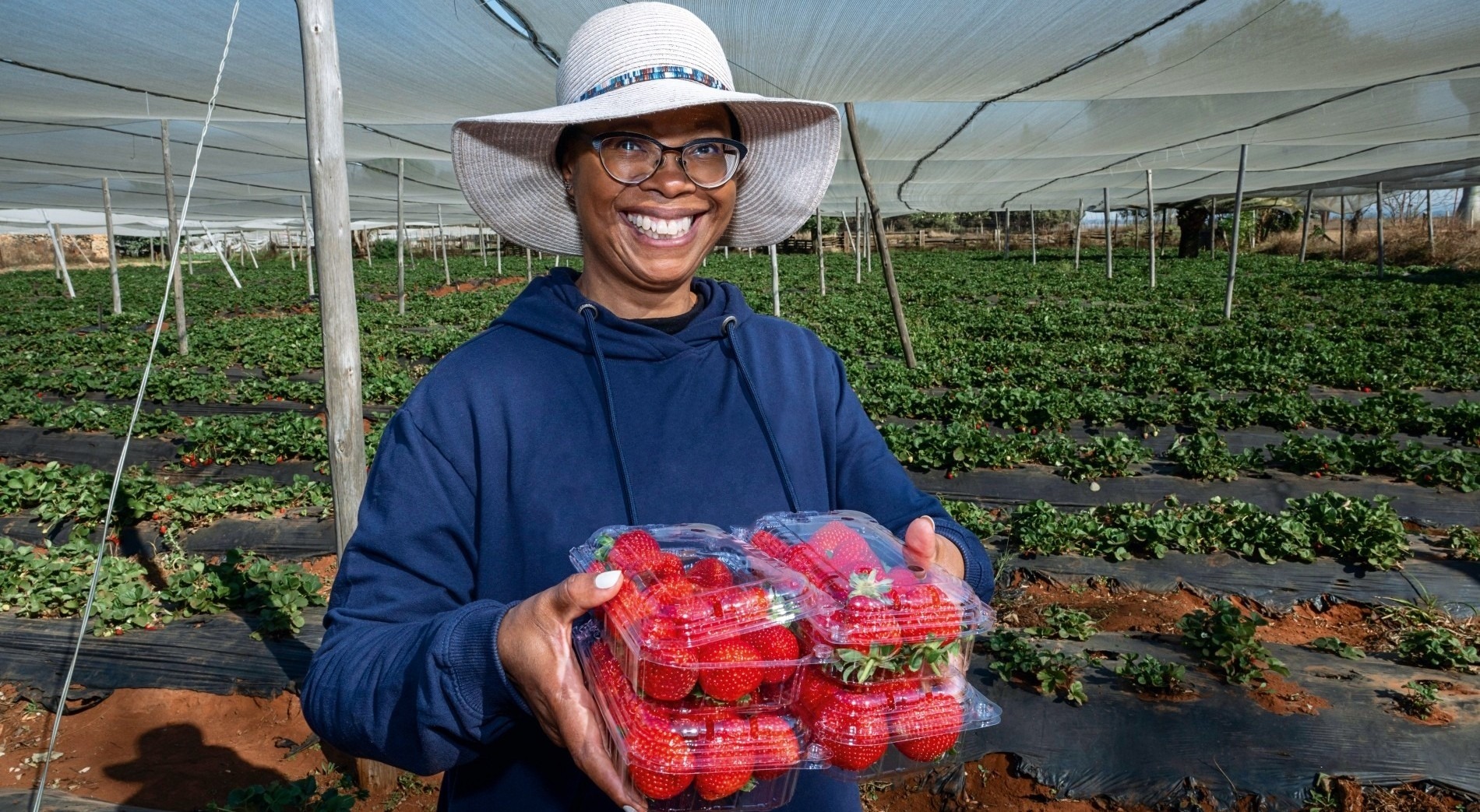
 Agro-entrepreneur and founder of Toberri Farms, Zimbili Mosheshe supplies Woolworths with strawberries.
This Women’s Month, we spoke to Zinzi Mgolodela, Woolworths’ Director of Corporate Social Justice, about how Woolworths is advancing women’s empowerment across its business and value chain.
Why is women’s economic empowerment important for Woolworths?
At Woolworths, we believe creating opportunities for women is one of the most effective ways to build thriving communities and support stronger local economies. Women make up more than half of South Africa’s population and play a critical role in driving economic growth. When women succeed, they create jobs, support more families and contribute to resilient communities.
Woolworths was the first South African retailer to sign the UN Women’s Empowerment Principles (UN WEPs), tell us more about this?
The UN Women Empowerment Principles guide organisations on how to advance women empowerment and gender equality in the workplace, marketplace and communities. We wanted to turn our commitment to women empowerment into practical strategies and action by adopting this globally recognised set of guidelines.
The UN WEPs are also in line with Woolworths’ Inclusive Justice Initiative which seeks to build a business and society where people have greater opportunity to participate, thrive and feel a sense of belonging.
How have the UN Women Empowerment Principles influenced change at Woolworths?
The Principles have helped us to move from commitment to accountability. Through the UN WEPs Gender Gap Analysis Tool, we have been able to identify where we are making progress and where we need to improve in creating an environment where women can flourish. The tool focusses on four areas: leadership and strategy; workplace; marketplace and community. Within these areas the tool assesses commitment, implementation, measurement and transparency.
Our first assessment in 2023 was a deep institutional reflection point which highlighted several opportunities for improvement. We scored 36 percent, placing us in the “Improver” category. This allowed us to set practical strategies and plans to improve. These included setting clear and measurable targets, formalising policies and practices that advance gender equality, tracking and reporting on progress. Since then, our score has improved from 36 percent to 71.3 percent in the 2026 financial year, elevating us to “Achiever” status. We are now on track to reach our target of 75 percent and “Leader” status by end of FY2027.
One area identified for improvement is increasing the representation of women-owned businesses in our supply base. We are addressing this through tailormade supplier development financial and non-financial support. Over the past 13 years, Woolworths has invested more than R49 million in women-owned small and medium businesses, of which R11 million was in the last five years. Today, more women entrepreneurs are joining our supplier base. Furthermore, in this year’s Woolworths Youth Makers programme, 11 of the 15 winners are innovative businesswomen.
/file/attachments/2996/ZinziMgolodelaheadshot_301722.jpg)
Can you share some examples of women-owned businesses that have recently been supported through Woolworths’ supplier development programme.
One example is Toberri Farms. Founded in 2022 by agro-entrepreneur Zimbili Mosheshe, the farm grows strawberries in Kliprivier south of Johannesburg. Toberri joined our supplier development programme in July 2025, and it took them only three months to supply us with Woolworths quality strawberries.
Following a business assessment by Woolworths’ Enterprise Inclusive Justice Institute (EIJI), Toberri received R1.5 million in funding to install cold chain infrastructure and purchase an adjacent 4.5-hectare farm. This has given Toberri the opportunity to more than double future production capacity.
Woolworths’ fresh produce team is also supporting Toberri with integrated pest management and introducing our Farming for the Future regenerative agriculture programme to strengthen the farm’s long-term sustainability. Toberri currently employs eight permanent and ten seasonal workers, with further job creation expected as the business grows.
“As a female entrepreneur in agriculture, the support of the Woolworths team has been invaluable. Their partnership has not only provided resources and expertise, but has also helped us strengthen our operations, improve our capabilities and grow with confidence. Woolworths has enabled us to pursue opportunities that once seemed beyond reach. We are deeply thankful for their commitment to developing local suppliers like us,” commented Zimbili after her first year of supplying Woolworths and being part of Woolies’ supplier development programme.
Another new inspiring supplier is MOTHERBUD, founded by social impact strategist Kenny Morifi-Winslow, produces exotic mushrooms while creating opportunities for women through skills development in community-based food production.
/file/attachments/2996/KennyMotherbudwithoystermushrooms_694473.jpeg)
After a successful trial in seven Woolworths stores, MOTHERBUD now supplies blue oyster mushrooms to 39 stores across the Western Cape and has recently joined our supplier development programme to expand their production into our Gauteng stores. The business has already created four additional jobs through its Woolworths partnership.
“The Woolworths partnership is such a strong indication of what is possible not just in the local food system, but in the social one as well. To be such a small, young, and female led team, working with the gold standard of food quality at this stage in our growth journey, is the honour of a lifetime. It proves that grit, determination, and a little faith can be a force multiplier. Woolworths’ commitment to empowerment, regenerative agriculture, and social responsibility has given MOTHERBUD the opportunity to turn a dream into real purpose, uplifting women along the way and setting an example for a new generation of innovators,” says Kenny Morifi-Winslow MOTHERBUD’s founder and CEO.
These businesses demonstrate the powerful impact that targeted support, access to markets and long-term partnerships can have in unlocking women’s economic participation and creating sustainable livelihoods.
/file/attachments/2996/Motherbudblueoystermushrooms2_986115.jpg)
What does Women’s Month mean to Woolworths?
Women's Month is an opportunity to celebrate progress, but it is also a reminder that there is still work to do.
Real empowerment happens when women have access to opportunities, markets, skills, finance and networks that enable them to build sustainable futures. That is why our focus extends beyond our own workforce to the entrepreneurs, farmers, innovators and suppliers who form part of our broader value chain and society.
At Woolworths, we believe that when women thrive, businesses prosper and nations grow stronger. DM
/file/attachments/2996/MYWOOLIESROTATINGBANNER_399646.jpg)