





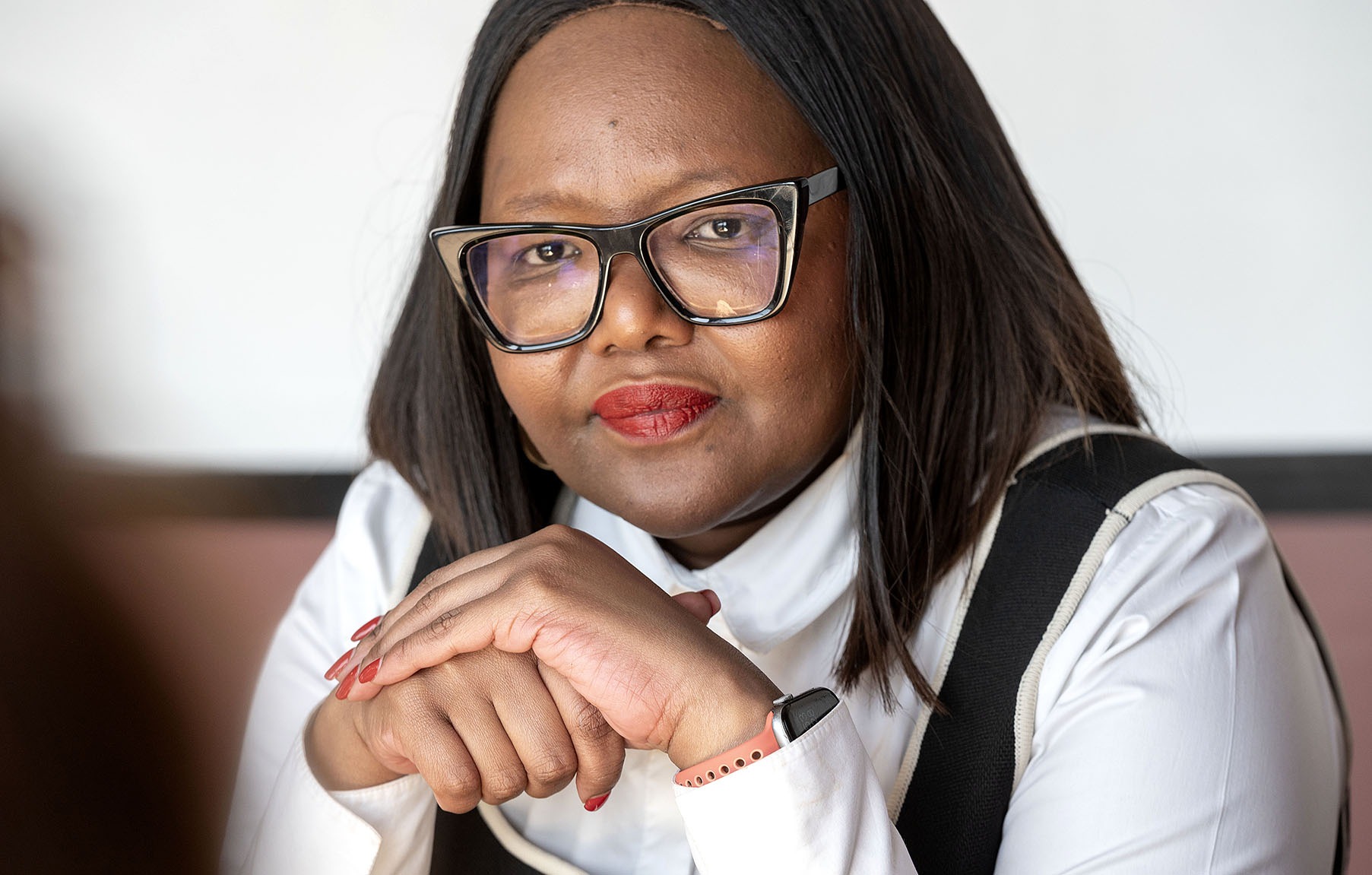
 Siviwe Gwarube, Minister of Basic Education, during a Daily Maverick interview in Johannesburg on 28 July 2026. (Photo: Leon Sadiki)
Since being sworn into office as South Africa’s Minister of Basic Education in 2024, Siviwe Gwarube has consistently advocated for urgent and sustained investment in early childhood development (ECD), framing quality learning in the early years as a critical mechanism for fixing the national literacy and numeracy crisis.
In November 2025, Minister in the Presidency Khumbudzo Ntshavheni announced the approval of the National Strategy to Accelerate Action for Children, a framework that aims to intensify efforts to advance the welfare and development of South Africa’s children.
In May 2026, Gwarube said that more than 13,300 ECD centres had been registered in the past year, and that upward of 1.2 million children were accessing registered early learning programmes across the country.
However, sitting down with Daily Maverick to discuss her vision for the ECD sector, Gwarube was not afraid to acknowledge that there was still significant work to be done.
“We are able to see the direct correlation between children who have access to [the ECD] subsidy, who are on the Child Support Grant, and education outcomes... I think the ECD team is incredible and they do really great work, but we’ve got to push ourselves harder and harder. Remember, the target is seven million children in structured ECD centres by 2030,” she said.
Referencing the Department of Basic Education’s (DBE) Bana Pele ECD Mass Registration Drive, launched in 2024, she noted that focus had shifted from getting centres registered at bronze level, to elevating programmes to silver and gold level, where they could access the ECD subsidy of R24 per child per day.
Expanding ECD subsidy access
In 2025, the National Treasury allocated an additional R10-billion to the Department of Basic Education over the medium term to increase the subsidy to R24, and support expanded access to ECD for about 700,000 more children under five.
“The R10-billion that has been allocated over the medium term is going to hinge on whether or not we are able to spend that money, and spend it effectively. So, that has to be the obsession,” said Gwarube. “We never want to demonstrate to National Treasury that we are unable to spend that money.”
Gwarube, who was born and raised in KwaMdingi, a village near Qonce (formerly King William’s Town) in the Eastern Cape, reflected on how her own childhood experiences had shaped her passion for the development of the early learning sector.
“I was raised by a woman who was a teacher in a village, and I can understand that having children go to a structured centre is far more important than we would have really given it credit for… Now, we are saying it’s important that our ECD centres are structured places where children can come learn, play, but also [have assurance] that they are looked after and that they are safe,” she said.
/file/attachments/orphans/SiviweGwarube2_800262.jpg "Siviwe Gwarube, Minister of Basic Education, during a Daily Maverick interview in Johannesburg on Jul 28, 2026. (Photo: Leon Sadiki)")
Reducing barriers to registration
So, how is the DBE centring subsidy access for ECD centres?
Gwarube chairs the Inter-Ministerial Committee on ECD, a task team that brings together various departments, including the Department of Basic Education, Department of Home Affairs, Department of Social Development and Department of Cooperative Governance and Traditional Affairs (Cogta), to “break down silos” between agencies in the development of early learning.
Through collaboration with Cogta Minister Velenkosini Hlabisa, and various metros, the Department of Basic Education was attempting to make it easier for ECD centres to comply with bylaws and zoning requirements, said Gwarube.
“We can’t allow red tape to be the barrier to people being able to comply and do what they need to do,” she emphasised.
The Department of Basic Education has been pushing specific targets for government partners on the committee, including getting the births of more children in early learning programmes registered through home affairs, and expanding access to the Child Support Grant through the Department of Social Development.
“Government services have to serve people, and not the other way around. And often in SA, to access a government service is so arduous, and we have to make sure that we don’t do that,” continued Gwarube.
Combatting stunting and malnutrition
A Department of Basic Education tender for the appointment of a service provider to implement an ECD Nutrition Support Programme for a period of three years was published in March 2026, and remains open on the department’s website with a closing date of 11 September 2026. The National Treasury first allocated R197-million for the project in 2024/25, scaling the allocation to R772-million over the medium term in 2026/27.
Asked about the implementation of the programme, Gwarube said: “We’re going to be piloting that… nutrition programme in the Eastern Cape, because of course we know that the Eastern Cape is acutely affected by child malnutrition and child stunting.
“I do want to make it quite clear that I think it’s an absolute indictment on us as leaders in this country to have children who go hungry... I think, frankly, it’s a crime. SA is not a poor country. That there are children who’ve lost their lives because they couldn’t access food is something that we all, as leaders, need to take stock of and pause.”
Beyond the rollout of the pilot nutrition programme in the Eastern Cape, Gwarube said that Department of Basic Education was looking to collaborate with corporate and civil society partners in the nutrition space to identify and address hunger hotspots in areas across the country.
“Once a child is stunted, it is irreversible, and that is why it is so incredibly heartbreaking for me, because that child’s prospects of success in life diminish significantly,” said Gwarube.
“If we don’t get this right, every single thing that we do from here onwards is not going to matter, and we’re still going to have this incredible divide of those who have, and those who have not. The only time we will ever start closing that inequality [gap] is if it doesn’t matter whether you grew up in Qwa Qwa or in Sandton.”
Closing the inequality gap
Gwarube is of the view that basic education is more of an economic portfolio than a social one, arguing that any country that is serious about addressing inequality needs to prioritise education. She referenced the findings of the Department of Basic Education’s South African Systemic Evaluation that many children who were in Grade 3 were actually at a Grade 1 level, in terms of literacy and numeracy.
“That, for me, is the crisis of our time because it’s not about... how many matriculants take up maths and science. It’s about the fact that we’ve allowed learning losses to take root... If you say you want to really undo inequality in SA, you have to fix that,” Gwarube told Daily Maverick.
South Africa’s ECD sector is a largely entrepreneurial space, according to Gwarube, led by women in local communities who have identified gaps in the market. The Department of Basic Education is not looking to “schoolify” centres, but rather empower and upskill practitioners when it comes to qualifications and training, and ensure better infrastructure for young learners.
“Economists around the world have often remarked that when we invest in the foundations of learning, we could literally grow our GDP by 2%. So, this is not a peripheral issue, a social issue about saying, ‘Oh, the children are cute.’ They are cute, but it’s literally about building a country,” she said. DM
/file/attachments/orphans/ChildrensReporterV2_187851.jpg "Tamsin-DG-Murray-Trust")
Comments
Scroll down to load comments...