




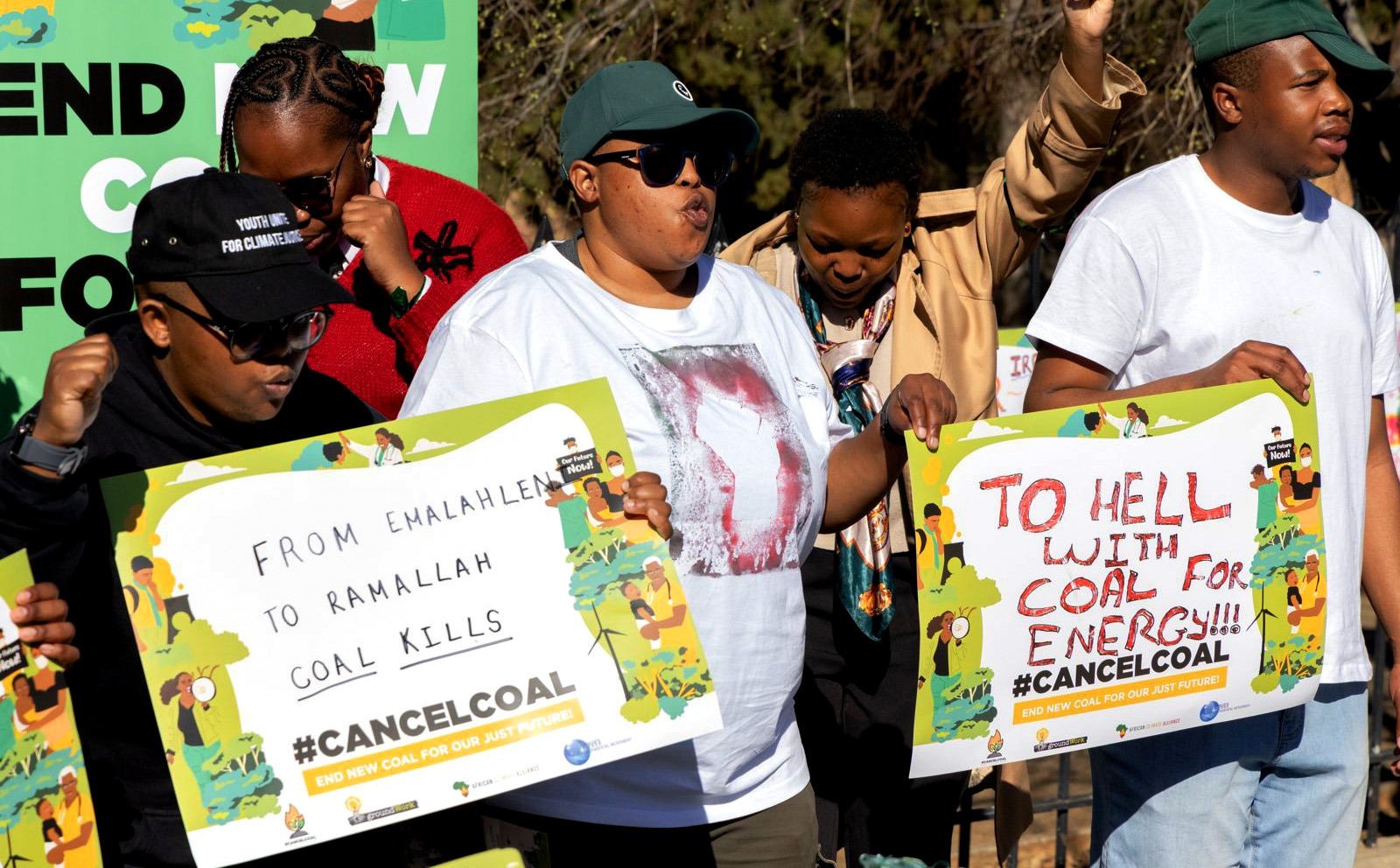
 Climate activists outside the Supreme Court of Appeal in Bloemfontein, which is hearing the government’s appeal against a landmark high court judgment against its plans to build new coal-fired power stations. (Photo: Chris Louw)
Singing filled the air outside the Supreme Court of Appeal (SCA) in Bloemfontein on Wednesday, 19 August, as activists from the African Climate Alliance, Vukani Environmental Justice Movement in Action and groundWork gathered outside South Africa’s second-highest court.
Almost two years ago, similar scenes unfolded outside the Gauteng High Court in Pretoria, where activists from the same groups gathered to challenge the government’s plans to develop 1,500 megawatts (MW) of new coal-fired electricity generation under the 2019 Integrated Resource Plan (IRP 2019) in what is now known as the #CancelCoal court case.
The lower court ruled in favour of the environmental groups, with Judge Cornelius van der Westhuizen handing down a landmark judgment that found that the then minister of mineral resources and energy, Gwede Mantashe, and the National Energy Regulator of South Africa (Nersa) had failed to adequately consider the impact of new coal-fired energy generation on constitutional rights, particularly those of children.
/file/dailymaverick/wp-content/uploads/2025/03/DSC_1011.jpg "Residents in Phola, a mining town in Mpumalanga, as smoke rises from Eskom’s Kendal coal-fired power station in the distance. Glencore’s Tweefontein Water Treatment Plant supplies treated drinking water to the region, including Phola. (Photo: Julia Evans)")
Judge van der Westhuizen subsequently found that the government’s plan was inconsistent with the Constitution, as well as “unlawful and invalid”.
Now, the minister of energy and electricity, Kgosientsho Ramokgopa, who is in charge of shaping SA’s energy future, is asking the SCA to overturn the landmark judgment.
“The impression is that government is not just appealing the court case, but they are appealing our rights and our future as young people. It’s really an appeal against a liveable future for young people everywhere in South Africa,” said Sibusiso Mazomba, advocacy coordinator at African Climate Alliance.
The State’s appeal is based on a plan set out in IRP 2019; however, Ramokgopa published an updated Integrated Resource Plan (IRP 2025) that effectively cancels the old one and, notably, makes no mention of new coal-powered generation capacity.
This policy shift should render the government’s appeal moot; however, Mazomba explains that the original ministerial determination issued under the IRP 2019 by the Department of Mineral Resources and Energy was never formally revoked or repealed.
/file/attachments/orphans/WhatsAppImage2026-08-19at152741_208454.jpeg "Climate activists and affected Mpumalanga communities demonstrate outside the Supreme Court of Appeal in Bloemfontein, as government appeals a landmark High Court judgement it’s plans to develop 1,500MW of new coal-fired electricity generation on 19 August, 2026. (Photo: Chris Louw)")
This means that even as policy frameworks move on, the Section 34 ministerial determination giving legal effect to procurement for 1,500MW of new coal-fired generation capacity remains active, allowing the state to pursue fossil fuel expansion legally until overturned or formally withdrawn.
Government’s argument
The cornerstone of Ramokgopa’s appeal is that the high court’s ruling was marked by errors, a misapplication of constitutional rights and judicial overreach that threatens the separation of powers and South Africa’s energy security.
Mazomba said one of the government’s key arguments – that requiring specific, child-focused consultations for national energy planning misapplies constitutional law – caused a stir in the court.
According to the government, plans to construct new coal-fired power stations would not directly harm children, and a stable power grid is essential for children’s overall health and education.
However, Mazomba emphasised that constitutional protections leave no room to isolate energy choices from children’s everyday wellbeing.
“The Constitution enshrines the best interest of the child. Every decision that gets made in South Africa should consider the best interest of the child, particularly issues where children and young people are most affected,” said Mazomba.
/file/attachments/orphans/WhatsAppImage2026-08-19at1527402_364096.jpeg "The environmental group's main argument is that the government did not take into account the effects of new coal power plants on children's health. (Photo: Chris Louw)")
In its heads of argument, the government argued:
Premature Challenge: The high court ruling was premature as no specific plants, sites or developers have been chosen yet.
No Secret Capacity: The increase from 1,000MW to 1,500MW resulted directly from public feedback; reconsulting after every draft revision creates endless delays.
Conflated Decisions: The court wrongly grouped the flexible 2019 IRP policy and the statutory 2020 determination into a single Act.
Missed Section 36 Balance: The ruling weighed environmental risks (Section 24) without balancing them against grid stability and economic survival (Section 27).
Grid Stability Threat: Striking down coal imposes an unviable “blanket ban”, ignoring renewable intermittency and the need for a managed energy transition.
Environmental groups’ argument
In defending the High Court’s landmark decision, the Centre for Environmental Rights (CER), which was representing the environmental groups, argued the following:
Ignored Children’s Interests: Section 28 of the Constitution requires the best interests of vulnerable children to be prioritised in all energy decisions.
Unproven “Clean Coal”: The State offered no real feasibility studies for clean coal technology, producing only a Wikipedia printout, while experts show it remains polluting and unviable.
Unjustified Rights Infringement: Adding 289 million tonnes of cumulative CO₂ by 2050 violates constitutional rights without proper scientific justification.
Irrational Economics: Solar and wind are significantly cheaper. CSIR modelling excludes new coal from least-cost plans.
Air pollution’s impact on children
The consequences of living under the shadow of a coal-fired power plant are already felt acutely by younger people, particularly those living in SA’s Coal Belt.
Daily Maverick has reported on papers published in the Journal of Global Health, which found that children are particularly susceptible to climate-related health issues because of their developing immune systems and greater need for nutrient-rich food and water.
/file/dailymaverick/wp-content/uploads/2025/07/IMG_1241-2.jpg "The air in Thubelihle carries a constant yellow/ochre-tinted haze due in no small part to the Kriel Power Station and other industries in the area. Despite that, life continues and children play in the street like in any other South African town. (Photo: Ethan van Diemen)")
Additionally, a study released by the Centre for Research on Energy and Clean Air and Greenpeace Africa in April found that the delayed coal phase-out detailed in government plans would result in around 32,000 additional premature deaths. The research also projects an additional 41,000 preterm births, 17,000 cases of childhood asthma and 370 deaths among children under five.
“With this rising air pollution, children are even more susceptible. There are cases of asthma and children missing out on school, and that affects their quality of life growing up. There has to be more acknowledgement of the fact that energy planning is child rights planning, and those two are not distinct from each other,” said Mazomba.
With proceedings adjourned, the SCA will now deliberate on the case before it delivers judgment. Youth climate leaders maintain that the outcome will define both environmental accountability and the legal protections afforded to South Africa’s future generations. DM


Comments
Scroll down to load comments...