




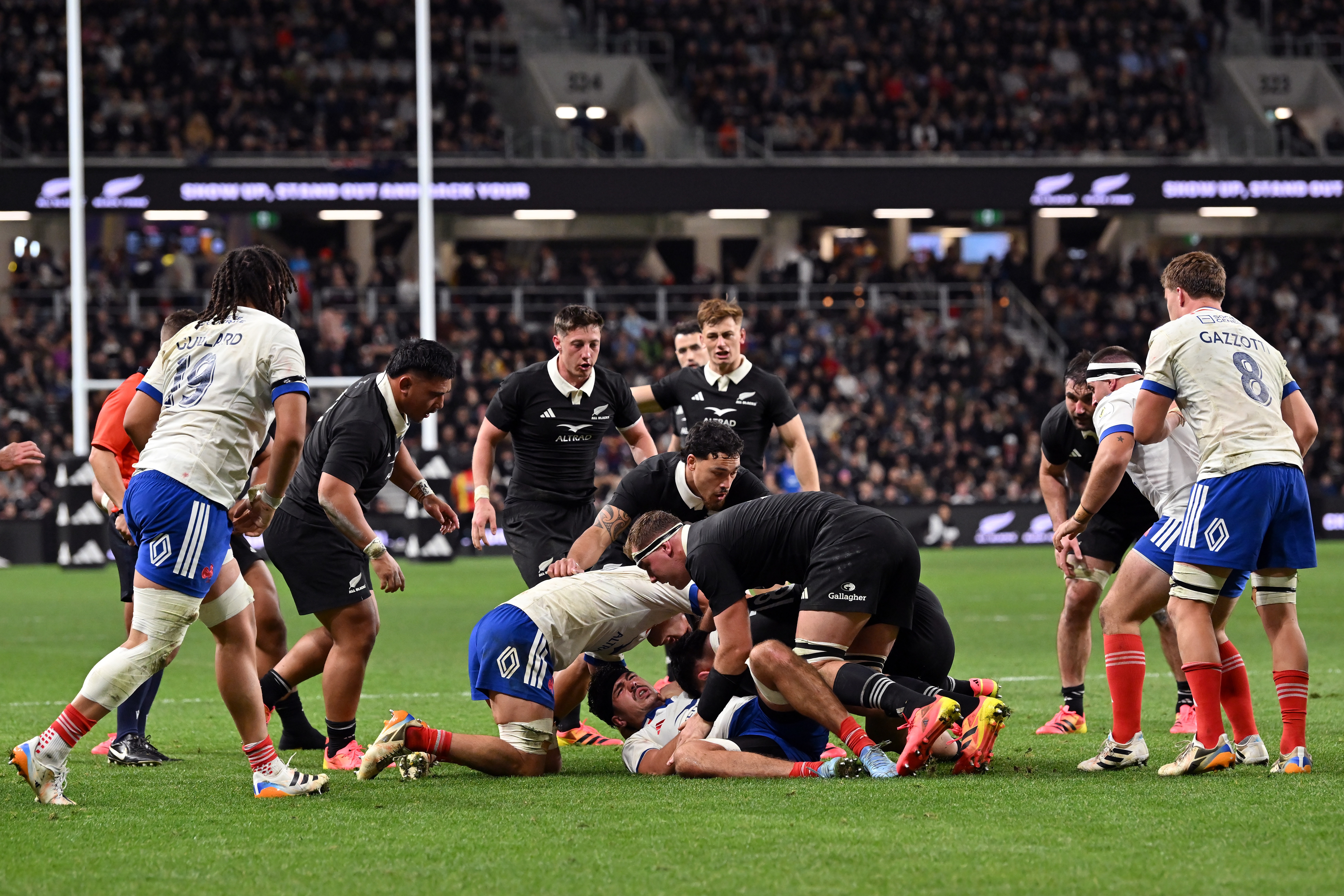
 The Springbok management has questioned the All Blacks’ technique at breakdowns before the Greatest Rivalry Test series starts at Ellis Park on 22 August. (Photo: Kai Schwoerer / Nations Championship via Getty Images)
It’s still three days to the first of four Tests between the Springboks and All Blacks, and already there is enough spice from either side to liven up the blandest of dishes.
On Tuesday, Bok assistant coach Felix Jones pulled no punches in his assessment that the All Blacks under coach Dave Rennie tend to hit rucks illegally.
It was an unusually frank and blunt assessment of an opposing team in the lead-up to a big Test. But it seems the gloves are off and the Boks are out to make the tourists know they’re on to them.
Jones, who is often the man in the coaching set-up tasked with finding chinks in the opposition’s armour, has gleaned his intelligence from extensive debriefs with the Stormers, Sharks and Bulls coaching staff, and from hours of video clips of previous All Black games.
Obviously, it’s not only their questionable ruck tactics that have caught his eye, and he did venture some opinions on other aspects of their game.
But you can be sure his public insights are not the entire picture that the Boks have built up of Rennie’s All Blacks.
/file/attachments/2996/TL_2606519_976535.jpg "JOHANNESBURG, SOUTH AFRICA - AUGUST 18: Felix Jones of the Springboks during the South African men's national rugby team media conference at Southern Sun Hyde Park on August 18, 2026 in Johannesburg, South Africa. (Photo by Sydney Seshibedi/Gallo Images)
<br>")
Intelligence-gathering
“A lot of it [information from SA clubs] has been confirmation of what we saw in the Nations Championship – how they’re trying to attack, how they’re trying to defend, what they’re doing in their kicking game and trying to develop there,” said Jones.
“A couple of things probably trended across the feedback across the different franchises. A few things around the breakdown they experienced, like tucked shoulders going into the breakdown, which I know they weren’t happy with. It’s a reversed-arm-type non-wrapping action. That was a consistent theme that came out.”
Jones was not shy to call out the actions, which caused some controversy in the Nations Championship when All Blacks flanker Luke Jacobson crashed into the head of Ireland’s Josh van der Flier and was only given a yellow card.
Jacobson led with the shoulder and dived recklessly into the ruck at pace.
Asked if this trend of leading with the shoulder and a tucked arm into rucks was just poor technique or deliberate, Jones was clear.
“Well, I don’t think it’s something I’ve really seen with them over the last number of years,” said Jones.
“We’ve obviously analysed them extensively, but definitely this is the feedback we got from the franchises. We’ve seen there’s an element of that [tucked arm] in there. We’re all for the physical side of the game, as everyone is aware, so whatever word wants to be associated with it, we just want it to be within the law.
“I don’t want it to be something that gets written and becomes a controversial thing. We’ve coached against Glasgow and Australia when Dave [Rennie] has been there. There are some amazing pieces to the play, to his coaching and to how quick they get their ruck speed going.
“World Rugby’s number one priority is safety, so we’re just super aware of the feedback we got from the franchises that there were several of that type [tucked arm] of clear-out and actions, and we just want to make sure that brutality and physicality stays within the laws.”
/file/attachments/2996/TL_2606497_469877.jpg "JOHANNESBURG, SOUTH AFRICA - AUGUST 18: Players working on the field during the New Zealand men's national rugby team training session at St Stithians College on August 18, 2026 in Johannesburg, South Africa. (Photo by Sydney Seshibedi/Gallo Images)
<br>")
Clash of styles?
Much of the debate about this series has also centred on whether it’s a clash of styles. The simplistic version is that it’s the “boring Boks” versus the “flashy All Blacks”.
The truth lies somewhere in between. In his analysis of the All Blacks, Jones readily acknowledged that the team is displaying new trends compared to previous years.
“They’ve clearly got a very strong identity around what they’re trying to do in each area of the game,” said Jones. “Those common threads, I believe, were present in the franchise games, even in the wet-weather game again in Durban, so they’re really committed to the way they’re trying to go.”
It therefore raises the question – are Rennie’s All Blacks that different to predecessor Scott Robertson’s, or Robertson’s predecessor, Ian Foster?
Jones partly answered, wary of giving too much away.
“I would say if you looked at plenty of metrics you would see significant shifts in the amount of kicking or the amount of ball that they’re trying to hold on to or their phase count or the amount of time in possession,” said Jones.
“You can see there has been a shift in what they’re trying to do here.”
Jones also defended the perception that the Boks are trying to slow the game down.
“Any defence coach is going to say they want to slow down the attack,” said Jones. “There are legal ways of doing that. You can tackle a guy behind the game line to slow that defence down. You can contest a ruck so long as you enter the ruck and stay on your feet and compete as a counter ruck or a jackaler.
“But then there’s also the other ways you can slow a defence down. There are many illegal ways you can do it, like repeatedly infringing when someone gets into your 22, or going offside deliberately. I would almost see those ones as worse and almost more cynical than a team that might have someone that’s down for an injury and the game has to be stopped.
“We’re aware of that narrative but we’re also super aware we are playing within the laws.”
Aerial battle
Another area that has seen a shift is the way the All Blacks have been dealing with contestable kicks.
Instead of coming forward to meet the ball, the defending player tends to turn towards his own tryline and take the ball over his head. He will have other players around him, but the idea is to make it difficult for the chaser to get to the ball, as he must jump over the shoulder and back of the defender.
Considering the aerial battle is one of the Boks’ key attacking weapons, the coaching staff will have to come up with innovative ways to deal with this.
/file/attachments/2996/2284586547_670315.jpg "CHRISTCHURCH, NEW ZEALAND - JULY 04: Will Jordan of New Zealand and Theo Attissogbe of France battle for the ball during the Nations Championship match between New Zealand All Blacks and France at One New Zealand Stadium, on July 04, 2026 in Christchurch, New Zealand. (Photo by Joe Allison/Nations Championship via Getty Images)")
“It’s like anything – whether it was the old system or this new system – when the skill set of the player is really high, and they can execute it, it can be effective,” Jones conceded.
“But it can also be a negative because there’s a huge amount of momentum or force coming back against you to generate a tackle. We’ve seen teams struggle with that. For us, we see a positive and a negative to every single tactic that you try to employ.
“I think if their skill set is good enough and they do it, it can work for them. It comes down to the execution of it on the day.” DM
Comments
Scroll down to load comments...