




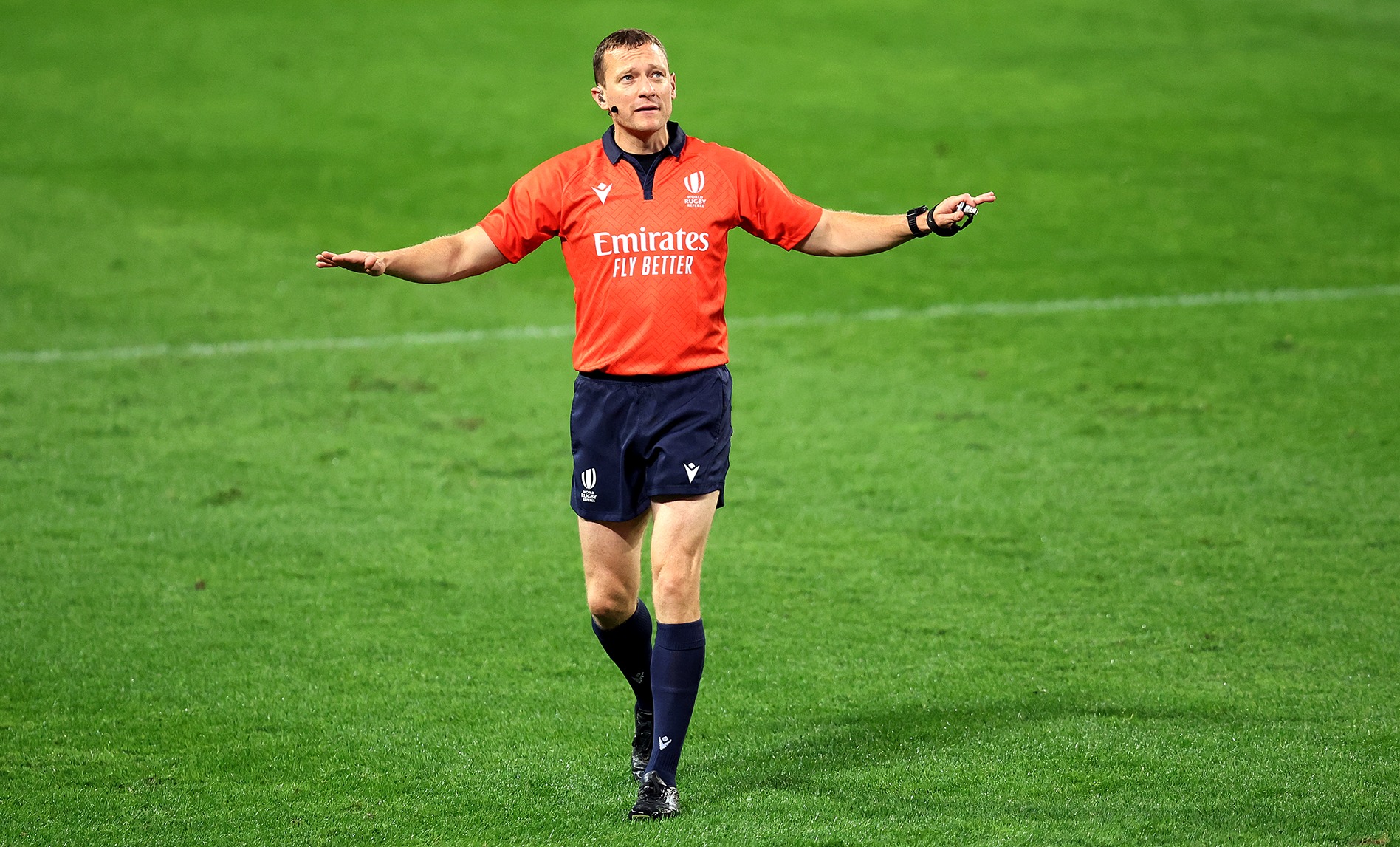
 Referee Matthew Carley (England) during the Rugby's Greatest Rivalry match between the Sharks and New Zealand on 11 August 2026. He will take charge of the first Test at Ellis Park. (Photo: Steve Haag Sports / Gallo Images)
World Rugby’s latest protocols, strictly limiting the amount of feedback to officials, as well as changing the rules about engaging with them, have left both the Boks and All Blacks in a strange position.
Until this July, coaching teams were allowed to give unlimited feedback via email directly to officials. That has now changed to uploading a maximum of six clips and accompanying notes to World Rugby’s Athlete Management System (AMS).
That is slightly problematic as it limits dialogue on areas of concern, but the flipside is that it also keeps teams focused on the main problem areas, and not every perceived injustice.
The second new protocol, and the one that will have a direct impact on this series, is that the coaching staff of any team can only meet with the referee before a Test with the approval of the opposing team, and with them in attendance.
/file/attachments/orphans/22351737262_526958.jpg "Pieter-Steph du Toit of South Africa is tackled by Quinn Tupaea of New Zealand during The Rugby Championship match between New Zealand All Blacks and South Africa Springboks at Sky Stadium on September 13, 2025 in Wellington, New Zealand. (Photo: Hagen Hopkins / Getty Images)")
As you can imagine, that has killed any chance of pre-Test meetings.
Good, some might say. But there are some very compelling reasons why coaches may want to meet with a referee before a Test, and not only to try to get in their good books.
It’s also likely to lead to a situation where teams are unhappy with certain aspects of the opposition, and the only way they can express that view is via the media.
The All Blacks have already done it with their view that South African teams, and the Boks, try to slow the game down. They want the game to be faster.
And in response, Bok coach Rassie Erasmus and laws manager Jaco Peyper used their Monday media briefing to counter that narrative.
At the best of times, coaches are cautious about commenting on referees in public (as Erasmus well knows), but now they are using the media to plant ideas in officials’ heads.
/file/attachments/orphans/TL_2606452_609072.jpg "Rassie Erasmus (coach) of the Springboks and Jaco Peyper (adviser) during the South African men's national team media conference at Southern Sun Hyde Park on August 17, 2026 in Johannesburg, South Africa. (Photo: Sydney Seshibedi / Gallo Images)
<br>")
Frustration
In most sports, a pre-match meeting with the referee would not really matter, but rugby has so many opaque areas, and so many laws that have loopholes that are open to interpretation.
Occasionally a coach wants to forewarn a referee about a certain trick play they might use, which falls within the laws, but they just want to ensure the referee understands the law, especially in the heat of battle.
“I think there’s definitely frustration from the coaches that you can’t have meetings with the referee if both teams don’t agree,” Erasmus said.
“It’s now at a stage where you almost accept both teams’ coaches aren’t always going to agree to a pre-match meeting.
“I, this week, said, ‘No, no, we don’t need one,’ because it doesn’t help now, after they’ve (the All Blacks) have played three games, and now we want to sort out things in three training sessions.
“We had to look at what they put on the Athlete Management System and then sort of learn from what the answers are from World Rugby.
“In future (with this protocol), if you want to get something out, you have to get it out here (in a media conference) because you can’t really talk to the referee.”
/file/attachments/orphans/TL_2606451_670844.jpg "Rassie Erasmus (coach) of the Springboks during the South African men's national team media conference at Southern Sun Hyde Park on August 17, 2026 in Johannesburg, South Africa. (Photo: Sydney Seshibedi / Gallo Images)
<br>")
Erasmus used some examples of previous plays the Boks have used, and that came off, because the referee was pre-warned of what was coming.
“There are small things, which in normal referee meetings you would alert the referees to a plan. We might want to do a midfield maul, so we’d ask him to be aware of that and know the law around it,” Erasmus said.
“Now you can’t. Because you must have the meeting with the opposing coach present.
“You can’t say, ‘Listen, we may be doing a front peel in the line-out, so maybe don’t stand there because you might not see if it’s obstruction or not.’
“Under this system, teeing up the referees with things you want to do is very difficult.”
/file/attachments/orphans/TL_2606468_743749.jpg "Dave Rennie (coach) of the All Blacks during the New Zealand men's national team media conference at Sandton Convention Centre on August 17, 2026 in Johannesburg, South Africa. (Photo: Sydney Seshibedi / Gallo Images)")
All Blacks coach Dave Rennie confirmed that Erasmus was the one who declined a meeting with the refs under the new protocols.
“No, there’ll be no meeting. For us to do that, we both have to agree,” Rennie said.
“And they sent out an email last week just to have a chat around maybe four key areas, and one of them was around the time wasting.
“Rassie didn’t feel there was any need to meet. I feel the same way, to be honest. We’ve had conversations via email, and we’ve got a summary sent to us this morning, so we’re pretty clear.”
Trust the process
It probably isn’t ideal that the group of officials who will run the four Tests in the Greatest Rivalry series are staying in the same hotel as the All Blacks in Sandton.
The Boks didn’t go so far as to suggest there might be some quiet comments in the corridor between the All Blacks management and the Test officials, but they let the implication hang.
“The tough thing for the referees due to the new protocols is that in the past when a referee is in your hotel you could say: ‘Let’s go for a beer quickly and we have a chat,’” Erasmus said.
“Now, the poor referee has to say ‘No I can’t,’ because the protocol is both coaches must be there. Dave (Rennie) has probably experienced the same thing.”
/file/attachments/orphans/TL_2606455_967607.jpg "Jaco Peyper (adviser) during the South African men's national team media conference at Southern Sun Hyde Park on August 17, 2026 in Johannesburg, South Africa. (Photo: Sydney Seshibedi / Gallo Images)")
When it was put to the Bok management that perhaps there had been some socialising between the referees and the All Blacks management, Peyper was cautious in his response.
“I’ve been in the same position many times and we fully trust the blokes that referee the game. So as professionals they have to handle themselves,” Peyper said.
“The referees have a manager who prepares them, just like Rassie prepares the Bok team.” DM
Comments
Scroll down to load comments...