




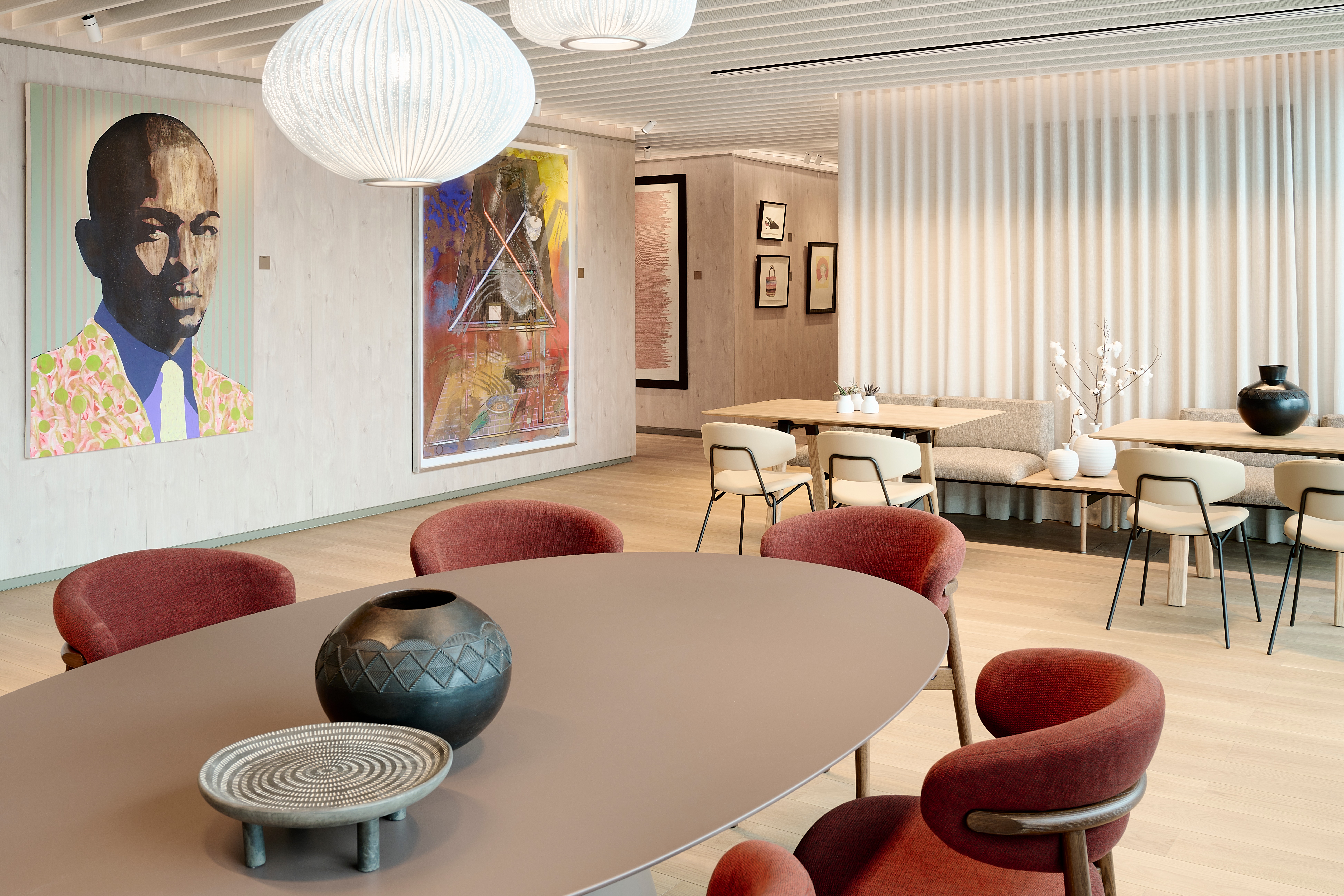
 Photo supplied
For decades, workplace design focused on operational efficiency: maximising floor-plate density, standardising configurations, supporting administrative processes. Employees came because that's where work happened.
Today, that equation has fundamentally changed. Hybrid work has given professionals unprecedented autonomy. While executives recognise the strategic value of in-person collaboration, the office is no longer the only venue for productive output.
This presents a critical strategic question: “Why would top talent choose to work here?”
The organisations winning the talent competition aren't the ones with the largest budgets or the most premium finishes. They're the ones that understand a fundamental truth: workplaces that succeed are those that create an environment people genuinely want to be part of. Spaces that support wellbeing, reflect authentic corporate culture, and enable individuals to do their best work.
The strategic value of workplace experience
For C-suite and HR leaders, the calculus is straightforward: office design is now a talent retention and productivity lever.
To answer why employees should choose the office, workplaces must deliver value that remote setups cannot replicate:
Authentic social connection. Cultivating trust, spontaneous problem-solving, and cross-departmental alignment–the moments that drive innovation and cultural cohesion.
Psychological belonging. Designing spaces where employees feel valued as human beings, not operational units. This directly impacts retention and engagement metrics.
Integrated environmental support. Natural light, acoustics, air quality, and ergonomics that actively boost cognitive output and reduce workplace fatigue.
/file/attachments/2996/trend-cpt-01_890206.jpg)
Authenticity over branding: culture as strategy
Many organisations display mission statements across reception walls. Yet culture is rarely built on slogans; it's experienced through the physical spaces employees inhabit daily.
There's an important distinction between branded offices and authentic ones.
A branded office tells people what the organisation wants to be. It relies on corporate colours, logos, and superficial signage. An authentic office reflects what the organisation actually is. Spatial flow, material quality, acoustic performance, and how teams naturally interact reinforce the company's real values.
Employees recognise the difference immediately. When workplace design genuinely reflects corporate culture–through materiality, spatial hierarchy, and operational systems–the office becomes more than a work venue. It becomes a reinforcement of identity and purpose.
Sustainability exemplifies this. For many organisations, sustainability was historically viewed as environmental compliance. Modern employees interpret it differently: as a direct reflection of organisational values.
When an enterprise invests in sustainable materials, responsibly sourced finishes, and durable craftsmanship, it communicates: 'We are investing for the long term, not taking shortcuts. We value both our workforce and tomorrow.' This becomes a language of care embedded in the physical environment.
/file/attachments/2996/TREND_SPOTIFYHQ_ParisB_4_LR_130045.jpg)
Designing for choice: beyond the open-plan myth
A common misconception in modern workplace strategy is that collaboration requires open-plan offices. Experience has proven otherwise.
People work differently. Some thrive through constant interaction; others produce their best work during uninterrupted concentration. Cross-functional teams need flexible project spaces; confidential conversations demand privacy. Modern workplaces must accommodate all these needs simultaneously.
This has led to activity-based working (ABW) environments–spaces designed around the task being performed, not the employee's desk assignment.
Collaborative hubs optimised for team brainstorming and dynamic project work. Quiet focus pods with acoustic enclosures for analytical work requiring deep concentration. Informal lounges fostering spontaneous conversation and mentorship. Private meeting rooms enabling sensitive discussions without distraction.
The objective isn't to prescribe how people work, but to provide environments that support different ways of working. When organisations provide genuine choice–and the design quality is thoughtful enough that each choice feels good–something shifts. People stop fighting the space and start thriving in it.
Ironically, these are often the workplaces where collaboration happens most naturally.
/file/attachments/2996/Somabay_Office_27_826745.jpg)
The micro-details that drive measurable outcomes
When people describe workplaces they enjoy, they rarely reference square footage or furniture specs. They remember how the space made them feel. Yet these 'small details' have extraordinary influence on measurable business outcomes.
Natural light. Access to daylight is consistently associated with improved mood, greater alertness, and higher workplace satisfaction. Where natural daylight is limited, carefully designed artificial lighting that supports circadian rhythms creates more comfortable and productive environments.
Greenery and biophilic design. Plants contribute far more than visual appeal. Biophilic elements reconnect people with natural systems, improve perceived comfort, and create subtle reminders of growth and renewal. This is not decoration; it's infrastructure supporting psychological wellbeing.
Acoustic performance. Removing background echo, harsh fluorescence, and ambient noise allows the environment to support deep focus effortlessly. Poor acoustic design is one of the highest sources of workplace dissatisfaction and productivity loss.
For CFOs and business leaders, these elements matter because they directly impact talent retention, sick leave reduction, and cognitive output. The cost of poor workplace design–expressed in employee turnover, health impacts, and productivity drag–far exceeds the cost of getting it right.
/file/attachments/2996/Trend-South-32-02_690684.jpg)
Execution matters as much as vision
The most successful workplaces share one characteristic: design vision is matched by delivery excellence. A beautifully conceived space that's poorly executed–acoustic specs that don't perform, materials that don't hold up, spatial planning that doesn't work operationally–undermines the entire investment.
For organisations embarking on workspace transformation, two principles matter: clarity on what you're trying to achieve, and partnership with teams who take accountability for translating that vision into operational reality.
Great workplaces don't announce their design. Employees are not constantly aware of why the office feels comfortable or productive. They simply experience fewer distractions, move more naturally through the space, and find it easier to focus, collaborate, and perform at their best.
In many ways, this invisibility is the ultimate measure of successful workplace design: the environment supports work so effectively that it almost disappears into the background.
/file/attachments/2996/Trend-Guild-01_704564.jpg)
The measure of success
A truly successful workplace is not measured by how impressive it looks in photographs or how many awards it wins. It's measured on an ordinary Tuesday morning, when people are immersed in meaningful work, collaborating with colleagues, and feeling entirely comfortable in the space around them.
The greatest compliment any workplace can receive is not that it impresses visitors, but that the people who work there genuinely want to stay. DM
About Trend Group
Trend Group specialises in delivering workplace design and construction. The firm works alongside architects, designers, and client organisations to translate workspace vision into built reality. With 18 years of track record across global studios in South Africa, UK, Middle East, and Africa, Trend Group has delivered transformative workspace projects for organisations.
For more information: trendgroup.co.za | trendgroupglobal.com