





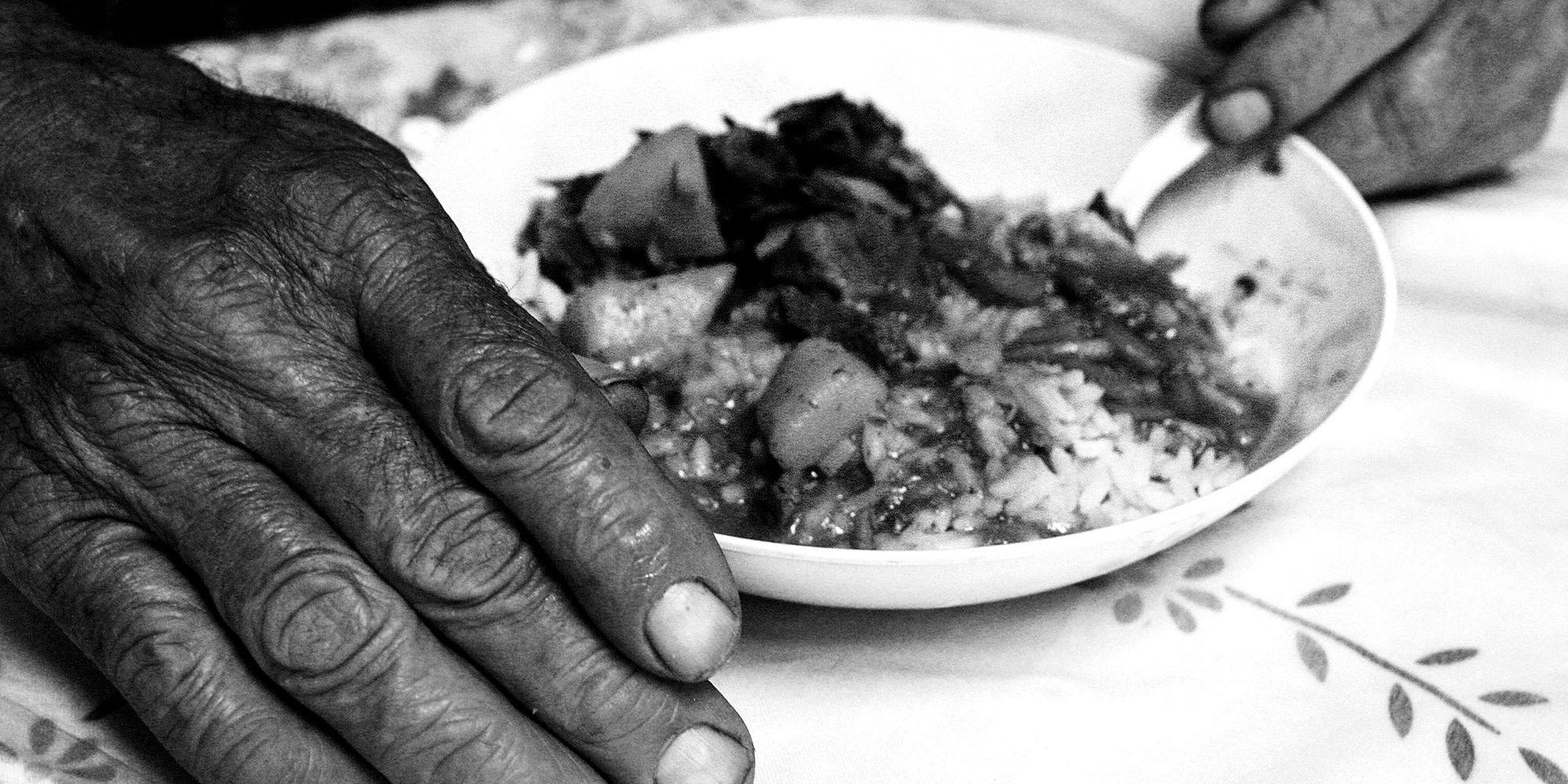
 Pensioners receiving the old-age grant often have to make it stretch to feed the entire family. Rising unemployment has hit South Africa, with 33.6% of the population unemployed in the second quarter of 2026.
(Photo: Joyrene Kramer)
Pensioners receiving the old-age grant often have to make it stretch to feed the entire family. Rising unemployment has hit South Africa, with 33.6% of the population unemployed in the second quarter of 2026.
(Photo: Joyrene Kramer)/file/attachments/2996/1HungerSeriesLogo_982669.jpg)
Exploring the impossible trade-offs families make to put food on the table, and the resilience keeping them afloat in backyard gardens to food stokvels. In this series, community journalists enter vulnerable homes to reveal how families fight hunger.
When there is not enough food in Sekhwele Mnisi’s home, he tells his children to drink water and have faith that God will provide.
The 66-year-old widower lives with his three adult children and two young grandchildren in a two-bedroom house in Ga-Motodi village near Burgersfort in Limpopo.
Mnisi’s oldest daughter, 24-year-old Karabo, and 19-year-old son, Thoriso, are also unemployed.
“My other daughter, Dipolelo, is 21 but still attends high school.”
Karabo has two young children, a two-year-old toddler and an eight-month-old baby. “We have many mouths to feed.”
The pensioner says he does odd jobs when they are available so that the family can eat. “Most times I accept food as payment,” he says.
/file/attachments/orphans/31Widowerprays_640793.jpg "Sekhwele Mnisi says he has faith that God will provide food when money runs out. (Photo: Thomo Nkgadima)")
Grants are not enough
With Mnisi’s old-age grant and his grandchildren’s child support grants, the family has a monthly income of R3,460.
He says R1,500 goes towards food for four adults and two children.
This works out to R375 per week, or R50 per day to feed the whole family. The rest of their money must pay for other essentials like water, wood, paraffin and candles.
When food runs out, Mnisi’s children sometimes spend hours at neighbours’ homes. “We pretend to watch television until they dish out an evening meal,” says Dipolelo.
“l was tired of bothering our neighbours instead of being grateful.”
Money for food goes towards wood and water instead.
/file/attachments/orphans/32Widowercooking_297470.jpg "A lot of time and money is spent on cooking the family’s meal on open fires. (Photo: Thomo Nkgadima)")
Mnisi says the two-bedroom RDP brick house that he shares with his children and grandchildren is falling apart.
Inside the kitchen, the cupboards stand bare. A few slices of bread lie on the kitchen table.
There is no fridge, no electricity and no running water. Four big water containers take up most of the kitchen space.
“There is no running tap water in the community, so we pay a water tanker to deliver water.”
/file/attachments/orphans/33Water_979047.jpg "The family stores water in the kitchen in large containers. (Photo: Thomo Nkgadima)")
The family spends about R400 a month on water and another R400 a month on paraffin and candles,” Mnisi says.
Their income must also cover the cost of firewood.
Mnisi says they cannot afford to buy food in bulk and without electricity they can’t refrigerate anything.
Life changed after their mother died.
/file/attachments/orphans/34House_161519.jpg "Mnisi outside his two-bedroom house that he now shares with his three adult children and two young grandchildren. (Photo: Thomo Nkgadima)")
Mnisi says he has struggled to support his family since his wife died in 2012.
His children were 10, seven and five years old at the time.
“She cooked for the family, did their laundry and she was showing them love,” he says.
“She was a hard worker, she grew crops and vegetables to help feed the family and to sell to generate income for the survival of the family.”
Mnisi’s youngest daughter says her mother’s death left the family struggling.
“Our biggest sin was that our mother passed away when we were very young,” says Dipolelo.
No electricity
The family says their home remains the only one in the village without electricity despite repeated attempts to get connected.
“We sleep with one eye open during the night in fear of being raped or die inside this run-down brick house,” says Dipolelo.
Mnisi says he continues to look for odd jobs to help support his family.
And when there is nothing left to eat, he tells his children to drink water and have faith that God will provide. DM
First published by Health-e News as part of an eight-part series about food insecurity in South Africa.
Comments
Scroll down to load comments...