




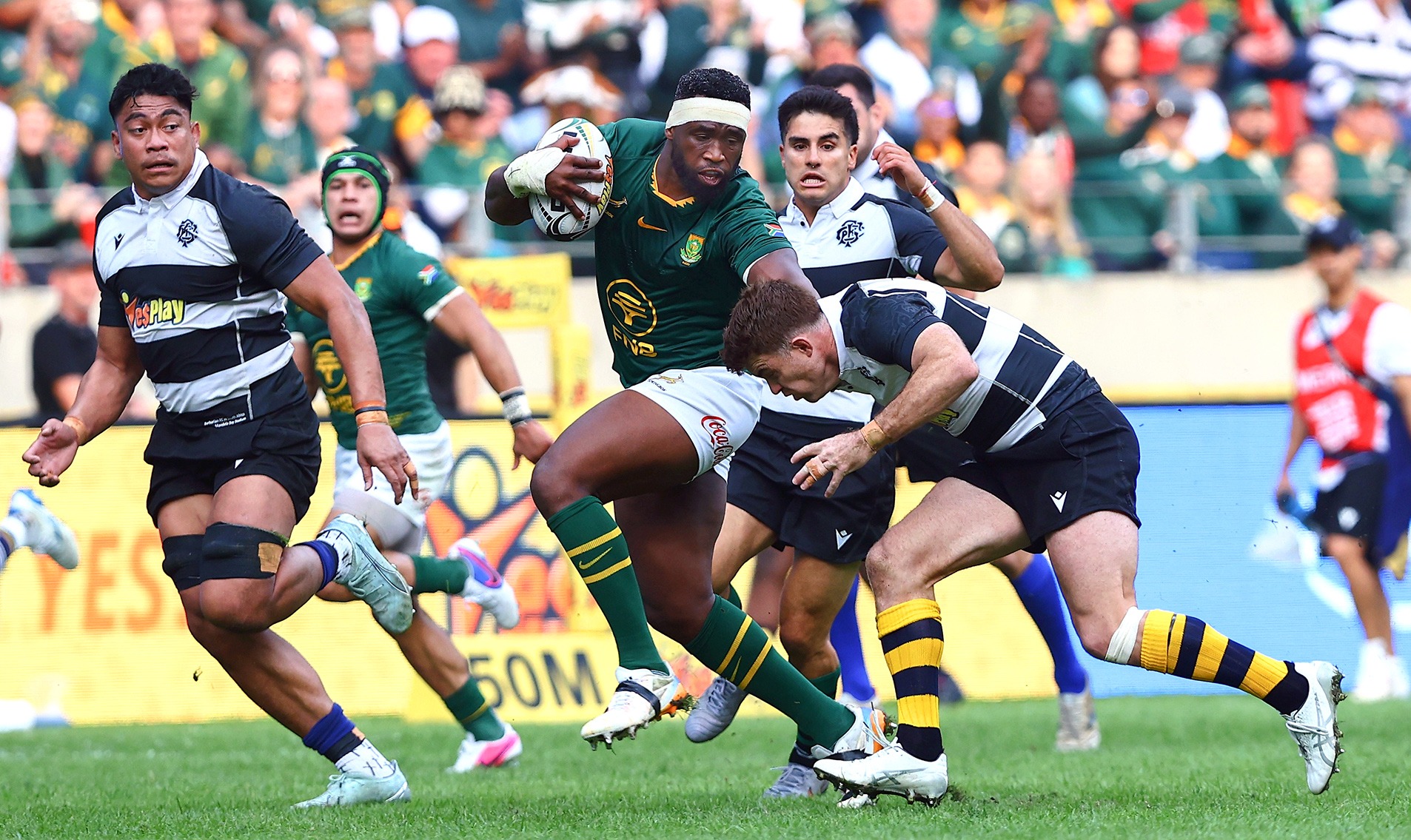
 Siya Kolisi of South Africa carries the ball during the YesPlay Cup match between the Springboks and the Barbarians at Nelson Mandela Bay Stadium on 20 June 20 2026 in Gqeberha, South Africa. (Photo: Richard Huggard / Gallo Images)
So much has been said and written about the set-piece battles and aerial kicking contests that will influence the Greatest Rivalry Test series between the Springboks and All Blacks over the next four weeks.
Meanwhile, the unstructured elements of the game have received relatively little air time, in spite of the All Blacks’ appetite for heads-up rugby and Rassie Erasmus’s Boks being one of the sport’s leading counter-attacking teams.
Though a strong set piece remains crucial to success, the modern game is largely shaped by the fight for “scraps” or “crumbs”. It’s in these chaotic and unstructured moments that the best teams shine, converting an opposition error into a score at the other end of the park.
Former Zimbabwe flyhalf Kennedy Tsimba, who also represented the Cheetahs, Bulls and Bath at the turn of the century, says these moments are more prevalent than some may believe. What’s more, the better teams have developed strategies to prepare their players for the moments when defence transitions to attack and vice versa.
Tsimba, who works with the Bulls, universities and schools in the Pretoria area, has crunched the numbers to determine how much of the modern contest is played in transition. The findings of his wide-ranging case study are eye-catching and show why the Bulls, Boks and other leading teams are upskilling their players to react when the game loses structure.
Preparing for unpredictable scenarios
On the back of this research, the World Rugby Hall of Fame has developed “shift theory”. Tsimba’s framework has caught the eye of the sport’s governing body and the brains trust of the Springboks. Erasmus and assistant coach Felix Jones collaborated with Tsimba earlier this year – and more on this in a moment.
Tsimba told Daily Maverick that more coaches are realising how unpredictable the game has become.
/file/attachments/2996/713824203_18322207411278871_4223716918452366053_n_701260.jpeg)
“People are surprised when I tell them that 80% to 90% of the modern game is unstructured or unpredictable,” he said. “Whenever I present the programme to other coaches … we go through each facet of play.
“What happens if the first kick-off of the game is dropped by the opposition? Do you know what’s going to happen at every line-out, whether the opposition is going to contest or the hooker is going to miss his jumper? What’s happening to the loose ball in that scenario?
“Everyone does their pre-game analysis, but the research shows the game doesn’t always go according to plan, for your team or the opposition, and you have to adapt and take advantage when play breaks down.”
Tsimba highlights the most significant statistic: 48% of tries are being scored when a team transitions from defence to attack.
“Consider what this means for a defence coach,” he said. “Most defence coaches will be happy when their team defends well from line-outs, scrums and so on – but is that defence coach preparing the team for passes that bounce or high balls that ricochet?
“The data shows that a lot of tries are being scored from these situations, so while your structured defence needs to be good, your shift defence also needs to be in place… Often, teams will look at how much possession they get from scrums or line-outs, but transition is actually the biggest source of possession at the moment,” Tsimba said.
The Bulls were outplayed by Leinster in the recent United Rugby Championship final, but over the course of the season, head coach Johan Ackermann, Tsimba and the other staff members prepared the players for these scenarios. Although they fell short in the decider, the stats tell a story, as the Pretoria side finished the URC campaign with the most points in the tournament (640) and the second most tries (92).
Bordeaux Bègles secured their second straight European Champions Cup title via a similar approach, and Northampton Saints – one of the best transition sides on show – broke the English Premiership’s try-scoring record en route to glory.
Every team has its own game plan, but as Tsimba points out, the current laws favour specific strengths. “Key performance indicators are things like high kicks and defensive pressure. Those are going to lead to more dropped balls and contests for scraps, and again, those are actually opportunities for teams to create scoring chances.
“The rules have changed in recent years, and I’m sure World Rugby wants more points, tries and entertainment. What we’ve seen, of course, is more chaos, and the best teams are going to capitalise on that.”
Cognitive skills to the fore
Tsimba confirms that the Boks trialled one of his shift training modules – with the aid of a virtual reality headset – ahead of the match against the Barbarians in June.
The Boks posted clips of “the virtual training session” to social media, with Sharks utility back Luan Giliomee and Erasmus himself completing the drills while barefoot inside one of the rooms at the team hotel.
As Tsimba notes, transition scenarios are difficult and occasionally dangerous to replicate on the training field, whereas a virtual reality exercise is risk-free and can boost the learning process. “We’ve been collaborating with the Boks, and they have been giving myself and my developer feedback on several prototypes.
/file/attachments/2996/Chaos_717818.jpg)
“Much will depend on a specific head coach and what their game plan is driving, but at the end of the day, the coaches need to understand how to train adaptability in their players.”
As the example above suggests, the framework aims to amplify the players’ decision-making rather than their physical prowess. “Your cognitive skills have to be heightened,” Tsimba explained. “The less predictable the game is, and the more change there is over the course of a contest, the more the players’ recognition and reaction skills come to the fore.”
Instinct versus control
What does this mean for the Greatest Rivalry series between the Boks and All Blacks? The All Blacks will be reluctant to engage in an aerial battle that maximises so many of the Boks’ traditional strengths. On the flip side, the Boks might do well to avoid an unstructured contest where the New Zealand running game is at its most potent.
Tsimba agrees that the Test series will witness a clash of styles – but makes the distinction between unstructured rugby and a concerted effort to control the chaos.
“All Blacks coach Dave Rennie understands that the transition is very important. They enjoy it when the game is unstructured, but controlling the transition is very different, because you’ve got to apply pressure to force mistakes, and to create transition opportunities. And unlike unstructured rugby, which might rely on the natural instinct of the players in a certain moment, transition rugby can be trained and follows a shape.”
It remains to be seen how the Boks will take this forward in the coming weeks – and as far as their transition skills are concerned, they may only realise their full potential over the next 12 months.
“The game itself is ripe for innovation, and we’ve seen how Rassie and the Boks have been leading the way in recent years,” said Tsimba, who played alongside Erasmus at the Cheetahs in the late 1990s.
“In many ways, the Boks are already a transition team, and they are well placed to lead this revolution.” DM
This story first appeared in our weekly DM168 newspaper, available countrywide for R35.
/file/attachments/2996/DM-140826_950258.jpg)
Comments
Scroll down to load comments...