




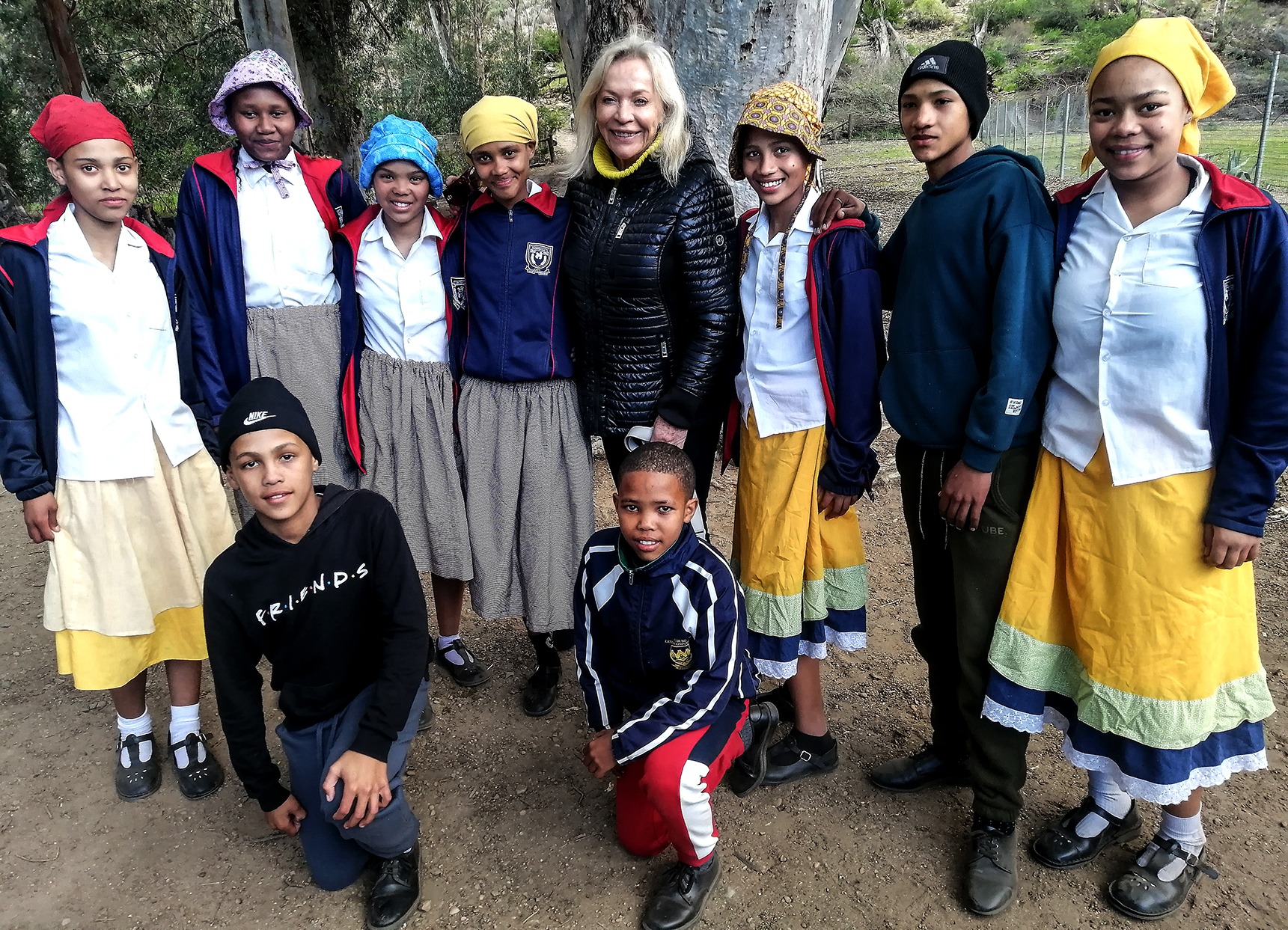
 Sandra Prinsloo (centre) with the Wüpperthal ‘rieldansers’. (Photo: Laurie Gaum / Juan Coetzee)
We have set off on a journey which will take us to about 13 communities around South Africa that were originally established as Christian mission stations in the 18th and 19th centuries. The “we” comprises interviewer Sandra Prinsloo, cameraman and editor Tim Wege, Juan Coetzee from the Stigting vir die Bemagtiging deur Afrikaans (SBA – Foundation for Empowerment through Afrikaans), and I, Laurie Gaum, as project manager.
Sandra is also deputy chair of the SBA board, and together we are on a mission to shoot documentaries about these communities and their specific variants of Afrikaans. This follows a series in which the SBA captured Bo-Kaap Afrikaans, Tankwa Afrikaans, Sabela Afrikaans (in prison), Tsotsitaal and Gayle Afrikaans (a queer version of Afrikaans), to mention a few.
/file/attachments/orphans/IMG_20260714_094738_243070.jpg "Sandra in conversation with Marshall Rinquest, Genadendal, with Tim Wege behind the camera.
<br>(Photo: Laurie Gaum / Juan Coetzee)")
First stop is, of course, Genadendal, which can write several firsts behind its name: one of the first printing presses in the Cape Colony; the first training of teachers; and Genadendal Dutch, which in 1816 had already distinguished itself from High Dutch while the Genootskap van Regte Afrikaners standardised Afrikaans only in 1875. The varied influences on “Genadendalafrikaans” range from Khoi, German and Dutch to Malay.
By 1799, Genadendal was the second-largest settlement in the Cape Colony after Cape Town, thriving like other Moravian mission stations as the “food basket” of the area.
Here on Die Werf (the churchyard), we meet those who have extended the local museum over decades with new themed exhibitions, the Moravian eerwaarde (minister), a school principal, a policeman and several other storytellers whose tales we record for this oral history project.
/file/attachments/orphans/IMG_20260713_173525_2_374256.jpg "Respairs being done to the Genadendal Moravian church.
<br>(Photo: Laurie Gaum / Juan Coetzee)")
We meet a mix of old and young, starting with Marshall Rinquest, who was recently featured in Daily Maverick, and become excited by his contemporary reappraisal of the “old ways”, teaching people locally and across our continent about sustainable, small-scale permaculture farming.
/file/attachments/orphans/IMG_20260720_161934_216452.jpg "The Goedverwacht Moravian church.
<br>(Photo: Laurie Gaum / Juan Coetzee)")
The next week we visit Goedverwacht near Piketberg, a somewhat more secluded Moravian community in a beautiful, fertile valley stretching up into a kloof. Here, industrious local tour guide Lorraine Cornelius takes us around. She has excavated her own heritage, laying bare the layered history of Goedverwacht and its origins connected to a handful of family names.
We are reminded that history is often messier than expected, with silences that are visited on consecutive generations. Lorraine has convened the community to share what she has found out about their roots, and this has been in itself an act of empowerment for the community, who are now able to take pride in their origin story.
At some stage, Sandra asks me what constituted the missionary endeavour. We get an answer via a definition from the Cape Synod of the Dutch Reformed Church, which considered mission work as the “Christianisation” of people of colour; therefore, to bring the gospel to slaves, labourers and the indigenous South African population groups. This belief was indeed embedded in the era in which it originated – influenced by the colonial era of which it was, some times more than other times, an extension.
These communities have been steeped in missionary and church culture. Their insularity is their saving grace from modern-day social ills such as crime and substance abuse, but they are also challenged to adapt in a contemporary connected and interdependent society.
/file/attachments/orphans/IMG_20260724_102319_765596.jpg "The Wüpperthal Moravian church.
<br>(Photo: Laurie Gaum / Juan Coetzee)")
Our last stop on this first leg of a trek that will take us later in the year to the Northern Cape and next year to the Free State, is Wüpperthal in the Cederberg Mountains. Burnt into the recent memory of the people living in this famous, but insular, picturesque village is the fire that ran rampant in 2018, destroying 53 houses. While the Rupert family has stepped up to contribute significantly to the rebuilding of most of the houses, it is as if the community is still reeling from more than one “plague” that has followed in the other’s wake: Fire, water, wind…
/file/attachments/orphans/IMG_20260721_101203_587890.jpg "Sandra with the Goedverwacht \"basuin-orkes.\"
<br>(Photo: Laurie Gaum / Juan Coetzee)")
Rebuilding the town’s industries seems essential, and here and there we see a spark of its rieldans (an indigenous form of dance) alluding to the unlocking of Wüpperthal’s magic. In our trip so far, we have also experienced on more than one occasion a practice session by the Moravian basuin-orkes (trumpet band), providing in Wüpperthal some much-needed extracurricular activity for young people.
/file/attachments/orphans/IMG-20260804-WA0004_851418.jpg "Sandra & Laurie with amongst other the two dynamic women \"eerwaardes\" of the Wüpperthal Moravian church, Salomé Rensburg-Bans and Indonesian Anugrah Llndawati Lankuy.
<br>(Photo: Laurie Gaum / Juan Coetzee)")
These reflections then stay with one after such bird’s-eye visits to these unique communities that originated organised around faith, or at least that formed around existing communities with the purpose of the latter’s evangelisation.
The European missionaries’ degree of success in meeting the already existing communities respectfully would, of course, have varied. In Georg Schmidt’s case during the first period of the mission at Genadendal, the encounter seems to have been quite commendable.
But if these mission stations provide a lens into community formation and how originally insular communities respond to changing circumstances, first that of a democratic South Africa and then as a microcosm of all the challenges South Africa is facing at present, how do they fare? Have the (Christian) values originally instilled in these communities assisted in their adaptation and survival today? Are these communities caught in the nostalgia of bygone times of which the aged are custodians, or are there signs of fresh energy and renewal, not only harking back, but also reinventing?
The validity of “evangelisation” and the understanding of “mission” today are indeed themselves in need of interrogation. The role of the church is furthermore key, at times perhaps as gatekeeper or with the potential to be a weaver of community. These communities, echoing many others today, are historically circumspect of inkommers (outsiders settling in the community), and the role and contribution of external agents therefore need further discussion.
For now, I’m looking out for the hope these communities may offer us. Or, if nothing else, for their being emblematic of how people grapple honestly with adapting to a fast-changing world, how they continue to connect over generations and the places of belonging they seek to create. DM
Laurie Gaum studied theology at the Universities of Stellenbosch and Cape Town, starting his ministry in 1997 in Gugulethu, Cape Town. He works with the nonprofit Genderworks facilitating workshops in gender and sexuality.
References:
Dyers, C. Sending en taal: die ontstaan en groei van Genadendalafrikaans in Tydskrif vir Nederlands & Afrikaans: 29th Volume (2022). 1st Edition.
Tweehonderd Genadejare 1824-2024: Die verhaal van die NG Kerk in Suid-Afrika (Sinode van Wes-Kaapland). Compiled by the Dutch Reformed Church in South Africa Archives (2024). Clairvaux Writer’s House, Wellington.
If you want to watch the SBA’s documentary series, keep an eye out for them at www.sbafrikaans.co.za. Also be on the lookout for more travelogues in Daily Maverick.
Comments
Scroll down to load comments...