




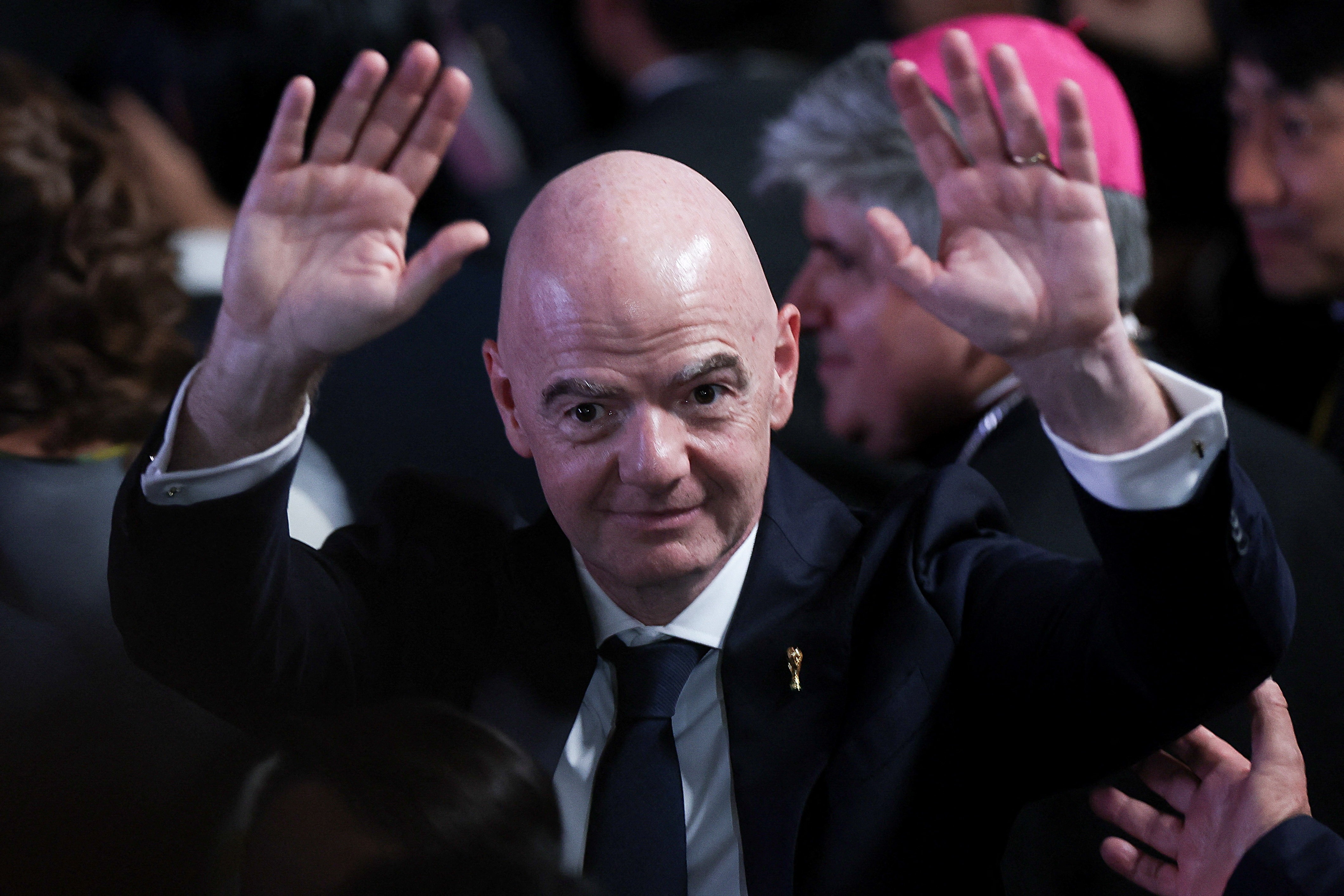
 FIFA President Gianni Infantino attends the inauguration of Abelardo De La Espriella as Colombia's president in Cali, Colombia, on 7 August 2026. (Photo: Luisa Gonzalez / Reuters)
Fifa president Gianni Infantino (56) would probably describe himself as an ambitious and innovative soccer administrator. However, his detractors would describe him differently, with “greedy” being the most likely adjective to be used when describing the incumbent boss of soccer’s global governing body.
Over the past few weeks, scrutiny and criticism have intensified around Infantino, and his role as Fifa leader is increasingly looking untenable. In fact, if it were up to confederations such as European body Uefa, Concacaf, which oversees soccer in North and Central America, as well as the Caribbean, and the Asian Football Confederation (AFC), Infantino would already be out of his seat.
The latest blast of heat on Infantino comes on the back of his audacious plan to sell off a stake of 20% to external investors through the Fifa Forward Enterprise (FFE). If the plan had not had a lifespan of just a handful of days because of the sustained, Uefa-led public criticism of it, Fifa would have created the FFE as a subsidiary.
External investors would then buy shares capped at 20%, with Fifa retaining the remaining percentage. This would have allowed the investors to have a say in major Fifa tournaments such as the various World Cups, including the global federation’s main moneymaker – the men’s World Cup.
Despite Fifa and Infantino ditching the plan, criticism directed at the experienced soccer administrator continues.
Critics apply pressure
One of the things that Infantino has had to constantly fend off during his 10-year tenure as the leader of Fifa is the accusation that he acts unilaterally when making decisions.
/file/attachments/2985/13557280_807602_e60a93990c89474690eecc222feaa6d1.jpg "Chelsea FC players lift the trophy as US President Donald Trump (5-R) looks on after winning the FIFA Club World Cup 2025 final match between Chelsea FC and Paris Saint-Germain, in East Rutherford, New Jersey, USA, 13 July 2025. (Photo: EPA/JUSTIN LANE)")
He faced the same accusation when Fifa expanded the Club World Cup from being an annual tournament with just seven participating teams to a quadrennial spectacle with as many as 32 clubs present. Although the expansion drew major criticism, Infantino rode that wave of backlash with the precision of a champion surfer.
His failed FFE plan will not be as easy to brush off or explain away.
“This is not about money. The confederations have already called for the responsible distribution of Fifa’s vast existing reserves to further strengthen investment in the development of member associations,” Uefa, the AFC and Concacaf said in a joint statement.
“Nor is it about any member association losing the support it has earned, despite the fearmongering directed at our membership to suggest otherwise. Nor is it about revisiting the expansion of competitions, World Cup allocations, or any other decisions reached collectively. Those decisions were made together, and they must stand.
“This is about something more fundamental: the integrity of the game, and the integrity of those elected to lead it. Leadership in football is not a possession. It is not about holding – or demanding – power to be held. It is a duty of service to the football family that entrusts it.
“When trust is broken through deception, when an individual places himself above the collective that entrusted him with authority, that duty has been abandoned,” they added.
“Fifa’s recent letter to its vice-presidents and 211 member associations acknowledges that mistakes were made in the process. It treats this as a failure of communication, when what football witnessed was a failure of judgement.
“A proposal advanced on a compressed timeline, without meaningful consultation and pushed towards a deadline before member associations could properly review its terms is not the product of an oversight; it is the product of a design intended to limit scrutiny.
“It did not acknowledge that the proposal itself was inherently wrong. There remains no recognition that attempting to sell an interest in the Fifa World Cup was a profound failure of judgement – not just a procedural misstep, but a fundamental breach of trust with the very institutions Fifa exists to serve.”
Of course, not all Fifa’s members are against Infantino. Even before the scrutiny that came as a result of the FFE, Confederation of African Football (CAF) president Patrice Motsepe publicly expressed his general support for the Swiss soccer boss, labelling him a “friend of Africa”. Since the furore around the FFE erupted, CAF has been one of the parties backing Infantino to remain at the helm of soccer globally.
/file/attachments/orphans/B26ADSM0081_532112.jpg "Fifa President Gianni Infantino and CAF President Patrice Motsepe during 2025 Africa Cup of Nations Last 16 match between South Africa and Cameroon on the 04 January 2026 at El Barid Stadium in Rabat. (Photo: Sydney Mahlangu/BackpagePix)")
“CAF will continue to focus on making African football among the best in the world and is reaffirming its commitment to adhering to global governance, transparency and auditing best practices. For us in Africa, adherence to governance, due process and transparency is crucial and non-negotiable,” the confederation stated.
South America’s confederation, Conmebol, also stands with Infantino. It has said it does not support calls for the former Uefa secretary-general to resign or be ousted by vote before Fifa’s next elective congress, its 77th, which will be hosted by Morocco in March 2027.
Infantino is seeking a fourth term. He was first elected in 2016 after the ousting of his predecessor, Sepp Blatter, because of allegations of corruption.
“On 18 November 2026, the deadline for submitting candidacies for the Fifa presidency will expire. Thereafter, the Fifa congress will elect, through the votes of its 211 member associations, the person who will lead the organisation during the next term, including overseeing the organisation of the Fifa Centennial World Cup,” said Conmebol.
“Accordingly, Conmebol will not support any action or procedure that disregards or departs from those institutional mechanisms … because, above all differences, football comes first.”
Infantino not moved
In spite of losing some support ahead of next year’s elections, Infantino seems intent on remaining in charge, as well as challenging for re-election for a fourth term.
Fifa has a three-term limit. However, since Infantino was parachuted into the role of president via an extraordinary congress because of Blatter’s departure, his first term was only three years (2016 to 2019) as opposed to the traditional four years. Hence he is allowed to run again.
Although Infantino has been under immense pressure, Fifa has pushed back against critics such as Uefa through its communications in support of him.
“It is increasingly evident that there is a concerted and ongoing effort by some to undermine Fifa and its president. Those who do not have the support of Fifa’s member associations should not seek to achieve through allegation, insinuation or misinformation what they cannot achieve through Fifa’s established democratic processes,” an unnamed Fifa spokesperson said in a statement.
“Recent reporting has included unsubstantiated assertions and demonstrably false claims concerning Fifa and its president. Speculation and insinuation should not be presented as fact, and repetition does not make an allegation true.
“Fifa welcomes legitimate scrutiny. But scrutiny is not a licence to distort facts, amplify unsubstantiated allegations or manufacture distractions designed to undermine progress.”
Regardless of Fifa’s stance, it is clear that there is a divide in global soccer’s leadership. But in his bid to stubbornly remain at the helm, Infantino will rely on the beauty of democracy. Despite being unwanted by some, he will depend on the “majority rule” concept come next year’s elections.
Infantino needs just 106 member association votes to return to his role. That is, if he is still around by that time. DM
This story first appeared in our weekly DM168 newspaper, available countrywide for R35.
/file/attachments/2996/DM-140826_950258.jpg)
Comments
Scroll down to load comments...