



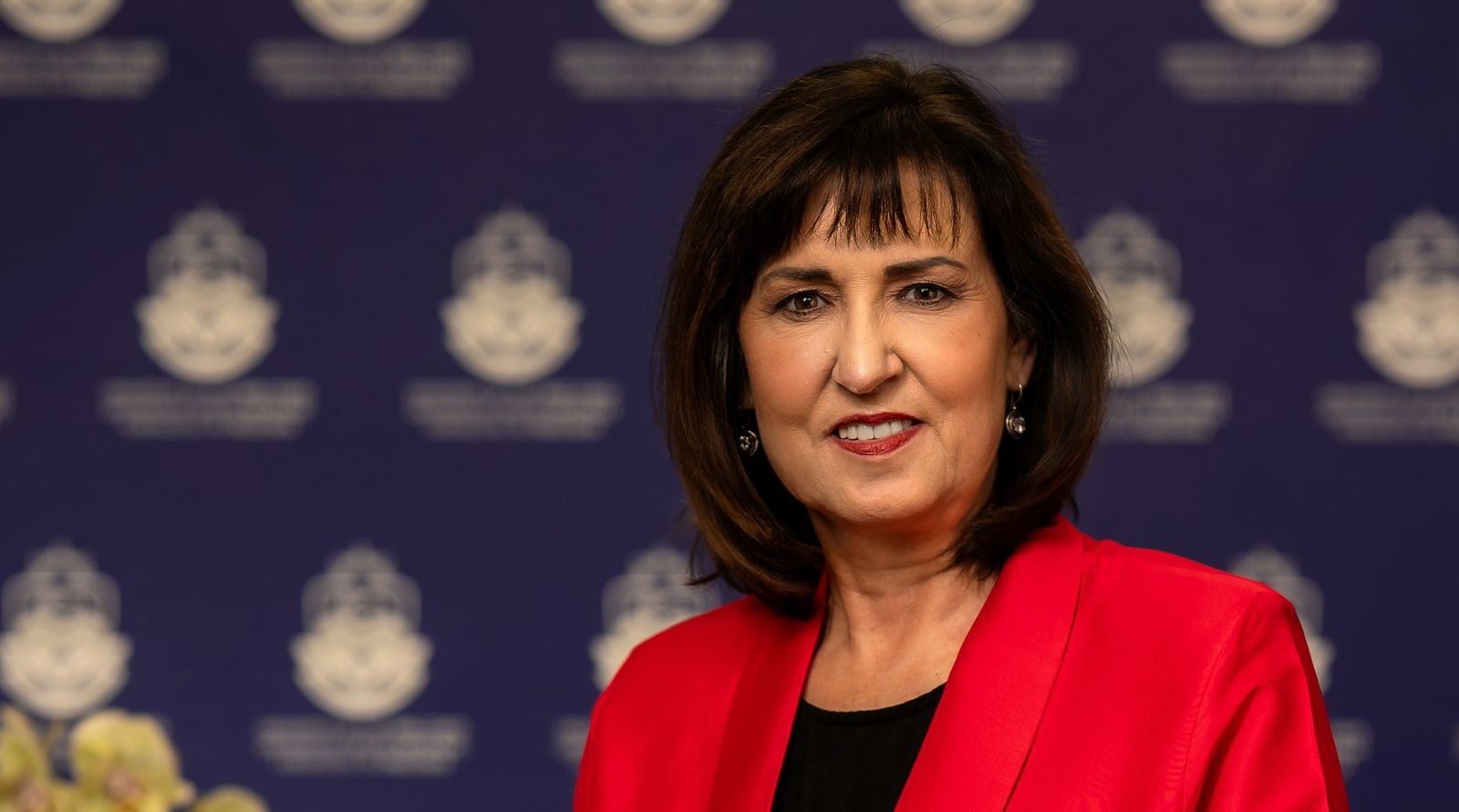
 Prof Hester C. Klopper, Vice-Chancellor and Principal of the University of the Free State
A first that set the tone
On 9 June 2025, Prof Hester C. Klopper was inaugurated as the 15th Vice-Chancellor and Principal of the University of the Free State – the first woman to hold the office in the university's 122-year history. For the university, this marked both a symbolic milestone and a celebration of the depth of leadership potential among South African women in academia.
Reflecting on her first year in office, Prof Klopper has spoken about ‘walking with purpose’ as a discipline of deliberate leadership and decision-making. That discipline has translated into a refined institutional strategy built around five priorities: advancing academic excellence and research impact, building institutional agility, nurturing a transformational culture, strengthening long-term sustainability, and accelerating collaborative innovation and global integration. Four transdisciplinary research themes now anchor the university's work: Sustainable Futures, Systems for Societal Advancement, Planetary Health and Well-being, and A Flourishing Life – themes that speak directly to the kind of complex, human-centred problems many women academics say drew them to research in the first place.
Prof Klopper's first year has also produced tangible wins that matter well beyond gender: the launch of the VC-ISRC Imbewu Legacy Fund – an initiative where she joined forces with student leaders to help remove financial barriers to student success, Platinum status under the Good Financial Grant Practice accreditation – the only South African university to achieve this, and rising positions in continental rankings, including ninth place in the inaugural QS World University Rankings for Sub-Saharan Africa. She has been direct about what leadership requires when things are hard: honesty about the sector's financial pressures, and a zero-tolerance stance on corruption, fraud, gender-based violence, and academic misconduct. But also, about the ‘heart-centred leadership’ she firmly believes in, focusing on and developing human potential first and foremost.
Among the initiatives Prof Klopper has been championing, one goes to the very heart of the Women's Month conversation: the pipeline of women rising through the university's own academic ranks.
Building a diverse professoriate
/file/attachments/2996/Phototwo_412659.jpg)
South African universities have long known that the ‘leaky pipeline’ for women in academia is not caused by a lack of talent. It is sometimes caused by prevailing gender bias and more often by a lack of structured support in the career stages when women are most likely to be juggling research output, teaching loads, promotion criteria and, disproportionately, caregiving and other responsibilities at home. The University of the Free State’s answer is the Transformation of the Professoriate Programme (TPP) – a mentoring initiative that has become one of its most consequential transformation projects.
Established to strengthen the pipeline of emerging scholars into associate and full professorships and academic leadership, the TPP runs across four coordinated streams. The Future Professoriate Programme (FPP) supports academics six to eight years post-PhD who are on the cusp of promotion to senior positions. The Emerging Scholar Accelerator Programme (ESAP) reaches earlier, working with academics one to five years post-PhD, while the Staff Doctoral Programme (SDP) supports early-career researchers completing their master's or doctoral qualifications. The tailormade Women Influencing and Shaping Education (WISE) initiative focuses specifically on mid-career women academics aged 40 and older who have not previously participated in a University of the Free State mentorship programme – precisely the cohort most at risk of being overlooked once early-career development opportunities have moved on.
The University of the Free State is proud to have the support of its Chancellor, Prof Bonang Mohale, who serves as Ambassador for the WISE programme. A passionate advocate for women's leadership and empowerment, Prof Mohale actively engages with WISE participants and continues to champion the programme through his commitment to its future initiatives.
The numbers tell their own story of momentum. Since 2019, 197 candidates have come through the ESAP and FPP streams alone, with active cohorts now numbering between 85 and 140 fellows at any given time. Selection since 2021 has deliberately targeted a quota of roughly 60% black and women candidates. Across all four programmes combined, 403 candidates have been supported. WISE – still in its early years – has already mentored 44 women academics through its first two cohorts, with a third cohort of 17 starting in May this year.
Success stories abound among those who have completed these mentorships. Of the 2019-2023 cohort of ESAP and FPP fellows still employed at the UFS, 84% have been promoted at least once in the past six years. WISE participants have posted a striking run of appointments in the past year alone: eight promotions to associate professor, new heads of department appointments, a research chair position, seats on national and international boards, and international keynote invitations. One WISE participant was nominated by the Swiss National Science Foundation for inclusion in AcademiaNet, a database of leading women academics in Europe and beyond – one of only two South African scholars to be included.
Women advancing with purpose
/file/attachments/2996/Photothree_551361.jpg)
Dr Lucia Meko, Head of the Department of Nutrition and Dietetics in the School of Health and Rehabilitation Sciences, joined the Future Professoriate Programme in 2019. The workshops and engagement with colleagues and the rectorate, she says, broadened her perspective and strengthened the networking and communication skills that prepared her for her current role as head of department. That growing confidence, she believes, is part of the reason she was appointed to the board of the Nestlé Nutrition Institute of Africa in 2023, and more recently as a trustee of the Tiger Brands Foundation Board.
Dr Meko is candid about the gender barriers that remain. “Women still face challenges as primary caregivers compared to our male counterparts. This is something that is difficult to explain, but it is a lived reality,” she says. “As women, we are the ones taking care of our children and sometimes our parents. This takes away time from work and often these responsibilities come with a sense of guilt when one has to take time to care for sick children or when you miss out on attending extramural activities.”
She believes that women's instinct to care makes them natural mentors. However, the competitive pressures and time constraints of academic life can complicate that role. She has seen women leaders act as roadblocks to other women's progress – but, in the same breath, she credits the women mentors who helped her get where she is.
Prof Petra Maass, Associate Professor of Basic Medical Sciences in the Faculty of Health Sciences, moved through both the ESAP and Future Professoriate streams. For her, the greatest value lay in the peer network the programme built – contact not only with UFS colleagues navigating the same early-career pressures, but with experts in her field, forensic anthropology, at other institutions. That network, she says, boosted both her academic growth and her personal confidence. It also had a direct, measurable outcome, namely her 2025 promotion to Associate Professor, which was achieved with the programme's help in identifying and closing gaps in her promotion application. She also believes that gender-skewed obstacles remain a reality.
“Despite significant progress, women are often still bluntly told that some aspects of work are ‘not for them’ or that they should just accept that some students will simply refuse to pay her the same respect as an equally or even less qualified or experienced male colleague,” she says. She has also experienced that women who are assertive and driven are too often read as cold or aggressive for pursuing opportunities the same way a male colleague would. She agrees with Dr Meko that women are natural mentors. She has found them to have a more perceptive, caring approach, and that both students and junior staff often gravitate towards women mentors.
Delivering on gender transformation
The University of the Free State puts a lot of care into its mentoring initiatives – constantly reviewing and refining them. Recent developments include introducing an industry mentoring component, aligning with the university’s goal of building an entrepreneurial ecosystem. It reflects an institution that has looked squarely at where women get stuck in the academic pipeline, and built distinct, well-resourced interventions to meet them at each stage.
Under a Vice-Chancellor who believes in investing in people as the foundation of institutional success, this pipeline work sits inside a broader strategic vision aimed at ‘responsible societal futures.’ This vision is backed by fund allocations, promotion statistics, and the testimony of the women moving through the system.
The result: A university that deliberately and measurably helps women lead. DM
Contact us:
Bloemfontein Campus: +27 51 401 9111
Qwaqwa Campus: +27 58 718 5000
South Campus: +27 51 401 9111
UFS social media