




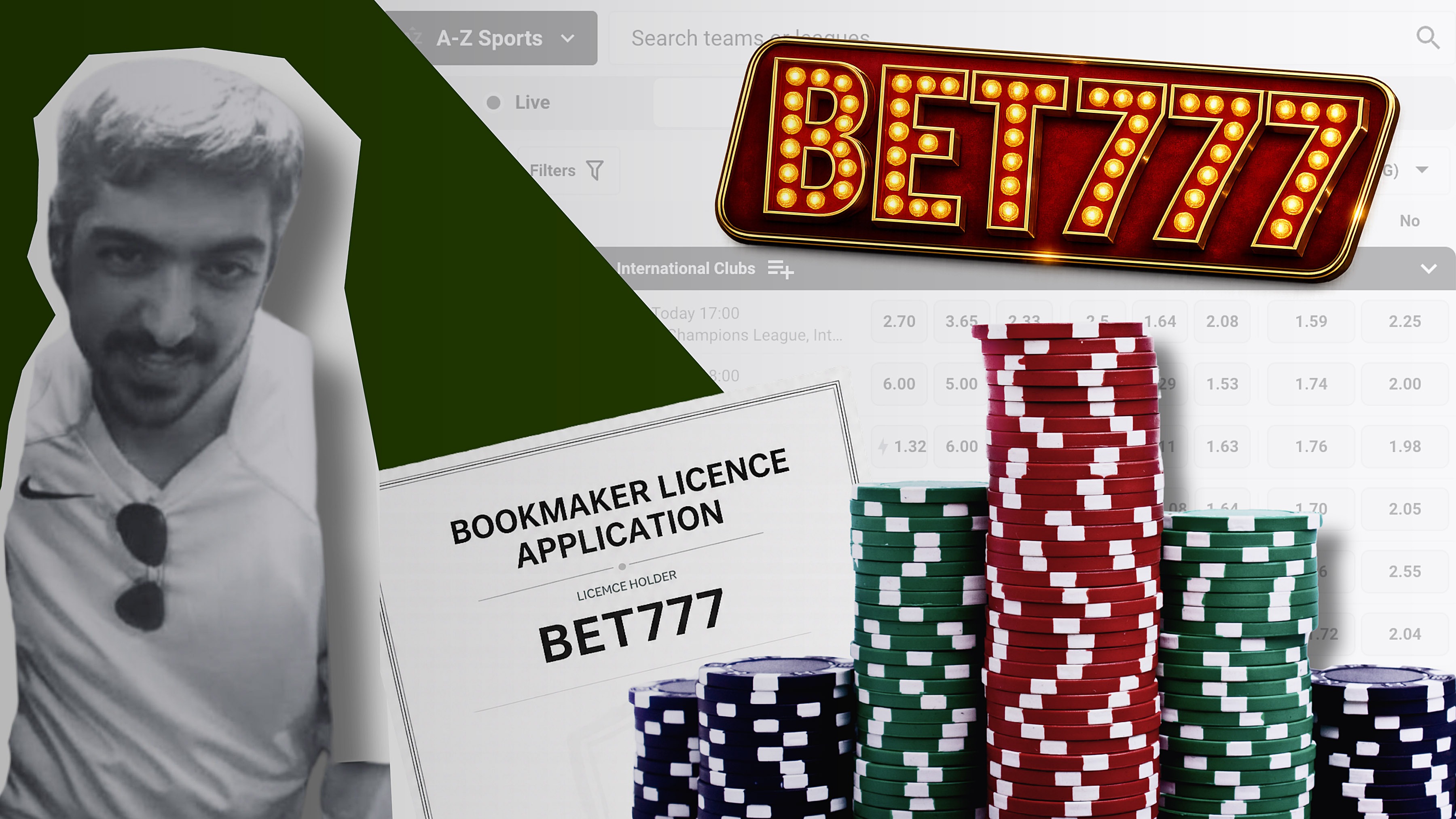
 Maor Yehudai, owner of Bet777, which applied to acquire a Western Cape bookmaker licence in February 2026. (Supplied / Canva / Envato)
In February this year a regulator, the Western Cape Gambling and Racing Board, announced the planned sale of a bookmaker licence to a newly formed company called Bet777.
Six months down the line, the regulator told us that this transaction is “still under investigation” – despite the applicant (Bet777), as we will show, raising countless red flags around possible fraud and money laundering that should have made for an obvious rejection.
If nothing else, what follows shows us that SA’s burgeoning online gambling industry can very likely be a honeypot for bad actors.
The regulator has been dishing out licences despite mounting concerns about the social and economic impact of the country’s snowballing gambling epidemic.
It is hard to gauge the full extent of this because that regulator refuses to even tell us who it has given licences to.
But with this application authorities risk doing more than paving the way for yet another gaudy online casino exploiting people’s hopes and desperation.
This time the applicant appears to have links to an alleged international syndicate of scamsters who would need one thing in particular: cover for a constant torrent of small payments that may otherwise raise all sorts of flags.
Which is to say, just the kind of thing an online casino is good for.
We know this because the owner of Bet777 is listed as Israeli-South African Maor Yehudai, a man whose 2022 legal battle with banking group FirstRand seemingly inadvertently exposed how he was a cog in an international cryptocurrency trading scam.
In this role, two of his other companies secretly provided a payment system for the crypto and forex “trading” that victims believed they were doing.
But this is just the first layer of the onion.
As it turns out, the Yehudai company secretly supporting the crypto scheme is also part of a multinational network allegedly doing a similar thing.
In other words, it was part of a network of companies seemingly offering “legitimate” online services that were also allegedly involved in providing infrastructure and payment-processing services to fraudulent investment operations. (In fact, the system strongly resembles another, also Israel-based, syndicate which amaBhungane, alongside a number of peers around the world, exposed last year and dubbed Scam Empire.)
And although details are scant, Yehudai has other odd connections that raise further questions and red flags.
Earlier this year Yehudai emerged as a “consultant” to the attorneys of Joseph Willah Mudolo, an alleged accomplice to the infamous self-proclaimed prophet Shepherd Bushiri.
Bushiri has fled the country but Mudolo remains in SA while fighting a running battle for a relaxation of his bail conditions that would allow him to travel to his native Zambia, despite the obvious flight risk.
Mudolo has tried to get the judge presiding over his case to recuse himself. It was in these proceedings that Yehudai emerged as an adviser whose expertise served an unknown function.
The law firm in question, Matojane Malungana Inc, told us it could not divulge any details but confirmed that one of Mudolo’s “erstwhile” attorneys at the firm consulted with Yehudai.
Various attempts to reach Yehudai to put all these allegations to him were unsuccessful.
To understand why Yeduhai running an online casino is a worrying prospect that one would have wanted regulators to block straight away, we have to start with the way, back in 2022, his banking legal battle revealed his connection to a fraudulent crypto scheme.
The chargebacks
Yehudai used to run at least two South African emigration support websites – GoodAdvise.co.za and express-canada.co.za – that, via a call centre, in the main promised to help people get North American visas.
In court papers Yehudai described the operation as a subsidiary of an unnamed group in Israel which was set up in SA due to high demand for emigration to the US.
The part about an Israeli parent company was at least true.
/file/attachments/orphans/1Links_965907.jpg "Links.
<br>(Image: LinkedIn / Supplied)")
As we will see, his websites were part of a conglomerate of similar visa schemes soliciting money from aspirant emigrants to the US all over the world.
This conglomerate has recently come under scrutiny by investigative journalists at Swedish digital rights organisation, Qurium, as well as the Australian ABC Story Lab.
Let’s shelve that for now.
The underlying company providing the visa service in SA was called MSG Marketing – and it and a sister company both banked with First National Bank (FNB).
In early 2021 FNB raised concerns about “excessive chargebacks” on the local companies’ accounts. A chargeback is when someone who paid money into a recipient account via their own bank requests a refund. This can be for all sorts of reasons, from accidentally paying the wrong person through to suspected fraud.
At Yehudai’s operation these came thick and fast with 117 chargebacks worth R3.8-million racked up in less than a year.
But the real clincher was a single client in Hong Kong called Yos Sae Ma who seemingly made gratuitous use of Yehudai’s company and then followed through with multiple chargeback requests via her Chinese bank.
In May 2021 FNB received an email from transaction processor PayGate, flagging this client’s worrying use of MSG Marketings “immigration services” – R1.5-million in less than two months using one card and R285,900 using another.
The next day FNB froze Yuhudai’s company’s account and set in motion a court case that would only reach finality last year. The case revolved around the technicalities of when and for what reason a bank can suspend an account based on excessive chargebacks.
Far more interesting is the evidence FNB ended up putting in the court record showing how Yehudai’s business was not what it seemed at all.
The mysterious ‘evidence’
First off, before the case got off the ground, Yehudai tried to justify Yos’ massive payments and subsequent chargeback requests.
He managed to come up with “proof” that her payments were both legitimate and were in fact for immigration-related services.
Said proof: a photo of a woman holding up a handwritten letter reading: “I Yos Sae Ma hereby declare that the transactions that I’ve made with card that end [Sic] with 6065 and 9107 were done as part of the Visa process, the large number of the transactions was due to cards limitations.”
The letter included an ID card and Yos’ signature.
/file/attachments/orphans/2YosSaeMaDeclaration_113594.jpg "Yos Sae Ma Declaration.
<br>(Source: Supplied)")
Later on this “proof”, however, suffered a severe blow.
FNB was clearly not convinced. A few months later, with a dispute in full swing, it came up with an actual complaint from Yos requesting chargebacks through her bank, China CITIC Bank.
Spoiler alert: it did not involve Visa applications.
Instead, Yos said that her chargeback requests were related to her use of a cryptocurrency trading platform called Gloffix which, she said, wouldn’t let her withdraw the funds she had deposited unless she would “keep trading”.
/file/attachments/orphans/3YosSaeMaComplaint_640447.jpg "Yos Sae Ma Complaint.
<br>(Source: Supplied)")
This already bears an unmistakable resemblance to schemes we uncovered last year in our Scam Empire reporting.
The information coming to FNB from Hong Kong was very detailed, including transaction records, written statements from Yos as well as an “expert opinion” she seemingly commissioned.
When presented with some of Yos’ information in court Yehudai pivoted somewhat.
“While acknowledging that GLOFFIX is a Turkish company which is associated with [MSG and its associate] and trades in cryptocurrency … [MSG and its associate] confirm that they have never traded in cryptocurrency. However, [MSG and its associate] did assist GLOFFIX to facilitate payments from their clients by the use of [MSG and its associate’s] facilities.”
This would in itself be enough to land Yehudai in serious trouble since MSG Marketing had never applied for a transactional account for the purposes of trading financial products – not a trivial requirement considering the extensive surveillance requirements in the banking industry.
In the court case FNB invoked the rules imposed by bank card behemoth Visa around the declaration of the purpose of accounts.
For the purposes of the FNB case Yehudai conceded that he has been “advised that the applicants ought not have permitted their nominated banking accounts to assist GLOFFIX, but in any event, [reiterated], as stated above, this issue is irrelevant to the issue to be determined in this application”.
That argument turned around the narrow issue of whether FNB was entitled to hold onto his money until the chargeback disputes were settled.
Suffice to say the original case and a subsequent appeal went against Yehudai.
But back to revelations from Hong Kong.
Gloffix
As mentioned, Yos in Hong Kong was in fact not paying for visa services. She was paying money into a cryptocurrency scheme called Gloffix about which little was said at this point except that it was, according to Yehudai, a Turkish company.
Even that wasn’t entirely true, as we’ll see.
Yos’ experience, however, mirrored the plethora of desperate complaints of victims of the Scam Empire scheme we covered elsewhere.
Apparently she had clicked on a Facebook ad and before long was called up by an operator guiding her into opening a Gloffix account to ostensibly trade financial products. Like many before (and after) her she ended up paying large amounts of money into what seemed like a legitimate trading platform.
/file/attachments/orphans/4DefunctGloffixwebsite_585852.jpg "Defunct Gloffix website.
<br>(Image: Supplied)")
She ultimately claimed that the whole thing was a fraud with the interface being essentially a game with no actual trading taking place. Whatever the case, the main issue was that she was not allowed to withdraw her “deposits” hence her attempts to do so via chargebacks instead.
A closer look at her bank statements, however, revealed that the payments were being processed by a number of obscure merchants – MSG Marketing among them – that had no obvious connection to Gloffix.
After FNB shut down MSG’s accounts in SAa, Gloffix switched to a handful of alternative payment facilitators.
Notably, Yehudai’s company MSG here already finds itself in august company.
One alternative facilitator Yos’ payment got directed through was the Slovakian Global DLT Exchange, which has been identified many times as the payment processor for more than one of the world’s mushrooming “online trading” scams.
/file/attachments/orphans/5Tables_749010.jpg "Tables.
<br>(Source: Supplied)")
Back to Gloffix.
The trading platform had no licence to operate in any jurisdiction and has been subject to regulatory alerts in the UK and Spain. The internet is full of review sites where “traders” give accounts of their losses more or less identical to Yos’.
The platform’s site has now been scrubbed off the internet. The Internet Archive’s Wayback Machine, however, captured the site when it still existed and it provides a crucial clue about who we are dealing with.
Gloffix was, according to its abandoned website, operated by a company in the Marshall Islands called Advantiq.
On the money trail: MSG –> Gloffix –> Advantiq
To sum up, Advantiq was the mystery operator of the alleged scam website Yehudai’s South African “immigration service” was secretly providing transaction services to.
Advantiq may very well be registered in the Marshall Islands, but its address was listed in London.
And at that address, an apartment in a desirable part of the city, public records show 25 different companies registered – including some very interesting ones.
For instance, one of them is Sipay Ltd (not to be confused with the Turkish payments company of the same name). This is one of the other merchants used by Gloffix to accept payments alongside MSG Marketing.
Other roommates in the London apartment include a list of unsavoury global operations.
First there is Gloffix itself – or rather the actual underlying company called Gloffix Global Ltd (which has been renamed Neosava International Ltd).
There are also a number of other online scams that have been flagged and shut down including ones called BalFX, CIO Markets, Hadef Capital, International Fidelity, Kuveyt (Kuwait) Trader, Money Trade FX, Omnia Markets, Optimum Global Markets, Omnia Markets and Skyline Ecommerce LTD, which was flagged in Austria as a fraudulent “debt collector”.
This collection of companies seems to represent the tip of the iceberg for a whole different scam syndicate with a strong Turkish slant.
So while the corporate entity Gloffix was not registered in Turkey, Yehudai seems to have been truthful insofar as he was providing back-end transactional support for a network of companies targeting that country.
That’s not very unusual. Our experience with the Scam Empire investigation is that service providers, like payment processors and the providers of telephonic services to the “boiler room” call centres that contact victims, often have more than one master.
Which brings us to the second layer in the onion in which Yehudai operates – or at the very least has operated in.
Welcome to America!
As mentioned, the payment services secretly provided to the crypto scam Gloffix were ostensibly for a visa consulting service consisting of at least two websites targeting South Africans.
Included in the court papers is a letter from Yehudai’s lawyers to FNB in which they claim that the near R4-million in chargebacks FNB had flagged “equate to a fraction of the revenue generated” by the immigration service.
Yehudai also makes mention of the “sheer number” of transactions the now-defunct business processed.
It does not look great that his website Goodadvise has been heavily lambasted as a scam in online consumer review forums and subsequently taken down.
/file/attachments/orphans/6ScreenshotofdeadwebsiteforYehudaisvisaservicegoodadvise_262066.jpg "Screenshot of dead website for Yehudais visa service goodadvise.
<br>(Screenshot: Supplied)")
But who was Yehudai ultimately working for?
In the court papers he says that MSG had a parent company in Israel, which he did not name, but which provides the same kind of visa services internationally.
Also in the court file is correspondence where Yehudai uses an email address indicating that this Israeli company is in fact Go-Be Marketing, a company co-founded by an Israeli, Shefi Goldberg.
Among Goldberg’s previous ventures was a proposed “immigration” cryptocurrency called Immi-coin. The business plan for this is still available on the internet and gives a sense of the group’s larger footprint.
According to the business plan the Go-Be group has 100 people manning call centres in not only SA but also Israel, the Philippines, Cyprus and Spain with access to “a database of over 1 million potential immigration clients”.
Investigative journalists in Sweden and Australia have been on the Israeli company’s trail for a while and enlisted amaBhungane’s help with the South African leg of the larger drama.
In Australia, ABC found the initial indication that Goldberg has a wider involvement in the payment system for online scams. A victim of a fraudulent platform saw their sign-up payment running through a company called Trigo XO.
When ABC’s journalist pursued the putative owner of this company they ended up on a video call where Goldberg joined and said all questions should come to him.
Goldberg later told ABC: “I have no knowledge whatsoever of who this group is or who its clients are.”
On the central allegation that the Goldberg network was involved in processing fraudulent payments for a major scam network, Goldberg said he was “never involved in processing any of such payments” and denied any unlawful conduct.
In a way the kind of business Yehudai allegedly legitimately ran, a call centre giving visa advice, is a great cover for this kind of trading scam because it involves essentially the same back-end infrastructure.
Alternatively, the two “services” overlap and coexist.
Either way, this brings us back to where we started: Maor Yehudai’s entry into the regulated South African gambling industry via a brand-new licence applicant called Bet777.
Hiding in plain sight
The resemblance between online gambling and, for instance, something like MSG is obvious.
A legitimate business constantly processing a torrent of small payments would arguably be the perfect hiding place for something like the fraudulent trading platform Gloffix, which had transactions hidden in MSG’s bank accounts.
As SA mulls new ways to curb the runaway growth of the online gambling industry, the question arises: How are people with Yehudai’s history even getting a foot in thedoor?
What kind of due diligence actually gets done?
The relevant regulator is the Western Cape Gambling and Racing Board – the single most prolific issuer of licences in SA’s system of provincial gambling regulation.
As mentioned at the outset, the board has refused to provide amaBhungane with information about who even has been given licences, indicating a severe lack of transparency.
The Western Cape Gambling and Racing Board also told us that Yehudai had in fact declared his court case against FNB, although this has clearly not led to his Bet777 being outright denied a licence.
The Western Cape Gambling and Racing Act prescribes a “fit and proper person” hurdle which requires that the board determine that a licencee’s “character, integrity, honesty, prior conduct, regard for the law, reputation, habits and associations do not pose a threat to the health, safety, morals, good order and general welfare of the inhabitants of the Province”.
The board also says that it has in the past rejected applications, but did not say how many or for what specific reasons.
Given the internationally acknowledged association between gambling and financial crime a severe level of interrogation is arguably imperative before someone is allowed to wield a gambling licence. DM
This story was produced by the amaBhungane Centre for Investigative Journalism. Sign up for their newsletter.
Comments
Scroll down to load comments...