




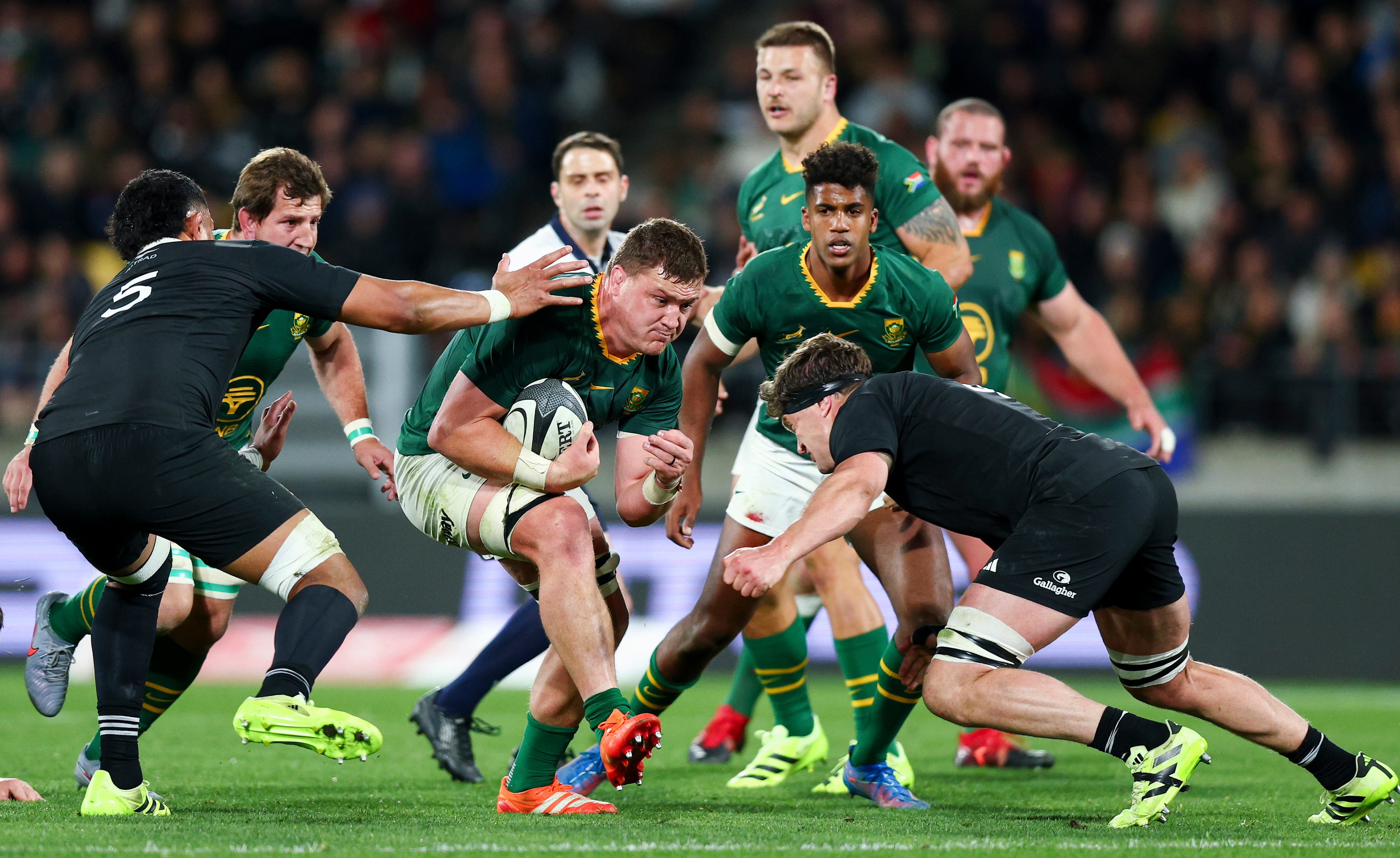
 Powerful Bok No 8 Jasper Wiese on the charge against the All Blacks during The Rugby Championship at Sky Stadium in Wellington on 13 September, 2025. (Photo: Hagen Hopkins / Getty Images)
With nine days to the first Test between the Springboks and All Blacks, the narrative coming from the New Zealand camp is screaming: “Speed the game up.”
There is a suggestion from the All Blacks coaching staff that they are the “saviours” of rugby, that theirs is the only style worth pursuing and that fans, administrators and most importantly, referees, should take the same view.
There is nothing the All Blacks would like more than for rugby to be played like it was in 2015 when they ruled the world with superior skills and superior conditioning.
/file/attachments/2996/495385878_931418.jpg "LONDON, ENGLAND - OCTOBER 31: Ma'a Nonu of New Zealand makes a break during the 2015 Rugby World Cup Final match between New Zealand and Australia at Twickenham Stadium on October 31, 2015 in London, United Kingdom. (Photo by Stu Forster/Getty Images)")
Back then the talk was all about ball-in-play time and multi-phase play. New Zealanders were the best team, so it followed that the world should try and emulate the way they played to become as good as them.
The folly for followers, though, was that the high-paced, multi-phase passing game the All Blacks of a decade ago played, and the one the All Blacks of today under Dave Rennie are starting to play again, was underpinned by superior skills.
New Zealand rugby, from junior structures, places a huge emphasis on ball skills, speed and movement. The problem for the chasing pack was that at the highest level, they simply could not match the skills and pace for long enough periods without errors.
Against an All Blacks side that also had an excellent defensive system, which placed massive pressure on the opposing players’ skill sets with ball in hand, it was fatal. Opponents often coughed the ball up and the All Blacks, in turn, thrived on the broken play it created.
Change the narrative
When Rassie Erasmus became the Springboks’ head coach, he and former Bok coach Jacques Nienaber quickly identified that beating the All Blacks at their own game was a fool’s errand.
At least it was in 2018 and 2019. Erasmus and Nienaber, who earned the collective moniker “RasNaber” between 2020-23, knew that to beat the All Blacks in the short-term, an opposite approach was needed.
Tactical kicking has always been part of rugby, so have set pieces. But RasNaber doubled down on using tactical kicking as an attacking weapon in conjunction with superior scrumming and lineout work.
/file/attachments/2996/1034568260_188783.jpg "WELLINGTON, NEW ZEALAND - SEPTEMBER 15: Far de Klerk of South Africa kicks the ball through during The Rugby Championship match between the New Zealand All Blacks and the South Africa Springboks at Westpac Stadium on September 15, 2018 in Wellington, New Zealand. (Photo by Hannah Peters/Getty Images)")
They fixed the defensive system first over 2018 and 2019 and perfected a limited but effective aerial kicking game to win quick territory and regather possession more than 40% of the time in a good area of the field.
This tactical approach was also developed around changing laws (which we won’t get into here) and an acceptance that the generation of South African players at the time were not going to suddenly, en masse, become superior ball players to the All Blacks.
They had to find another way to beat New Zealand. Going toe-to-toe in a running battle with the All Blacks was never going to cut it.
In addition to the aerial kicking ploy, which was mostly off the scrumhalf (Faf de Klerk was a master at it), RasNaber added other subtle tactics such as slowing the game down by walking to lineouts. Stopping the All Blacks’ momentum was crucial.
Contestable kicks, the way the Boks used them, created broken field play, just as the All Blacks’ defensive pressure on opponents with inferior ball skills does. They’re two different roads to the same outcome – turnover ball from which to attack.
/file/attachments/2996/boks_ab_rassie_all_donuts_674030.png)
In the RasNaber era since 2018, the Boks have clashed against the All Backs 15 times, won eight, lost six and drawn one.
Not trying to beat the All Blacks at their own game has clearly worked, although the past two years have shown that the Boks can play with width and pace as well as anyone when they switch into attacking mode. They just choose not to do it all the time.
/file/attachments/orphans/2235159357_981809.jpg "Ardie Savea of New Zealand is tackled during The Rugby Championship match between New Zealand All Blacks and South Africa Springboks at Sky Stadium on September 13, 2025 in Wellington, New Zealand. (Photo: Joe Allison/Getty Images)")
Play like us
So, it’s no surprise then that the narrative coming from the All Blacks camp since they arrived in South Africa nearly two weeks ago for the Greatest Rivalry tour has been to paint themselves as the saviours of rugby.
They seem to be saying: ‘The All Blacks style is the only one that people like.’
These comments from All Blacks assistant coach and former skipper Tana Umaga back up this assertion.
“It’s no surprise how we want to play the game. We want to speed the game up,” Umaga said this week.
“It’s very frustrating for us when teams are visibly trying to slow it down.
“That’s something we all have to get aligned on: what kind of game we want to play, in terms of globally.”
/file/attachments/orphans/2289539185_928421.jpg "Tana Umaga Defence Coach of New Zealand All Blacks arrives for the Rugby's Greatest Rivalry match between Hollywoodbets Sharks and New Zealand at Hollywoodbets Kings Park Stadium on August 11, 2026 in Durban, South Africa. (Photo: Steve Haag Sports/Gallo Images/Getty Images)")
It sounds very much like the All Blacks want everyone to emulate their style because it’s perceived to be more aesthetically pleasing.
The sight of a Bok scrum putting opponents into rapid reverse, or Cheslin Kolbe and Damian Willemse ruling the air as they gobble up pinpoint aerial kicks, is actually jaw-dropping. Not all skills are the same.
The increasing whingeing from the All Blacks is an interesting take considering the Boks have won 31 of their last 34 Tests. That includes the last 12 in a row, and they have scored an average of more than five tries per Test since 2024.
The Boks beat the All Blacks 43-10 in Wellington last year. By the end, the All Blacks were doing everything they could to slow the game down to stop the green and gold tide.
That doesn’t sound like a team that plays negative rugby. The Boks and others just don’t play rugby in the way the All Blacks would like. The last time I checked, New Zealand didn’t own the sport.
Stormers coach John Dobson admitted that his team kicked and slowed the game where possible as a strategy during their 38-21 loss against the All Blacks. But he knew his team would be outgunned and therefore came up with a legal plan to give them the best chance of causing an upset.
It’s a different tactic designed to frustrate the opposition – in this case the All Blacks. And it’s clearly working.
“Both sides were pretty competitive post-tackle and what we know is we will have sides who will try and slow our ball down, so we played a fair bit of footy under penalty advantage,” Rennie said after the Stormers game.
/file/attachments/orphans/TL_2597836_939339.jpg "Yaqeen Ahmed of the Stormers and Beauden Barrett of New Zealand during the Rugby's Greatest Rivalry match between DHL Stormers and New Zealand at DHL Stadium on August 07, 2026 in Cape Town, South Africa. (Photo: Roger Sedres/Gallo Images)")
TMO dragging
Where Umaga and All Blacks supporters have a point, though, is the inordinate amount of time some Television Match Official (TMO) decisions are taking.
Still, do we want the right call or do we want the game to move faster?
There is also a growing social media campaign out of New Zealand that the referees appointed for the Tests are anti-All Blacks.
It’s a lazy assessment because it misses the point that the Boks have adapted well to the way the game is policed, as this assessment highlights.
“What is this game that we want to put out to our public? Because we can hear the public telling us ‘we love the way you’re playing’,” Umaga said.
“It’s great to see running rugby, yet I think we’re doing everything we can not to do it.
“The amount of stoppages in our game, the amount of people having a say on decisions.
“Look, our game’s a great game, when it’s played in the right spirit, and I think for what it was meant to be, how it should be played.”
/file/attachments/orphans/2182312888_613059.jpg "Former All Black, John Kirwan watches the New Zealand Captain's Run at The Lensbury on November 01, 2024 in Teddington, England. (Photo: Warren Little/Getty Images)")
Former All Blacks wing John Kirwan joined the chorus on the back of the New Zealand speed wagon, blaming the refs for the All Blacks’ ill-discipline against the Stormers that resulted in 16 penalties and three yellow cards.
“One of the disappointing things for me was the refereeing; for me it was just pedantic. I thought the yellow cards were marginal at best. To play any game with 13 is going to be tough, so I thought the refereeing was poor, and the All Blacks, rightly so, said we need to fix our discipline – and that’s true,” Kirwan said on the Rugby Rivals podcast.
“You cannot go through a game without that discipline; the discipline in the mid parts of that game will need improving, but I just pray that we don’t get referees that pedantic.
“World Rugby has lost control of what the referees want to do versus what our game wants to do.”
Has World Rugby lost control? Or have the All Blacks failed to adapt? DM
Comments
Scroll down to load comments...