




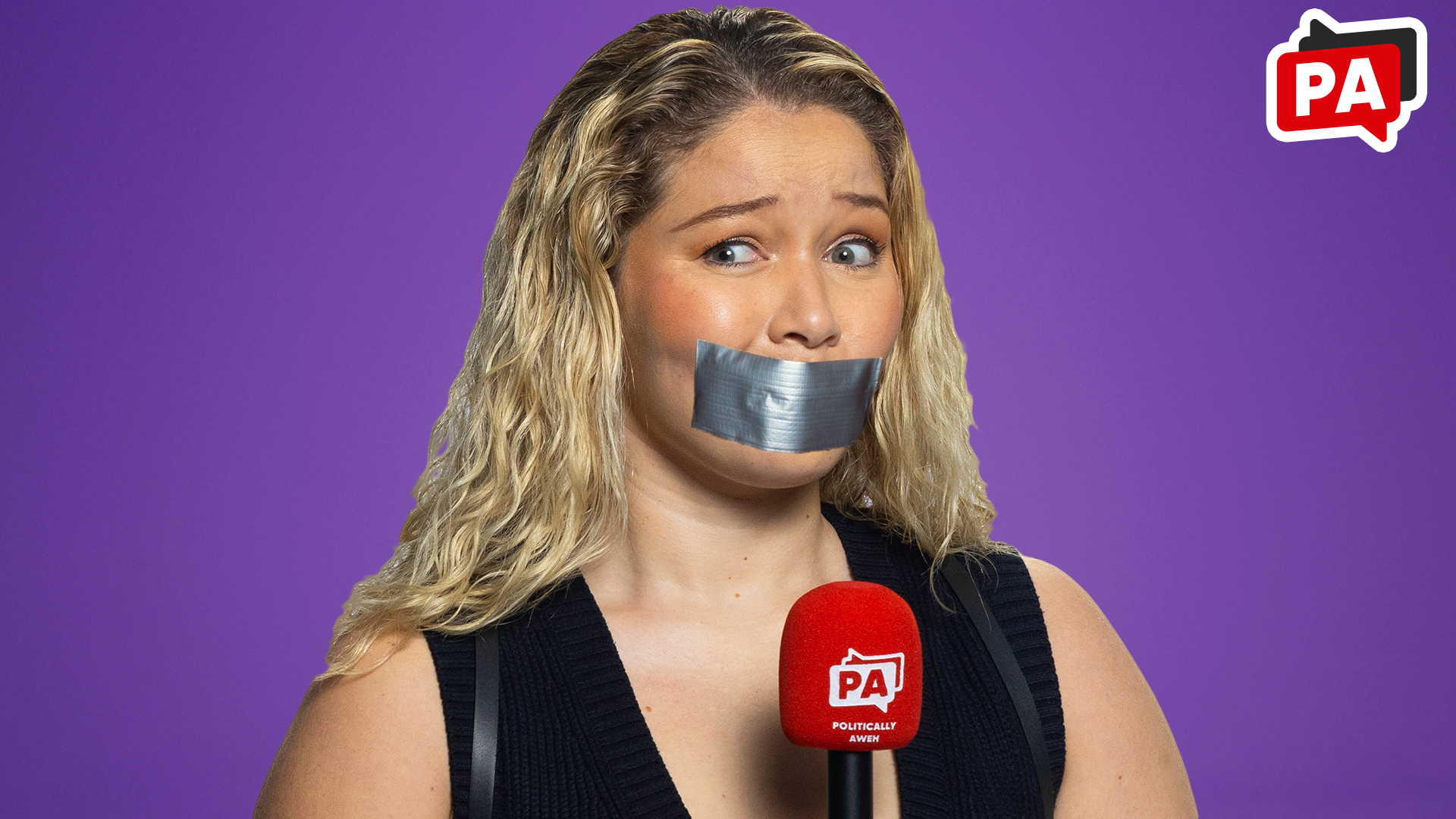
 (Illustration: Politically Aweh)
In honour of Women’s Month 2026, this week the satirical political podcast Politically Aweh shines a light on the sexism, disinformation and threats of violence perpetrated against the women who speak out in the political sphere in South Africa, to bully them into silence and acquiescence.
Ferial Haffejee, Associate Editor of Daily Maverick, was one of the first women in media who was exposed to this first-hand. “Very quickly it jumps from the ether into the real world.”
“The digital world isn’t separate from the real one any more,” says Politically Aweh co-host Zoë Barnes. “What starts with a post can become harassment; what starts with misinformation can become violence.”
“I’ve been threatened. It’s very scary,” admits Caryn Dolley, an investigative reporter who focuses on organised crime at Daily Maverick.
Political analyst Tara Roos received death threats so serious that she had to open a police investigation. “After I spoke online about the attacks that I received, there were many female journalists that also spoke up online and who contacted me to say they’d experienced the same thing,” she says. “I think threats like these are aimed at silencing people, and we should not be silenced,” she tells KG. “We should not be threatened for giving an opinion.”
Not that the SAPS would necessarily swing into dramatic Law & Order-type action, lights blazing and sirens blaring.
“In theory, the police should have hook-lines into these companies – to Twitter, or X, to Alphabet, which owns YouTube and Google, to ByteDance, which owns TikTok, Snap, which owns Snapchat, and to Meta. They all have these law enforcement takedown mechanisms which are supposed to fast-track requests for identification and removal notices,” says digital law expert Emma Sadleir. “But to be honest with you, if we go to the police in South Africa, they don’t even have email addresses. They don’t even have Wi-Fi.”
The problem is that the platforms hosting and often amplifying this abuse insist that they are not liable under South African law, says human rights lawyer and policy advocate Nicole Fritz. “We need to do a much better job seeking to hold the platforms to account for the crimes, the abuses, and the gross ills that we see perpetrated on these platforms,” she says.
In the meantime, let us celebrate our outspoken women in media and politics. They could have opted for a quieter life, but instead, they’re out there, undeterred, with their faces on camera and their profiles on X and their bylines proudly displayed. Because democracy depends on people who are willing to stand in the light. Aweh! DM
For more from Politically Aweh, subscribe on YouTube, visit their website or follow them on Instagram, Facebook, TikTok or X.
Comments
Scroll down to load comments...