




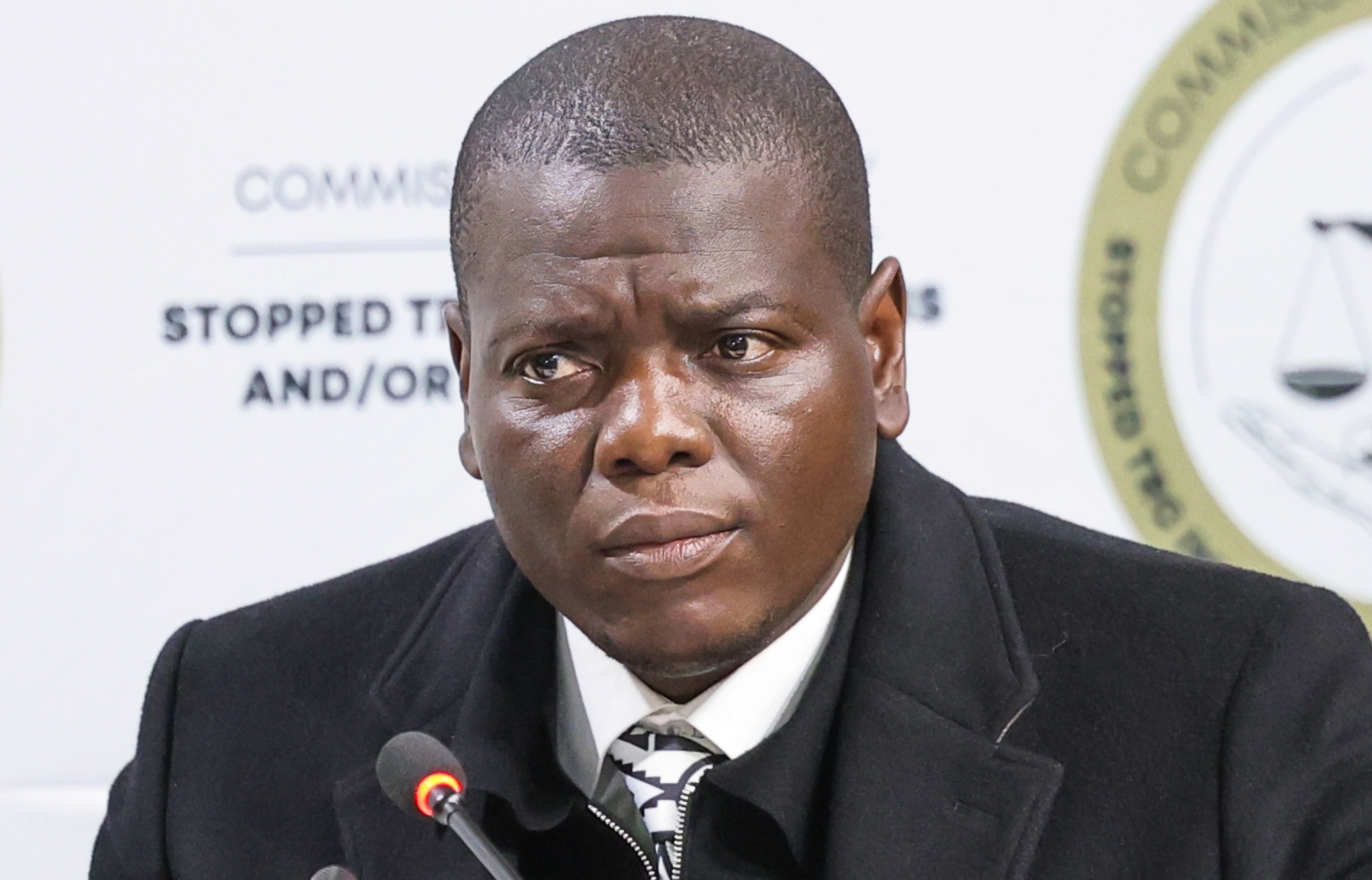
 Minister Ronald Lamola testifies at the Khampepe Commission of Inquiry at Sci-Bono Discovery Centre on 11 August 2026 in Johannesburg, South Africa. The inquiry was established to investigate allegations of political interference in the investigations of apartheid-era crimes. (Photo: Gallo Images / Luba Lesolle)
Ronald Ozzy Lamola, current Minister of International Relations and Cooperation and an MP, was minister of justice from 2019 to 2024 and told the Khampepe Inquiry on 11 August that several major institutional and case-specific successes had occurred during his term between 2019 and 2024.
Lamola was the fourth minister of justice tasked with the 30-year delay in the finalisation of outstanding TRC matters – a hard-won victory by the families of those whose human rights were violated by the state and who have demanded accountability.
Current Minister of Justice Mmamoloko Kubayi, appointed in 2024, testified earlier at the commission and denied any personal knowledge of alleged political interference in suppressing apartheid-era prosecutions.
Lamola told the commission that processes he had initiated included the successful engagement of the National Treasury to improve the National Prosecuting Authority’s (NPA’s) finances, strengthening investigative and prosecutorial capacity and overseeing the appointment of 23 dedicated prosecutors and 34 DPCI (Hawks) investigators. Additionally, the South African Police Service (SAPS) had committed 40 investigators, primarily retired officers, to assist with these matters.
Lamola added he had supported a shift in focus that led to directors of public prosecutions in various provinces assuming responsibility for TRC cases in their jurisdictions, allowing for local oversight and dedicated provincial teams.
There had been “a dramatic increase” in the volume of cases receiving active attention, he testified. By April 2021, 53 cases had been under active attention, and by March 2022 this had increased to 115. Further audits had identified an additional 57 matters, and three further cases were opened following representations from victims.
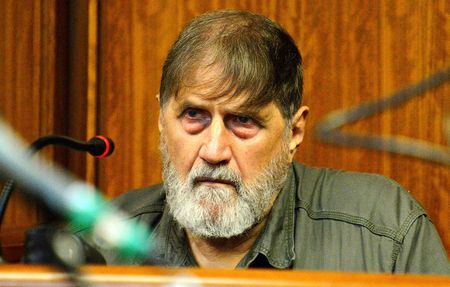
/file/attachments/orphans/ED_601773_566536.jpg "Former apartheid police commander Eugene de Kock testifies at the Cradock four inquest at Gqeberha High Court on March 23, 2026 in Gqeberha. The Cradock four inquest looks into the deaths of anti-apartheid activists, Fort Calata, Matthew Goniwe, Sparrow Mkhonto and Sicelo Mhlauli, who were abducted and killed in 1985. (Photo: Gallo Images/Die Burger/Lulama Zenzile)")
High profile cases
Lamola highlighted for the panel several high-profile successes in reopening inquests and the securing of convictions.
In 2025, former Security Branch and Reaction Unit officers were convicted for the murder of Caiphus Nyoka. Nyoka was a prominent anti-apartheid student leader and activist from Daveyton, Benoni. He was murdered by security police on 24 August 1987.
In November 2023, Gugulethu Madonsela was sentenced to 10 years for the murder of the 17-year-old UDF activist Siphelele Nxumalo in February 1989 in Chesterville. Madonsela had been part of an “A-Team” that worked closely with the Natal Security Branch. He vanished after the assassination but was eventually arrested.
Lamola gave evidence that he had also formally requested the reopening of inquests into the deaths of Neil Aggett, Hoosen Haffejee, Ernest Dipale and Imam Abdullah Haron.
In January 2024 the inquest into the deaths of the Cradock Four (Matthew Goniwe, Sparrow Mkhonto, Fort Calata, and Sicelo Mhlauli) was reopened. In May 2024, the reopening of inquests for Chief Albert Luthuli, Mlungisi Griffiths Mxenge and Booi Mantyi was approved.
The reopened inquest for Ernest Dipale (concluded in 2023) successfully found the Security Branch of John Vorster Square responsible for his death.
/file/dailymaverick/wp-content/uploads/Greg-Joao-Rodrigues-Timol-2.jpg "Greg-Joao Rodrigues-Timol 2")
Before and after the Rodrigues judgment
Lamola characterised the (former Security Branch policeman) João Rodrigues judgment as a “watershed moment” that had significantly altered the approach to TRC cases. His tenure had been divided into two distinct periods – the pre-Rodrigues judgment era and the post-Rodrigues judgment era.
The judgment, relating to the death in detention of student Ahmed Timol in 1972, ruled that there needed to be clear accountability and that the NPA “may need” to investigate whether a “political or executive hand” had obstructed the investigation or prosecution of TRC cases.
The judgment had created “intense public pressure”, particularly from the families of victims, who had interpreted the ruling as a mandate for a formal commission of inquiry to investigate political interference, said Lamola.
Following the judgment, the ministry sought extensive legal advice to understand its implementation.
This had led to a clarification of the minister’s role, said Lamola, confirming that investigating misconduct within the NPA was a power held by the NPA itself (under section 21 of the NPA Act) rather than the minister.
Investigative panel
In response to the judgment the NPA appointed senior counsel in 2022 to lead an investigating panel specifically to examine allegations of interference and delays in TRC-related prosecutions.
Before the Rodrigues judgment, Lamola said his primary focus had been ensuring the NPA and Hawks had the capacity and resources to prosecute cases.
After the judgment, “a new dimension was added that required the executive to address the legal and historical questions regarding why these cases had been delayed for so long”.
‘Zero political interference’
Lamola testified that during his tenure as minister he had received “zero” political interference or impediments. He stated that he had never received phone calls pressuring him to slow down or stop work on sensitive cases, and that the president had never suggested he should do so.
He added he had approached his role with “spirited energy” to ensure that these prosecutions moved forward.
Rather than focusing on a past “political hand” he had argued that the most effective way to advance accountability was to strengthen the NPA and Hawks through increased funding and dedicated personnel. DM
Comments
Scroll down to load comments...