




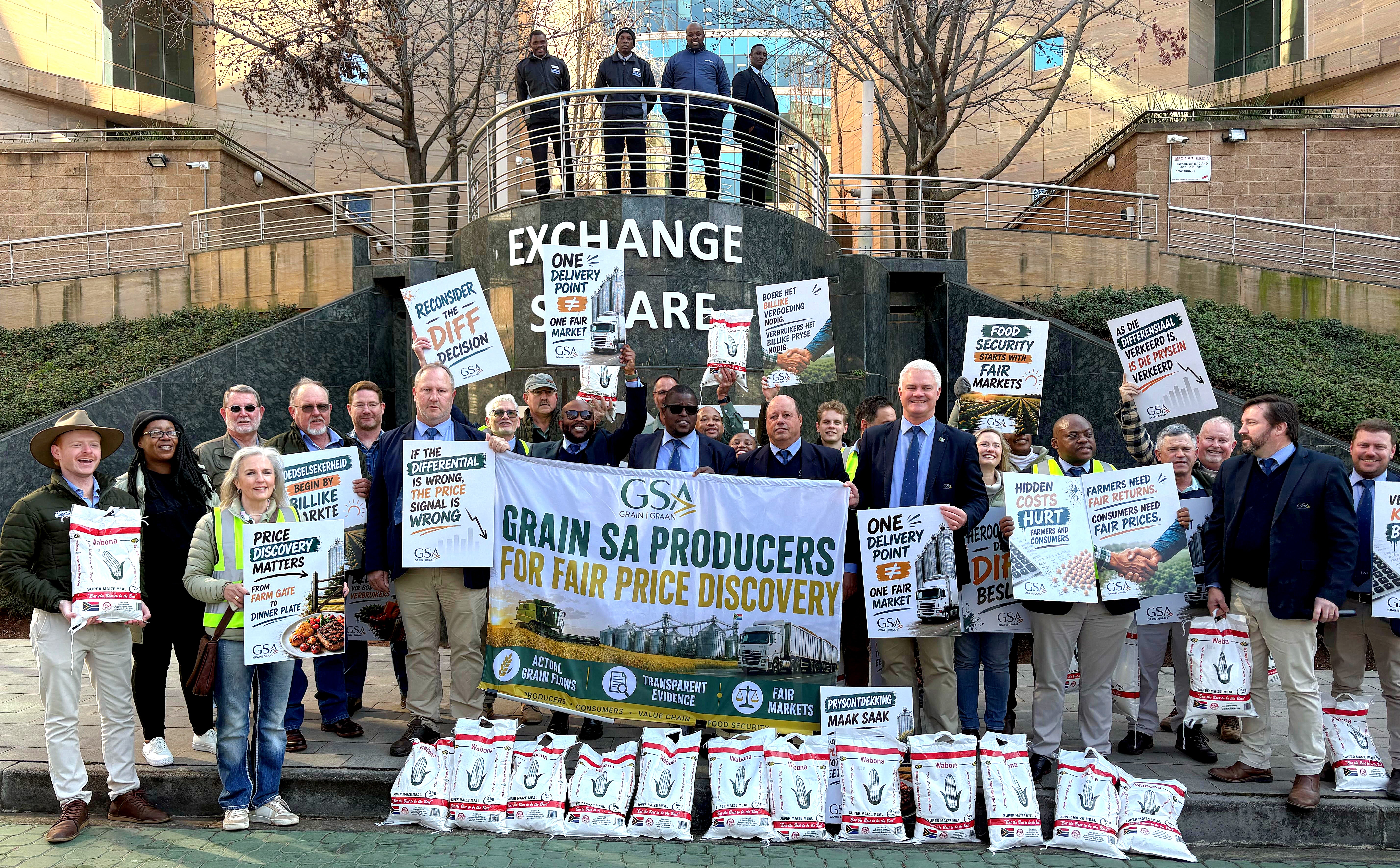
 Grain SA members outside of the JSE protesting against what they regard as unfair trading mechanisms, on 13 August 2026. (Ed Stoddard)
There was an unusual protest march to the JSE in the heart of Sandton, Johannesburg, on Thursday, 13 August, and it was not the typical one calling for the overthrow of “White Monopoly Capital” or some such thing.
Organised by industry group Grain SA, the protest was aimed at drawing attention to the JSE’s agricultural trading platforms, which the organisation says chow producer profits while inflating the prices consumers pay by adding unfair transportation costs to transactions.
The technical terminology in this tussle evokes a “single reference point” versus “multiple reference points” and it boils down to this: the “reference point” is milling operations in Randfontein, and the estimated cost of transportation to Randfontein is deducted from the price farmers are paid for their product regardless of their location.
The catalyst was a recent decision by the JSE regarding the “soybean reference point”, but the industry’s concerns extend to maize, wheat and other commodities. Grain SA wants to maintain the multiple reference points – or milling/processing locations on the map – that were used for two years in a pilot project for soybeans.
/file/attachments/orphans/Gilad-Isaacs-vat-zerorate_529764.jpg "Soybeans on sale are displayed in a grain wholesale market in Beijing, China, 31 July 2018. Soybean prices have plummeted in recent months after US President Donald J. Trump announced tariffs on 50 billion US dollars of Chinese goods. China is the world's largest buyer of soybeans, importing 12.4 billion US dollars worth of the legumes from the US in 2017. (Photo: EPA-EFE / WU HONG)")
“To have a single-point reference is not realistic because all the grain does not come to one place and go back out to the consumers again,” Grain SA CEO Tobias Doyer told Daily Maverick as the roughly two dozen marchers gathered while a handful of bored metro cops – all such protest marches require official permission – looked on.
“So to be fair to farmers and consumers and to give them a better deal we need to take these costs out of the supply chain, we need multiple reference points.”
Grain SA Chairperson Richard Krige said that the “system is skewed and it’s unfair to the two ends of the spectrum, and that’s the producer and the consumer. For 20 years it’s been a thorn in the side of farmers.”
The soybean multiple reference two-year trial was supposed to be evaluated, and Grain SA had hoped it would be adopted more widely.
“The idea would then be to look at rolling it out to the other commodities. Unfortunately, the JSE decided without enough due diligence... to revert back to the single reference point. But it’s taking money out of the pockets of farmers and costing the consumer at the end of the day,” Krige said.
“For example, 60% of the wheat produced in the Western Cape is being milled and consumed there. But farmers have to forfeit R800 a tonne in transport differential costs to Randfontein in Gauteng.”
Grain SA has launched a court interdict against the JSE’s decision, and Tobias handed a petition and memorandum outside the bourse to JSE CEO Valdene Reddy.
“We are here to engage, we are here to listen. No decision is taken lightly, and we are happy to engage,” she said.
Pointedly, Reddy did not take questions from the media, but the JSE did issue a brief statement.
“This decision followed an extensive review of the model and careful consideration of the JSE’s obligations as a licensed exchange. The review concluded that a single reference point methodology provides the most appropriate framework to support a transparent, efficient and robust derivatives market,” the statement said.
The JSE, which among other things is supposed to foster transparency in financial markets, missed an opportunity to present the reasons behind its decision in a more transparent manner.
/file/attachments/orphans/GettyImages-2229404014_173688_715453.jpg "SA grain farmers face dire challenges as surging fuel and fertiliser costs, coupled with low maize prices, make it easier to buy maize than grow it. (Photo: Alan Chin / Bloomberg via Getty Images)")
The issue speaks more widely to the way that futures and derivative markets for agricultural commodities are structured, and this ultimately effects your grocery bill.
Everyone needs to make money along the way – from the farmer to the retailer – and such markets are structured for contracts between sellers and buyers at an agreed price and date for delivery.
But some of the costs along this chain are – in the view of grain farmers in this case – unfairly imposed or needless.
This dispute is also bubbling against the backdrop of surging fuel and fertiliser prices in the wake of the Iran War and as a strengthening El Niño threatens to unleash drought during the summer grain-growing season.
The farmers on Thursday were not toyi-toying or hurling bricks at the JSE or burning tyres in the street, but they are pissed off.
And it’s probably a smart strategy to evoke the consumer and food security. The placards waved on Thursday proclaimed: “Food Security, Fair Markets” and “Hidden Costs Hurt”.
It’s all food for thought and worthy of public debate and scrutiny. BM
Comments
Scroll down to load comments...