



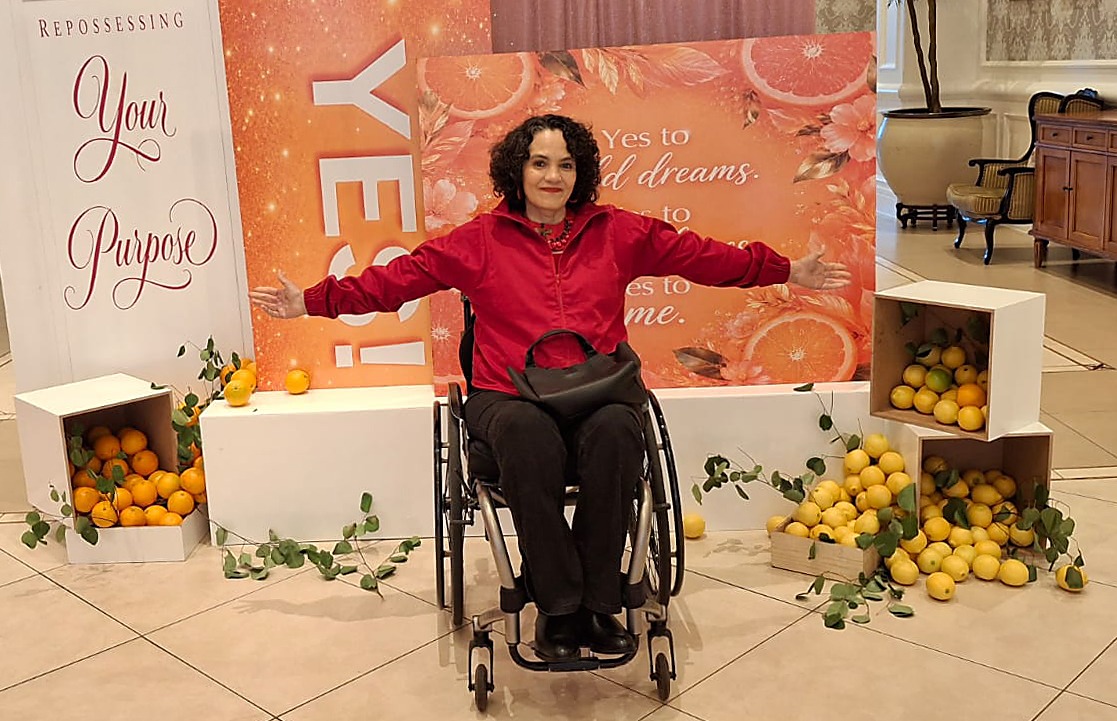
 Professor Shelley Barry at the Nelson Mandela Bay Business Chamber’s Annual Ladies Breakfast on 12 August. (Photo: Shelley Barry/Supplied)
Professor Shelley Barry keeps track of the years she has been given and all of her blessings. “I am 55,” she says. “I’m very proud of my years because I could have died at 24. Every year is a gift.”
Barry was 24 when a bullet fired during a minibus taxi shooting in Cape Town severed her spine. Doctors delivered a heartbreaking diagnosis: she would never walk or speak again.
She proved them very wrong – and today she is an award-winning filmmaker, writer and associate professor at Nelson Mandela University.
One of the most unexpected things to emerge from the injury that changed her life is a jewellery business.
It began with her mother, Pam, who made Barry necklaces from cloth, old jewellery and whatever she had around the house. Barry had been told to cover the tube in her throat to protect it from dust, hair and other particles, and her mother found a way to make that necessity beautiful.
“My mother came up with a wonderful idea of making me jewellery, like nice necklaces that cover and protect the tracheostomy. She made handmade jewellery from cloth and old jewellery and things like that. She wouldn’t go out and buy stuff; she would use stuff around the house. She made me quite a range.”
Those protective designs have evolved into Whole Again Jewellery.
The business was launched in March, but the idea is nearly 30 years old. And for Barry, it is about far more than jewellery.
/file/attachments/orphans/Photo4_395101.jpeg "Professor Shelley Barry with her mother Pam Barry next to their exhibition at Nelson Mandela Bay Business Chamber’s Annual Ladies Breakfast on 12 August 2026. (Photo: Supplied / Sandra Harper)")
From a mother’s necklace to a business
Each piece is handcrafted from recycled jewellery and materials, including denim and other fabric.
“There’s no two pieces that are the same, because it’s not factory-produced, and it’s not mass-produced,” says Barry proudly.
People began asking whether they could have pieces of their own, and last year, Barry’s aunt Sandra Harper suggested they turn it into a business.
Barry is careful to explain what Whole Again does not mean. It is not about being broken and then repaired.
“We’re not saying ‘Oh, I was broken. And then I became whole again’. That’s not where the name originates from at all. Because we are not broken as people with disabilities. There’s nothing broken about us.”
The name, in fact, comes from Barry’s first film, Whole: A Trinity of Being, which won several international awards.
But Whole Again Jewellery has taken on a meaning of its own.
“It really is, for us, the intention behind it, besides making women feel fabulous with our wonderful, gorgeous jewellery. It’s also about celebrating life, celebrating your fabulousness,” says Barry.
She describes it as “crowning your scars”.
Those scars, Barry says, do not necessarily have to be visible.
“For many of us, we have scars, different kinds of scars. Not necessarily physical scars. Whole Again also then becomes like a crown in a way, or almost like a tattoo ... one that you can remove.
“It’s a statement of thriving. It’s a statement of a new beginning. It’s a statement of claiming your power and your agency. It’s more than just jewellery.”
Nearly three decades after the shooting, Barry is an associate professor in Media and Communication at Nelson Mandela University, an award-winning filmmaker whose work has explored disability and other social justice issues, a teacher, director, producer and writer – and, since March, an entrepreneur behind a jewellery business born from the incident that changed her life.
But Barry does not describe her journey simply as one of survival. For her, surviving was only the beginning.
“It is not only saying yes to living and surviving and going through the motions, but to consciously create a life of joy and a life where I feel like I’m in alignment with my purpose,” she said.
That purpose, Barry says, is to teach, create and be of service. It is also about making the most of the life she was given.
“In a nutshell, yes to life, but also yes to thriving. And yes to joy and not taking life for granted.”
A fateful journey
Back in 1996, a young Barry was travelling in a minibus taxi on her way to a job interview in Cape Town, unaware that rival taxi organisations were fighting a brutal turf war.
What happened next changed the course of her life.
“There was an assassination of our driver,” she says. “They didn’t care, because they shot from the side and then shot from the front as well. They were targeting whoever was in the taxi.”
The driver was hit seven times and killed. Barry was hit once. “I got one bullet, which severed my spine,” she says.
A friend sitting beside her was also shot and survived.
Barry needed to be intubated and underwent a tracheostomy – a procedure that left her with a tube inserted in her throat through which she breathes and speaks.
Barry believes the tracheostomy resulted from a medical error.
“This is a second disability I should not have had. I do believe that they put it in the wrong place and that caused a problem further down the line,” she says.
“I was basically told that I wouldn’t be able to walk and wouldn’t be able to talk. That was very harrowing news.”
‘Try, try and try again’
However, Barry was determined to speak again.
“I started with writing on paper, communicating to people that way, just writing my thoughts.”
Then, slowly, her voice began to return.
“And then when I first started being slightly audible ... people struggled to hear me and to hear what I was trying to say. Sometimes that was extremely frustrating, as you can imagine.
“It wasn’t a quick, quick process, but there was a constant improvement. Constant improvement until I was, you know, clearly audible. It was really just try, try and try again. I just kept practising. I just kept trying to talk.”
Nearly 30 years later, the physical echoes of her tracheostomy remain. A soft whistle accompanies her words, and her voice grows fatigued after long lectures.
“I’ve just come from a lecture now,” she says. “I’m fine, but I feel it afterwards – more like an ‘Oh, I should have used the microphone’ kind of feeling.”
Yet, the profound gift of having a voice is never lost on her. “I’m just so grateful that I learned how to speak again to the extent where I’m now a lecturer,” she reflects, noting that she spent decades in teaching — a career reliant entirely on her voice. Surprisingly, many people she meets never even notice the tube.
“Many people don’t even know I have this, because they don’t realise ... because it’s not physically visible,” she said.
This is all because of a necklace that resulted in the founding of Whole Again Jewellery.
/file/attachments/orphans/Photo2_153702.jpeg "The team behind Whole Again Jewellery Pam Barry, Professor Shelley Barry, and Sandra Harper at the Nelson Mandela Bay Business Chamber’s Annual Ladies Breakfast in Gqeberha on 12 August 2026. (Photo: Supplied / Sandra Harper)")
‘A lot of adjustment’
The physical changes were only part of what Barry had to deal with. “I was a young woman having to adjust from being an able-bodied person entering the world as a person with a disability,” she says.
“It was a lot of adjustment, realising the injustice that people with disabilities face. And so it was a lot for a young woman to go through.”
At times, she became depressed, but she had the support of her family and her faith.
“My mother kept saying to me when I was so depressed, she was like, ‘Stop feeling sorry for yourself ... you’re alive, and you can still do great things.’”
But there was one question that continued to trouble her: How would she make films?
“That was my big worry, because it had been my big dream. Who makes films in a wheelchair?” she asked.
“I had to basically challenge my own perception. And think, why not? Why can’t I? I used to shoot many of my early films myself from a seated position.”
Over time, she began working with cinematographers, but filmmaking remained central to her life.
“I love being behind the camera. I also love directing and producing, writing and teaching. It’s a nice combination,” she said.
/file/attachments/orphans/Photo5_902375.jpeg "Professor Shelley Barry with a jewellery piece from Whole Again. (Photo: Supplied / Sandra Harper)")
Stories that need to be told
Much of Barry’s body of work has been in documentary filmmaking. She has made short fiction and is now returning to longer-form fiction, but remains drawn to the stories of real people.
“I find telling the stories of people very compelling. Real life, real people,” she says.
Her work is often rooted in social justice, exploring issues including disability, gender and sexuality.
She has also made films about people whose stories she believes deserve to be remembered, including a documentary about the Cape Town poet James Matthews, who has since died.
Barry describes this kind of filmmaking as a way of creating “an archive where there isn’t one, or where there is very little of [one]”.
Closer to home, she made a film about Gqeberha-based DJ Mr Shakes and his fight against drugs, focusing on their effect on young people and mental health.
/file/attachments/orphans/Photo1_886707.jpeg "Professor Shelley Barry the Nelson Mandela Bay Business Chamber’s Annual Ladies Breakfast in Gqeberha on 12 August 2026. (Photo: Supplied / Sandra Harper)")
She has also turned the camera on her own family, documenting how they were forcibly removed from Fairview in Gqeberha under the Group Areas Act.
For Barry, the subject matter can vary widely, but the reason for making the film remains the same.
“It’s really the story that comes to me that I feel is a story that I need to tell and to pay attention to that,” she says. “Everything that I do, I do because I know how much time it takes when you have to invest in making a film. So you must really care about your subject matter, because you’re going to be sitting with that subject matter for quite some time.”
Barry’s philosophy of life has been shaped by everything that came after the shooting.
She could have allowed survival to become the measure of her life. Instead, she chose to build something beyond it.
“It’s not only saying yes to living and surviving and going through the motions, but to consciously create a life of joy and a life where I feel like I’m in alignment with my purpose.” DM
Comments
Scroll down to load comments...