




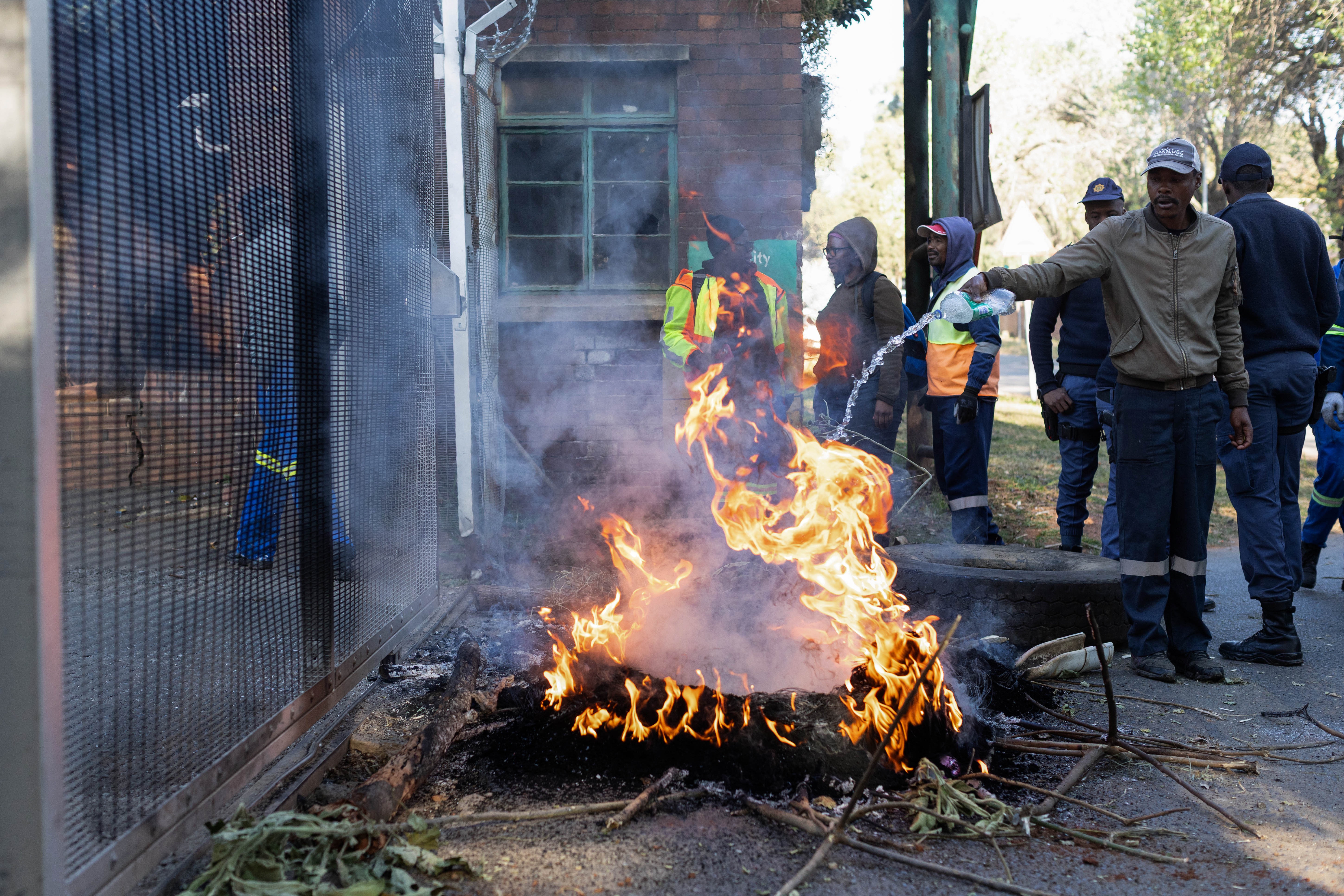
 A man pours water on a barricade erected by striking workers at the Pikitup Waterval depot in Johannesburg on 8 July 2026. (Photo: Our City News / James Oatway)
Three of Johannesburg’s most public-facing entities, and the ones that make a real difference to the lives of city residents, are in deep financial trouble.
Johannesburg Water and City Power’s financial woes are well known, but in the latest Pikitup quarterly report to the City council, the extent of the entity’s alarming financial crunch becomes evident.
Pikitup provides waste services to 908,208 households, communities, and businesses and 207 informal settlements. It owns and operates 12 waste management depots located across the City of Johannesburg’s seven regions, and manages 40 garden sites, four operational landfill sites and two closed landfill sites. Pikitup is the permit/licence holder of the Ennerdale, Robinson Deep, Goudkoppies, Marie Louise, Kya Sands and Linbro Park landfill sites within the City of Johannesburg boundaries.
/file/attachments/orphans/ocn_pikitup_01_484237.jpg "Rubbish piled high in Linden, Johannesburg. August 11, 2026. (Photo: OUR CITY NEWS / James Oatway)")
In the preamble to the third-quarter report, tabled before council in July, managing director Bukelwa Njingolo said Pikitup faced fiscal and operational constraints, including low supplier invoice payment, high critical vacancy levels, underfunded waste diversion efforts, and reduced fleet availability due to maintenance budget limitations.
A quick read through the report shows:
R800-million spent year-to-date on rentals because the City does not have enough trucks to collect rubbish.
A 56% vacancy rate, ranging from senior management to unskilled workers.
Fuel costs of R47-million year-to-date, way over the budget of R36-million. By the third quarter, 98.2% of the annual budget had been spent.
Infrastructure projects halted for almost a year because of non-payment.
Landfill sites are almost at capacity, and there is no available money for interventions to extend their life cycle.
No money for surveys to monitor air quality at landfill sites.
More than R61-million owed to Pikitup by seven state hospitals, including Chris Hani Baragwanath, Helen Joseph, and Sizwe Tropical Diseases Hospital.
Out of the 12 capital expenditure projects planned for the 2025/26 financial year, none has been completed.
Collection rates have decreased in the quarter from 70.9% to 65.0%. For the financial year to date, collections are at 61.0%, a decrease when compared with the 62.5% collected in the previous financial year.
The Pikitup fleet
Most of the entity-owned fleet is well beyond its economic lifespan, and the City has not yet replaced most of the units that should have been scrapped, the report noted.
“In line with the continuous increase in service delivery requirements as a consequence of the increasing population and breakdowns of the City-owned fleet, the entity has to rely heavily on service providers to provide ad-hoc fleet,” the report noted.
The entity spent R280-million on fleet rentals during the period January to March this year, and year-to-date has spent R800-million on rentals.
/file/attachments/orphans/unnamed_180750.jpg "Pikitup in Crisis. (Source: OUR CITY NEWS)")
Looking only at compactors with bin lifts (like the ones servicing our suburbs), Pikitup owns 97, 27 of which were in the workshop between January and March this year and 25 of which have been scrapped.
Commercially available municipal compactors with bin lifts cost, according to AutoTrader South Africa, about R2.2-million.
A quick calculation shows that the City could have bought more than 300 of these compactors for the R800-million it has spent on rentals.
Pikitup said that despite improved workshop efficiency, some vehicles assessed at the workshop were not economically viable to repair or maintain due to their age and the severity of the damage.
The report noted that continuing maintenance of the current specialised fleet units had become a challenge due to inconsistent payments to the fleet service provider.
The refuelling of the estimated 261 active fleet units also poses a challenge due to non-payment or inconsistent payments to the service provider.
Fuel costs for the three-month period were R13-million, and year-to-date R47-million, significantly higher than the budgeted R36-million.
Halted Capex projects
Pikitup has spent a tiny fraction of its approved capital expenditure, or infrastructure project, budget. As of the end of the third quarter (nine months) of the 2025/26 financial year, total expenditure amounts to R92-million, representing 29.74% of the approved budget of R309-million. There are 12 capex projects for the 2025/26 financial year, and none of them has been completed.
The report noted that out of 171 supplier invoices, 102 were paid within 30 days.
Massive personnel backlog
Pikitup currently has vacancies for 5,874 people, but no budget to employ them. It needs 120 professionally qualified staff, 585 skilled technicians, 751 semi-skilled workers and 4,400 unskilled workers.
The overtime cost is currently 24.2% over budget.
Salary costs are over budget for the quarter and year to date, a result of the PFA (politically facilitated agreement) increases approved by the City. Pension fund contributions were over budget for the quarter due to the unfunded PFA salary increases.
/file/attachments/orphans/EDITORS_CHOICE_pikitup_06a_816544.jpg "Non-striking pikitup workers wait for a barricade erected by striking workers to be removed at the Pikitup Waterval depot in Johannesburg. July 8, 2026. (Photo: OUR CITY NEWS / James Oatway)")
No funding exists in the approved revised budget to fill vacancies, and the City has placed a moratorium on filling vacancies to improve profitability and cash flow.
The report notes that overtime costs are over budget for the quarter and have increased by 14% when compared with the same period in the prior financial year. The majority (98.8%) of the overtime costs relate to the operations department.
During March 2026, the City limited all staff to working a maximum of 15 hours of overtime per month, and if this is implemented, costs will decrease in the final quarter.
However, given that most of the Pikitup depots were not operational last week due to labour disputes, the entity has had to play catch-up this past weekend to get rid of the mountains of rubbish all over the city.
By Monday this week, Pikitup had not yet cleared the backlog from last week’s protests. DM
The stalled projects
Projects have been stalled because of the non-payment of contractors, a city-wide problem as the same has happened at Johannesburg Water and City Power. Here are just some of the stalled projects:
1: Phase 2 construction of a new temporary leachate pond, installation of the leachate pumping system, and rehabilitation of the existing contaminated pond at the Goudkoppies landfill site. Work has been on hold since 8 October 2025, and the contractor has not been on site for the past four months. “Projects that remain on suspension due to nonpayment incur standing time costs that could be avoided by paying the contractor or entering into an agreement with the contractor to avoid the standing time costs,” the report noted. (A leachate pond collects rainwater and other liquids that percolate through waste at landfill sites and pick up contaminants like organic and inorganic chemicals, metals and biological waste. It prevents pollutants from entering the soil and water systems.)
2: Construction of a boundary wall at the Ennerdale Landfill Site. The project’s progress is hindered by non-payment, leading the contractor to suspend work on site. Currently, the project is more than six months behind schedule. Construction work is currently at 40% progress.
3: Phase 1 construction of the boundary wall at Midrand Depot. The contractor halted work from 27 October 2025 until mid-January 2026. Although the contractor is now back on site, the project has faced setbacks due to delayed payments. The consultants frequently suspend their on-site services due to delayed payments, which negatively affects the contractor’s progress.
4: Phase 1 construction of a reinforced concrete boundary wall at the Marie Louise Landfill Site. The contractor suspended work on the site due to non-payment. The contractor has not resumed work since the beginning of 2026. The consultants have not suspended on-site services despite being owed money from the last financial year. The contractor is currently at 48% progress.
5: Phase 1 construction of a sorting facility for reclaimers, a stormwater management system, and access roads at the Linbro Park Landfill Site. The contractor is currently at 78% progress. The contractor has not resumed work since leaving the site on 12 December 2025 due to non-payment.
6: Phase 2 construction of a new temporary leachate pond, installation of the leachate pumping system, and rehabilitation of the existing contaminated pond at the Goudkoppies landfill site. The contractor is currently at 50% physical progress. The contractor has suspended work due to a delay in payment. The site was closed on 8 October 2025.
7: Relocation of existing offices, weighbridge and services (water, sewer and electricity) to the newly procured land to make space for landfilling at the Ennerdale landfill site. The consultant halted services due to non-payment, which delayed the contractor’s procurement via the Johannesburg Development Agency.
8: Consulting services for stages 5 and 6 at the Ennerdale Landfill Site.
9: The construction of a face brick boundary wall at Zondi Depot. The contractor is currently at 70% physical progress. The contractor is off-site due to non-payment.
10: Air quality monitoring at landfill sites, which measures landfill gases, has not been done for the second (October 2025 to December 2025) and third quarter (January 2026 to March 2026) because of unpaid invoices. The scope of work is to monitor landfill gases such as methane (CH4), carbon dioxide (CO2) and other gases.
This story was produced by Our City News, a non-profit newsroom that serves the people of Johannesburg.
/file/attachments/2985/WhatsAppImage2025-11-21at1946001_346702_1cea9e715c05dc0a538fc79753ac3401.jpeg "Our City News logo")
Comments
Scroll down to load comments...