




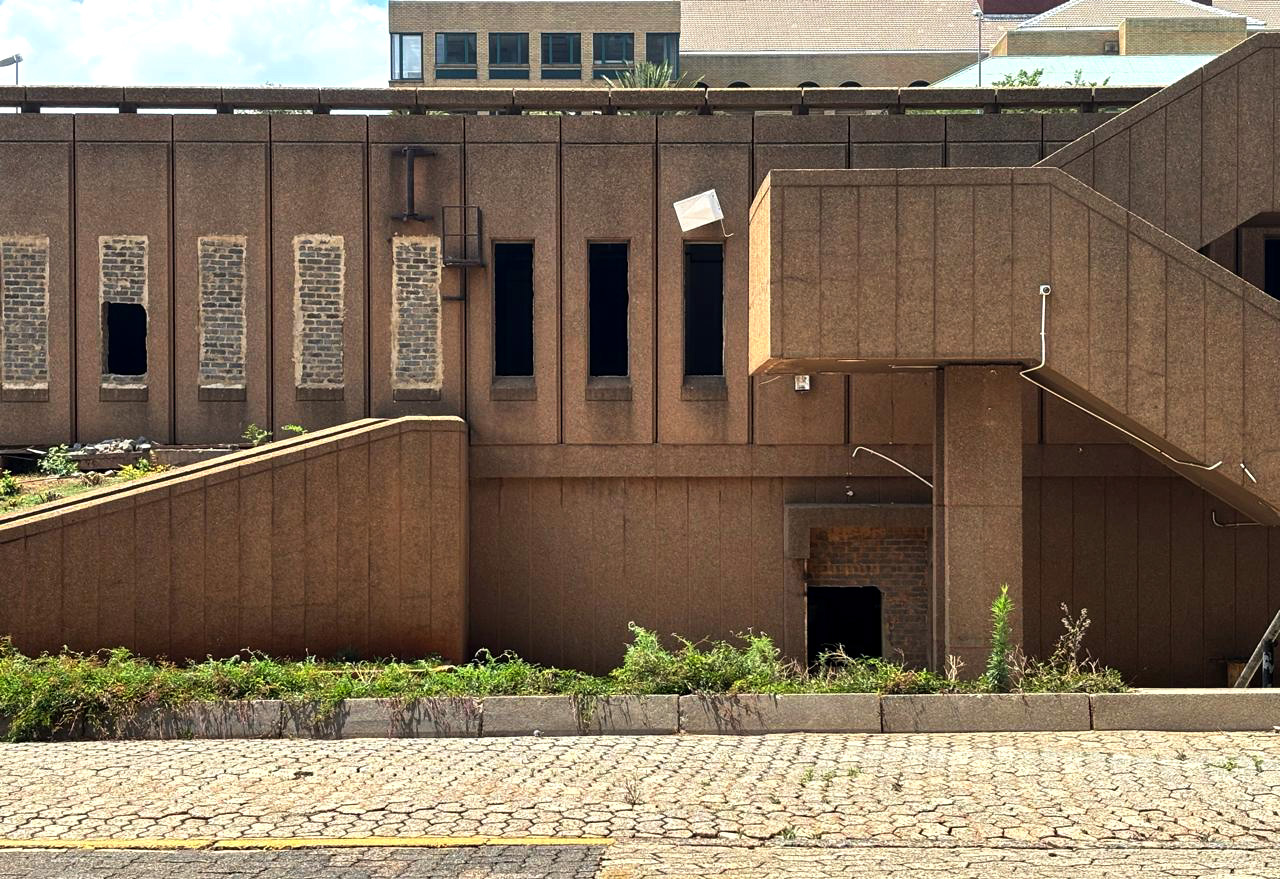
 Joburg's abandoned Metro Centre.
(Photo: Supplied)
Joburg's abandoned Metro Centre.
(Photo: Supplied)The Legal Resources Centre (LRC), a public-interest law organisation acting on behalf of affected property owners and civic groups, has submitted a formal Promotion of Access to Information Act (Paia) application compelling the City of Johannesburg to release all engineering and safety reports behind the Metro Centre’s closure.

Shaatirah Baboo Hassim, an attorney at the LRC, confirmed the legal action that aims to force transparency over whether the closure of the landmark municipal precinct — and the dumping of an estimated two million planning records in the basement — is grounded in genuine technical findings or is serving as a cover for severe administrative failure.
These physical files — including irreplaceable, historic architectural designs and protected heritage drawings dating back over a century — now lie abandoned, unmonitored and scattered across the dark, flooded subterranean levels of the condemned complex.
While these foundational records rot underground or fall prey to illicit syndicates raiding the basement, Joburg residents, architects and home buyers face daily financial ruin. Property transfers across the city remain deadlocked as conveyancers and commercial banks refuse to register mortgage bonds without certified as-built plans. Left in administrative limbo by the City’s archive blackout, desperate homeowners are being forced to pay private professionals upwards of R20,000- R100,000 to remeasure and redraw existing buildings from scratch just to obtain basic municipal approvals.
Operational breakdown
The legal challenge comes as shocking figures in the municipality’s third-quarter performance report for the 2025/26 financial year lay bare a total operational breakdown across the Department of Development Planning, contradicting more than a year’s worth of public assurances from senior municipal leadership.
In May 2026, the City launched a public relations campaign under the city manager, Floyd Brink, the executive director of development planning, Eric Raboshakga, and the group chief technology officer, Aubrey Mochela. Reframing the Metro Centre crisis as part of a “Smart City” modernisation programme, the administration made a series of explicit operational promises:
Hardware and systems: High-capacity, specialised large-format scanners were claimed to be delivered, installed and operational, with the Electronic Document and Records Management System (EDRMS) deployed.
Immediate scanning launch: Scanning of physical records was promised to commence that very month (May 2026), starting with 30 boxes already packed and prepared.
Intergovernmental transfer: The city claimed active engagement with the Gauteng Provincial Department of Sport, Arts and Culture to formally transfer physical records to the provincial archives once scanned.
However, when Daily Maverick asked the city’s media office for specific budget votes, project numbers and actual expenditure figures — and confronted the City with allegations that “zero rands” had been budgeted for the archive rescue — municipal officials failed to respond or provide financial proof.
But the City’s third-quarter performance report confirmed that up to the end of Q3, zero dedicated capital budget had been executed for the retrieval or transfer of the basement archives, exposing how earlier commitments had already lapsed unfulfilled while current operations remain in severe deficit:
Revenue collection collapsed to 47.41%: The department collected less than half of its R151-million revenue target, leaving a massive financial shortfall in the municipality's operating budget.
55.6% failure rate on executive scorecard: Out of nine core gatekeeper targets on the executive director’s personal scorecard, five were failed or missed entirely — a 44.4% pass rate for leadership.
Capital budget lagging at 58%: Out of the R79-million capital budget, tens of millions of rands were unspent, while zero dedicated capital funds were executed to physically retrieve or transfer the basement archives.
Manufactured compliance metrics: While the department claimed a 100% turnaround success rate on service delivery standards, official notes reveal this metric was calculated on a sample size of just two early childhood development applications during the entire quarter.
Strategic projects in paralysis: Lower-level planning for the Lanseria Smart City collapsed following a service-level agreement standoff with the Joburg Property Company; town planning for the Kliptown Multipurpose Centre was halted to pay a vendor for a 3D architectural model; and informal settlement deprivation mapping was scrapped entirely via formal deviation.
While municipal leadership framed the Metro Centre closure as a transition toward digital governance, millions of physical building plans — spanning 140 years of Johannesburg’s architectural history — remain trapped in the unlit, unmonitored basement.
Meanwhile, illicit syndicates continue to exploit the vacuum, charging desperate property owners thousands of rands in bribes to illegally extract physical files from the guarded basement or issue unauthorised land-use approvals outside official council channels. DM
Comments
Scroll down to load comments...