




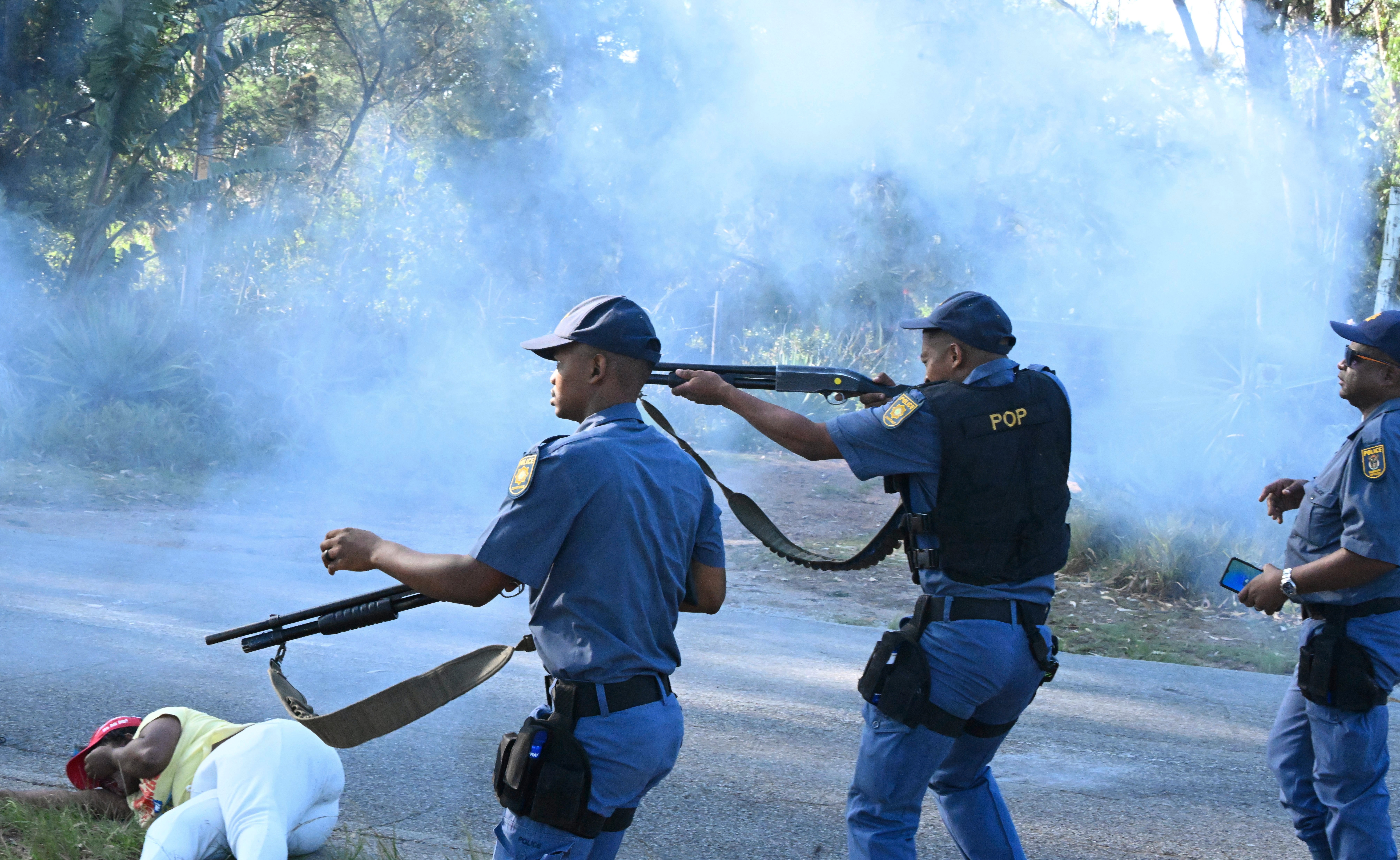
 Police fire tear gas at protesting Grogro settlement, Gqeberha, residents on the Kragga Kamma Road on 10 February, 2026. (Photo: Gallo Images / Die Burger / Lulama Zenzile)
Acting Police Minister Firoz Cachalia has taken to publicly talking about a police reset and the “Madlanga moment”. During Wednesday’s initial briefing on the SAPS Amendment Bill, he spoke to MPs of “this Madlanga moment that calls out for reform”.
The Madlanga Commission’s bruising testimony on factional politicking, political influence and corruption in the criminal justice system has not only captured the public imagination (the police are among the least trusted public institutions, according to various opinion surveys), but also put pressure on the state to take action.
“If we get this right, it does have the potential to reshape policing in the decades to come,” the acting police minister told MPs. Yet his SAPS Amendment Bill does little for fundamental reform.
/file/attachments/orphans/ED_605437_616171.jpg "Firoz Cachalia during the media briefing at the Union Buildings on April 23, 2026 in Pretoria. (Photo: Gallo Images/Frennie Shivambu)")
It fails at the first step – demilitarising police ranks. This was proposed as far back as the 2012 National Development Plan (NDP). It was also endorsed by the panel of experts that was established on the recommendation of the Farlam commission of inquiry into the August 2012 Marikana massacre, when police killed 34 striking Lonmin miners. The recommendation emerges repeatedly in other policing reform proposals.
The Bill also fails on the setting up of a national policing board, or an independent body, for recruitment, selection, appointment and promotions as a substantive reform that has repeatedly been recommended. This amendment legislation simply adds, without detail, a clause about “a transparent, competitive and merit-based process to ensure the best-suited person is appointed”.
This language may mirror the NDP and panel of experts report, but leaves intact the current system where no role exists for public or parliamentary participation before the President appoints the national police commissioner. The appointment of deputies, provincial commissioners and other senior ranks is left to the national commissioner. In the context of the police factionalism exposed in the Madlanga Commission, this risks entrenching patronage networks, rather than dismantling them.
In contrast, the 2018 panel of experts’ report recommended that a national policing board would not only set standards and criteria for recruiting, selecting, appointing and promoting SAPS members, but also manage “a transparent, competitive and merit-based recruitment process” to assist the President in appointing the national commissioner. The NDP recommended the President establish a selection panel to select and interview candidates against objective criteria before appointing the national commissioner and deputies.
Appointment oversight failure
Instead, the national policing advisory board that the Bill establishes can only recommend standards for appointments and propose professionalisation and competency standards for the national police commissioner to consider.
Rather than strengthening oversight and independent appointment processes, the Bill largely consolidates authority within the existing SAPS hierarchy.
It fails to deal with years of messy Crime Intelligence revelations, including controversies around appointments and procurement that are now playing out before the Madlanga Commission. It rebrands Crime Intelligence as an “intelligence division”, expressly preserving the existing leadership when this law comes into effect.
In what has been styled as key to the so-called policing reform and reset project, this draft legislation instead centralises power in the national commissioner, who keeps control over public order policing and specialised units, determines education, training and development needs for recruits, lateral entrants and everyone else, and disciplinary proceedings.
/file/attachments/orphans/ED_613868_781500.jpg "SAPS police officers at the parade as law enforcement agencies intensify operational readiness ahead of the planned demonstrations scheduled for June 30th at FNB Stadium on July 26, 2026 in Johannesburg, South Africa. The parade forms part of the SAPS' nationwide state of readiness and operational mobilisation, following recent briefings by police management and assurances that the constitutional right to peaceful protest will be protected, while acts of violence, intimidation and criminality will not be tolerated. (Photo: Gallo Images/Sharon Seretlo)")
Here one potentially positive development emerges, given the national commissioner must establish a disciplinary system with dedicated disciplinary units. It would replace the current ad hoc system where senior police officers are taken from the job to oversee disciplinary matters.
What the Bill also does is to finally revise outdated laws and constitutional references. That’s needed because the original SAPS Act was passed in 1995, before the final Constitution. So “supreme court” judges are amended to “high court judges”, and references to laws such as the 1975 Exchequer Act are updated to the Public Finance Management Act (PFMA).
Years after key Constitutional Court rulings declaring unconstitutional, for example, warrantless search and seizures, the SAPS Amendment Bill now embeds these changes into the draft law. It also includes definitions, like blue lights, as “a lamp capable of emitting blue light”.
Beyond necessary housekeeping, the SAPS Amendment Bill does the barest minimum. This legislation signals a SAPS hard line, to hold on to established powers, control and conduct with the smallest of nods to reform, despite public talk of a “reset”.
Coincidentally, on that much-talked-about SAPS reset agenda that Cachalia has described in a recent parliamentary reply as a “transformative organisational renewal programme” based on professionalism, accountability, ethical leadership, the rule of law and restoring public confidence in policing: “It is a decisive commitment to fighting crime while simultaneously rebuilding the integrity, legitimacy and public standing of the South African Police Service”.
Whether Parliament strengthens the Bill so systemic reform establishes a credible, trustworthy police service remains to be seen. As drafted now, however, it looks less like the foundation of a policing reset than an exercise in preserving the status quo while talking the language of reform. DM
Comments
Scroll down to load comments...