




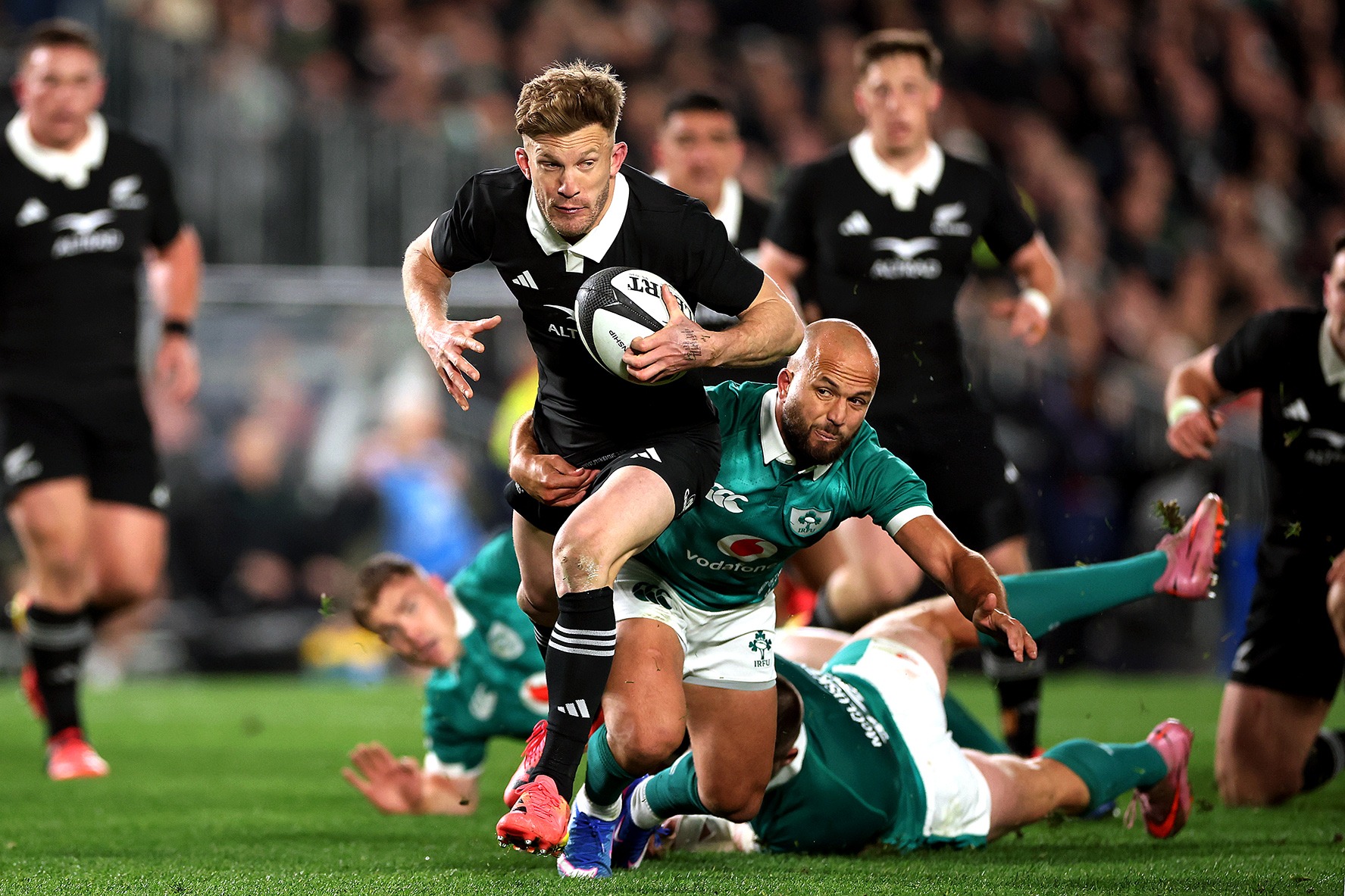
 All Black playmaker Damian McKenzie makes a break during the Nations Championship match against Ireland at Eden Park on 18 July 2026. Coach Dave Rennie has used McKenzie effectively in his three matches in charge. (Photo: Phil Walter / Getty Images)
Some coaches have attempted to replicate Rassie Erasmus’ largely successful management strategies in recent seasons, while others have persisted with a more traditional approach.
Nowadays, most Six Nations bosses favour a six-two bench – a selection policy made popular by the Boks during their successful 2019 and 2023 World Cup campaigns – while France have rotated their squad in a nod to the development project that transformed the Boks into the most consistent team on the planet.
Meanwhile, the All Blacks have continued to go their own way.
Former coaches such as Ian Foster and Scott Robertson persisted with a five-three bench as well a consistent starting XV in big matches and series. Dave Rennie has followed suit in 2026, favouring a largely unchanged starting lineup in the recent wins against France, Italy and Ireland.
Fast forward to the present, where the All Blacks are in SA, preparing for an unprecedented challenge of four-consecutive Tests against the world’s No 1 team.
/file/attachments/orphans/TL_2593342_896658.jpg "Dave Rennie (Head Coach) during the All Blacks Welcome event at DHL Stadium on July 31, 2026 in Cape Town, South Africa. (Photo: Ashley Vlotman / Gallo Images)")
The Boks are well equipped to survive this demanding schedule, given that Erasmus rotated his squad regularly over five matches in November and in the recent Nations Championship Tests, without compromising the team’s quest for results.
Are the All Blacks prepared for such a stern examination of their depth? The question was asked after their squad was announced last month, and will continue to be asked in the lead-up to the first Test in Johannesburg on 22 August.
The tour matches against the Stormers, Sharks, Bulls and Lions are unlikely to provide any significant answers, given that the contests against the Boks will be played at greater speed and intensity.
That said, Rennie’s selections for the tour matches will offer a clue regarding his plan for the leading All Blacks in the coming Tests.
The All Blacks’ point of difference
The Boks have won five of their last six Tests against the All Blacks.
They have yet to face Rennie’s All Blacks, though, and over the next six weeks the head coach may well be New Zealands’ point of difference.
Rennie boasts an intimate understanding of local conditions and playing styles – having steered the Chiefs to 18 wins in 24 games staged in SA during the old days of Super Rugby, and having led Australia to three wins in four Tests against the Boks between 2021 and 2022.
/file/attachments/orphans/GettyImages-2286595743_620547.jpg "Josh Moorby of the New Zealand All Blacks is tackled during the Nations Championship match between New Zealand All Blacks and Ireland at Eden Park on July 18, 2026 in Auckland, New Zealand. (Photo: Phil Walter / Getty Images)")
While there is a lot of hype about the All Blacks’ high-tempo approach, it’s worth reflecting on some of the less glamorous characteristics of Rennie’s past teams.
The Chiefs team that won back-to-back titles in 2012 and 2013 was arguably the most complete side of the Super Rugby era. The Wallabies battled for consistency under Rennie, but were more than a physical and tactical match for the Boks.
Erasmus will be wary of what a Rennie-led side can do – and while critics and fans wrestle with questions about the tourists’ limitations, the Bok coaches may be wondering what Rennie has up his sleeve.
Starting on the back foot
While there is a lot of respect for what Rennie has achieved in the game, he’s had precious little time to prepare this squad after succeeding Robertson in March.
At the time of the appointment, Rennie attempted to juggle planning for the Nations Championship and Greatest Rivalry series while fulfilling his duties as head coach of the Kobelco Kobe Steelers in Japan.
While a three-from-three return in the Nations Championship suggests that all is well, Rennie hasn’t had much luck over the past few months.
/file/attachments/orphans/GettyImages-2286603144_394285.jpg "Anton Lienert-Brown of New Zealand runs in to score a try past the diving tackle from Jack Conan of Ireland during the Nations Championship match between New Zealand All Blacks and Ireland at Eden Park on July 18, 2026 in Auckland, New Zealand. (Photo: Joe Allison - Nations Championship / Nations Championship via Getty Images)")
When he eventually returned to the Land of the Long White Cloud, Rennie was told that first-choice All Blacks flyhalf Richie Mo’unga was unavailable – at least initially – for the series in SA due to New Zealand Rugby’s policy on overseas-based players.
Decorated loose forward Ardie Savea – one of the few New Zealanders who has played and won in SA – was granted a sabbatical after the Nations Championship, and will join the squad in the Republic about 10 days before the first Test. Another senior player in hooker Codie Taylor remains unavailable for the first part of the tour, due to a calf injury.
The All Blacks suffered their first casualty this past week, after hooker George Bell broke down with a calf injury during a training session in Cape Town. When the uncapped Bradley Slater was called up as replacement, the question regarding the All Blacks’ quality in depth was raised again.
Rennie has been positive in his dealings with the local media since arriving in Cape Town last week, and if he is worried about the present situation, he is doing a good job of hiding it.
/file/attachments/orphans/GettyImages-2286598743_221400.jpg "Ardie Savea of the New Zealand All Blacks scores a try during the Nations Championship match between New Zealand All Blacks and Ireland at Eden Park on July 18, 2026 in Auckland, New Zealand. (Photo: Phil Walter / Getty Images)")
Privately, he may be concerned by the fact that more than half of his squad has no experience of local conditions, and he will want to bring those players up to speed as soon as possible.
On the other hand, he will be monitoring the workload of his star players across the matches against the Stormers, Sharks and Bulls, with the aim of fielding a largely unchanged team across the four Tests that follow.
Red flags or red herrings?
There’s been some debate about the selection strategy, and how the All Blacks should go about managing their resources in the club fixtures before the four Tests.
Players unfamiliar with South African conditions may benefit from two hit-outs against club opposition before the Tests kick off.
Given that two of the local Tests will be staged at altitude and one in Cape Town, one might expect Rennie to field his strongest combination against the Stormers in Green Point and the Bulls in Pretoria – with the aim of exposing the uninitiated to those conditions well before the internationals.
It would appear that Rennie and the All Blacks selectors have other ideas.
The team named to face the Stormers on Friday is missing most of the players who started in the big Nations Championship Tests – namely Damian McKenzie, Will Jordan, Quinn Tupaea, Jordie Barrett, Ruben Love, Cameron Roigard, Luke Jacobson, Tupou Vaa’i, Fletcher Newell, Tyrel Lomax and Ethan de Groot, not to mention Savea and Taylor.
Rennie’s strongest combination may feature in the clash against the Sharks next Tuesday, and then spend the next 10 days preparing for the first Test. Alternatively, they will face the Bulls next Saturday.
One cannot see Rennie risking his star players in both matches against the Sharks and Bulls, which will be staged in the space of four days.
It’s hard to understand what these star players might gain from a hit-out at Kings Park in Durban, as the conditions will be very different when the Test side travels to Ellis Park, Cape Town Stadium and FNB Stadium. The fourth Test in Baltimore, US, will pose another challenge altogether.
/file/attachments/orphans/TL_2593330_944703.jpg "Dave Rennie (Head Coach) during the All Blacks Welcome event at DHL Stadium on July 31, 2026 in Cape Town, South Africa. (Photo: Ashley Vlotman / Gallo Images)")
It will also be interesting to see whether Rennie limits his stars to one warm-up game against the local clubs, and whether he attempts to field those players in all four Tests.
In recent seasons, Erasmus and his coaching staff have found that the performance of specific players tends to dip after consecutive Tests, and with that in mind, the Bok boss has been reluctant to push players to play three or more matches in as many weeks.
Of the 37 players used on the 2025 tour to Europe, only six featured in all five Tests – and Bok captain Siya Kolisi was the only player to start every match.
Rennie and the All Blacks may feel differently, and time will tell whether they have got their player management strategy right, or whether they are still behind the curve. DM
Comments
Scroll down to load comments...