




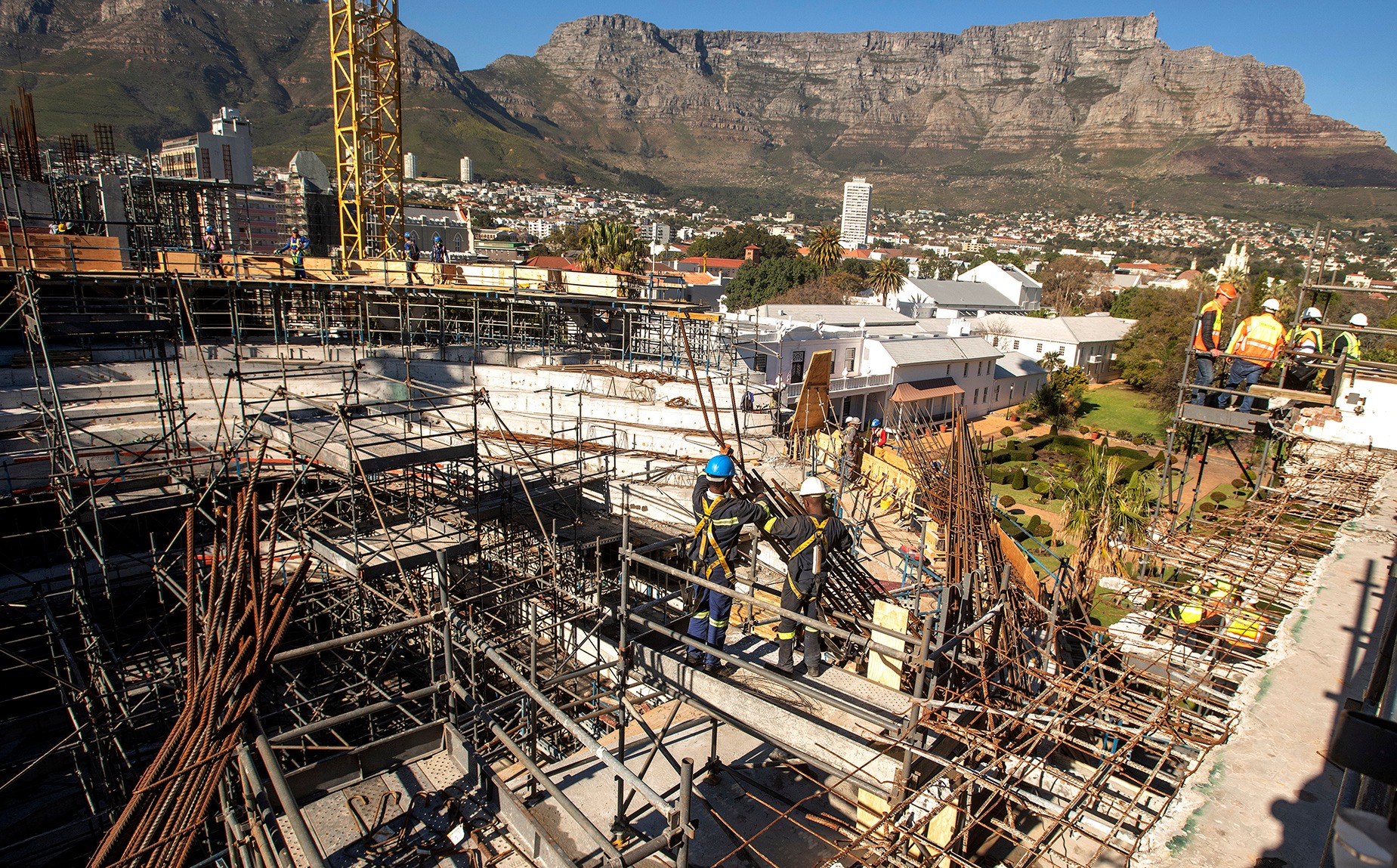
 The National Assembly under construction during a site visit to Parliament’s rebuilding on 7 August 2026 in Cape Town, South Africa. The site visit aimed to inspect the progress made in the rebuilding and reconstruction of Parliament project. (Photo: Gallo Images / Brenton Geach)
Parliament is expected to be ready to host the 2027 State of the Nation Address (Sona) and budget speech, with the rebuilding project on track for full completion by June 2027, MPs were told on Friday, 7 August 2026.
“The progress continues with regards to the construction,” said Chuene Ramphele, Development Bank of Southern Africa group executive: infrastructure delivery. “We want to see that the Sona and the budget speech are delivered in the new chamber.”
By then, five years would have passed since Parliament was devastated in the fire of 2 January 2022. Parliamentary protection staff had been put on compulsory leave over the festive season by the administration, leaving police in charge of patrols and CCTV camera monitors.
/file/attachments/orphans/ED_618028_732279.jpg "The National Chamber under construction during a site visit to Parliament rebuilding project on August 07, 2026 in Cape Town, South Africa. The site visit aimed to inspect the progress made in the rebuilding and reconstruction of Parliament project. (Photo: Gallo Images / Brenton Geach)")
/file/attachments/orphans/ED_618029_556408.jpg "The National Assembly under construction during a site visit to Parliament rebuilding on August 07, 2026 in Cape Town, South Africa. The site visit aimed to inspect the progress made in the rebuilding and reconstruction of Parliament project. (Photo: Gallo Images / Brenton Geach)")
A South African Police Service (SAPS) VIP bodyguard returning from duty elsewhere at 6.03am raised the alarm and arrested Zandile Mafe, who had been in the building for hours. Subsequent court proceedings, which declared Mafe unfit to stand trial in December 2023, and Parliament’s own investigation in October 2023 revealed “lapses in perimeter monitoring”, camera monitors left unattended and sleeping police officers.
Since January 2022, Parliament has used various venues for physical sittings, initially in 2022 using the Cape Town City Hall, but later moving to a purpose-built marquee on a former parking lot. The online system for committee and plenary meetings introduced under the Covid-19 restrictions ensured parliamentary business continued.
Initial renovation estimates stood at R1-billion, but the extent of the damage, including from water and mould, meant that by February 2023 new budgets and a completion timeline of late 2025 were discussed. In early 2024, the budget had increased to R3-billion, with Parliament saying demolition would start on 10 May, and construction in August, to keep to the estimated end of 2025 completion deadline. That did not happen.
The price tag now stands at R4.6-billion for all structural work, construction, furnishings, and landscaping, according to a presentation to MPs. Currently, 52% of that budget is spent, without cost overruns. Much of this has gone on invisible structural work like asbestos removal, waterproofing, improving ventilation and ensuring the stream that runs underneath Parliament does not again threaten its foundations.
Speaking on the sidelines of Friday’s site visit, Secretary to Parliament Xolile George told Daily Maverick that the budget for this project had been secured.
Earlier, Ramphele told the joint standing committee on the financial management of Parliament that the unexpected work to ensure structural and seismic integrity had delayed the project by about five months.
/file/attachments/orphans/ED_618025_412230.jpg "he National Assembly under construction during a site visit to Parliament rebuilding on August 07, 2026 in Cape Town, South Africa. The site visit aimed to inspect the progress made in the rebuilding and reconstruction of Parliament project. (Photo: Gallo Images / Brenton Geach)")
/file/attachments/orphans/ED_618037_738286.jpg "The National Assembly under construction during a site visit to Parliament rebuilding on August 07, 2026 in Cape Town, South Africa. The site visit aimed to inspect the progress made in the rebuilding and reconstruction of Parliament project. (Photo: Gallo Images / Brenton Geach)")
/file/attachments/orphans/ED_618036_692883.jpg "An over site visit to Parliament rebuilding project on August 07, 2026 in Cape Town, South Africa. The site visit aimed to inspect the progress made in the rebuilding and reconstruction of Parliament project. (Photo: Gallo Images / Brenton Geach)
<br>")
By January 2027, the 1,172-seater chamber, including public galleries, is expected to be ready for furnishing. Information and communication technology infrastructure, bathrooms and an industrial kitchen should also be completed. The building’s glass façade would have been installed in December 2026. The so-called “collaborative spaces” for MPs would also be done by January 2027, alongside the members’ lounge, so these office and other workspaces can be used at Sona.
The African drum design façade on the side of Parliament facing the presidential Tuynhuys offices is due for completion in February 2027, with its glass façade already on order. The viewing deck is the final element to be completed, by June.
For the first time, Parliament will have a complete set of digital plans. It was a challenge, not only in the immediate aftermath of the 2022 fire, but also during construction.
According to Ramphele, the targeted handover date is June 2027.
Right now, however, the parliamentary precinct remains a building site, with scaffolding, piles of building rubble, rubbish, noise and dust everywhere.
But that does not take away from the excitement among the project team, including architects, when peeling back layers of carpet and underfelt in the Old Assembly revealed Indian rubber tiles. These have been taken away for cleaning to return them to their original bright pink-and-cream state, to be used in the new parliamentary building.
These tiles were among many discoveries in the chamber where apartheid architect and then prime minister Hendrick Verwoerd was stabbed by parliamentary messenger Dimitri Tsafendas in September 1966.
A renovated Old Assembly will have its 1950s asbestos roof removed, in a move to return the building a bit more to its original 1910 state, although it will not be a reconstruction. As architect Mike Scurr said: “It’s not restoration for the sake of it. It’s blending old and new.”
/file/attachments/orphans/ED_618041_145372.jpg "Tuynhuys is the office of the President of South Africa at Parliament (Photo: Gallo Images / Brenton Geach)
<br>
<br>")
The design is speckled with motifs like “desert landscape and yellowwood tree” for the chamber and “savanna grassland” for the 600-seat public galleries, according to Friday’s presentation to MPs. More design themes evolve around proteas and African sunsets, while meeting rooms are styled according to “woodland thicket”.
Given Parliament’s heritage status, regardless of construction timeframes, heritage restoration would take the time it would take, parliamentarians were told. As would security vetting of workers on the site, regardless of time pressure, although steps were under way with the State Security Agency to ensure workers could start on time at 7am, rather than stand in queues.
Amid the controversies of the parliamentary rebuilding project is whether it was properly handed over from the Department of Public Works, the national custodian of all state-owned properties, to the national legislature and the Development Bank of Southern Africa as implementing agent. It is one of the legislative requirements to ensure accountability over state assets. DA MP Rikus Badenhorst, seemingly frustrated in the committee, publicly raised that Public Works Minister Dean Macpherson had indicated that no records of such a handover could be found.
On Friday, National Assembly Speaker Thoko Didiza met the matter head-on.
“It is important the issue is addressed and is put to bed,” she said, adding that it was important for public works, the National Treasury and Parliament to meet. Resolving the matter would require “executive-level discussions”, also including former public works ministers Patricia de Lille and Sihle Zikalala, alongside Finance Minister Enoch Godongwana.
However, Didiza added that a trilateral governance structure between Parliament, public works and the National Treasury remained in place to monitor the project.
For now, Parliament remains a construction site. But if the timelines hold, MPs will return in early 2027 to a rebuilt National Assembly, purpose-built for the first time in SA’s democracy. DM
Comments
Scroll down to load comments...