



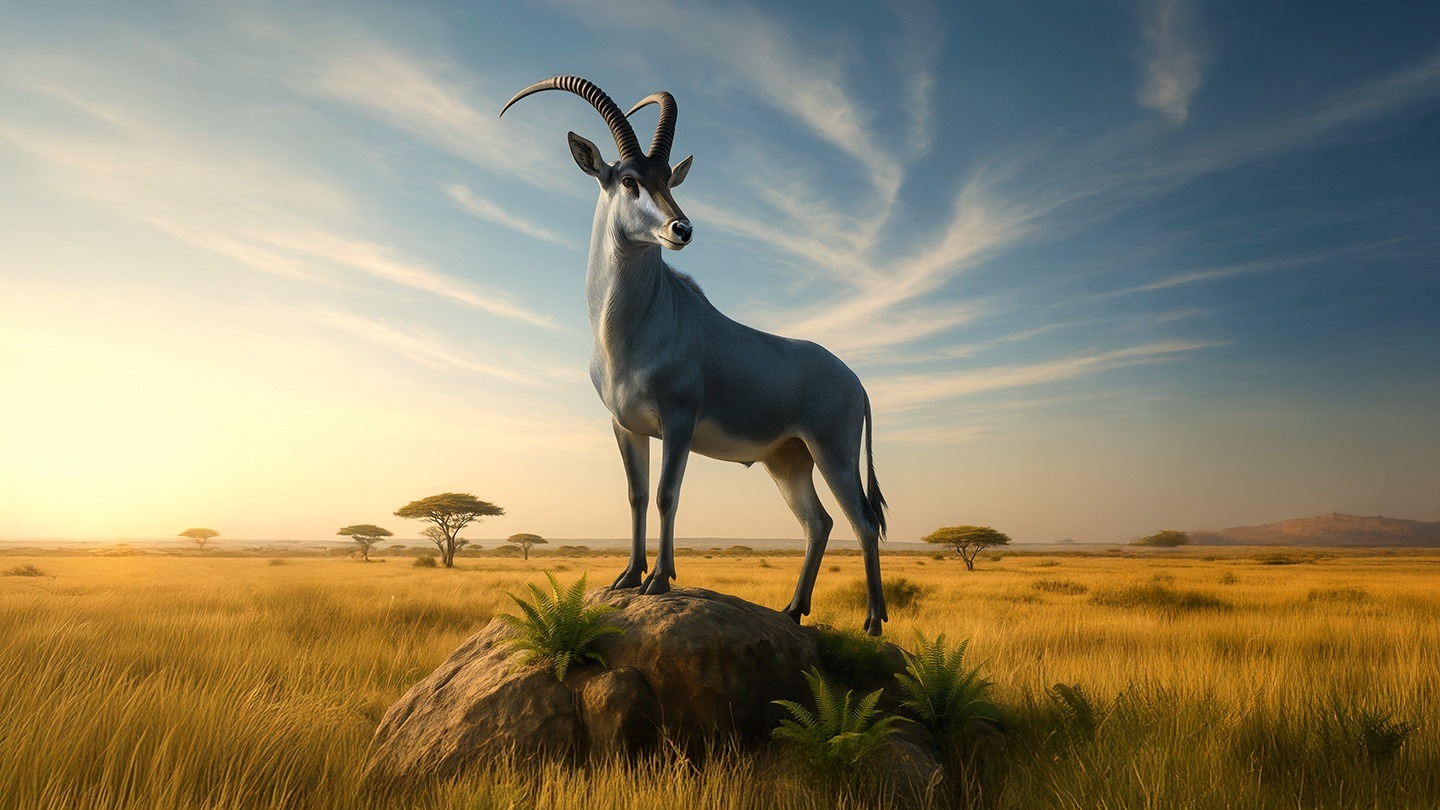
 A graphic reconstruction of the extinct bluebuck in South Africa. (Image: Colossal Biosciences)
The species disappeared from the Cape about two centuries ago.
If Colossal Biosciences succeeds, South Africa could become a major test for a radically different vision for conservation – one built around reproductive breakthroughs and venture capital.
Now Colossal, the company that claims to have resurrected the Americas’ dire wolf, says it is working to recreate the extinct South African bluebuck by editing the genome of a close living relative. First, the company is seeking to implant edited embryos into roan surrogates. If all goes to plan, the first birth could be “a couple of years away”, according to Matt James, Colossal’s chief animal officer and executive director of the company’s conservation foundation.
“I think we’re very close. We’re in the editing phase. We’ve unlocked a lot of the reproductive science. We still have a few hurdles to climb,” he says.
The most revealing part of James’ interview with Daily Maverick may be that the bluebuck and ambassador species like it do not necessarily represent the company’s ultimate objective.
“We’re interested in investing this amount of money not because of the resulting animal alone,” James says. “We’re also interested in rapid development of tech that helps bring that moonshot to life. That tech then is directly applicable to species on the brink of extinction today.”
With this, James reframes Colossal’s pitch.
Rather than simply trying to recreate an extinct animal, Colossal says “de-extinction” is a platform for new conservation technologies – an approach the company contends could eventually help threatened species teetering on the edge of the extinction abyss.
“Looking at historic samples, these are the ones you can find in European museums today,” he explains. “You can grab these little pieces of tissue and DNA.”
So, are we looking at an exact genetic copy?
“We’re creating a sort of average assembly of the bluebuck,” he says. “It would not be representative of a single individual that once existed. It would be the species.”
/file/attachments/orphans/CLSL_RoanAntelope_693242.jpg "The Colossal Biosciences animal operations team performs a world-first ovum pick-up procedure on a roan antelope, the bluebuck’s closest living relative. Colossal Antelope Research Preserve, December 2025. (Photo: Colossal Biosciences)")
A $100-million experiment
When asked, James estimates the undertaking will cost “north of” $100-million – R1.6-billion.
The funding, he says, comes from venture capital investors and individuals seeking environmental impact alongside financial returns.
“We’re a startup company, right?” he observes. “We have venture capital funding from your typical Silicon Valley investors to impact investors.”
For South African conservationists, however, this jumbo commitment would direct the spotlight at the elephant in the room.
Could the same money deliver greater biodiversity gains for protecting living species already under pressure?
This is a false choice, James proposes.
He says the science being developed for the extinct antelope could also eventually assist projects involving critically endangered animals, pointing to work underway through the Colossal Foundation on reproductive tools and genetic management for species that include the near-extinct northern white rhino.
His broader argument is that conventional conservation, while essential, is not keeping pace with biodiversity loss.
“I spent 15 years in American zoos managing African antelope. I love, love African antelope. I always wanted to have a project to develop tech to help protect antelope species on the brink,” he says. “The bluebuck is an iconic example – it is the first large African mammal to go extinct [in modern times].”
Existing conservation, he continues, is under-resourced, suggesting biotechnology would complement rather than replace traditional approaches.
“This allows us to begin to return large landscapes back to nature by using self-sustaining populations of bluebuck as this great, shining beacon of optimism,” he says. “In the same way that we’ve seen the safari industry and game industry in South Africa help drive a lot of conservation action, I’d hope this fuels that fire.”
He adds: “That doesn’t even account for when the bluebuck is returned, the investment into habitat restoration and employing people to help protect habitat. We think it becomes this great umbrella project.”
/file/attachments/orphans/Matt_James_BioVault_942187.jpg "Matt James in the Colossal Biovault in Dallas, Texas. (Photo: Colossal Biosciences)")
The science may not be the hardest part
Resurrecting this ghost from the past may prove easier than returning it to the South African landscape.
“The rewilding framework,” James concedes delicately, “is probably a more challenging and even longer pathway than the biological pathway.”
The company is already collaborating with specialists on embryo development and surrogate pregnancies. James also points out it is engaging South African partners to identify – among others – suitable release sites.
Suppose, for the argument’s sake, the biology proves to be a triumph.
Public acceptance and regulatory approval would also be essential in a country that takes wildlife as personally as the composition of the national Springbok rugby squad.
If it is not the first thing that springs to mind when turning over the complexities of this seemingly fantastical experiment, it is also true that this very expensive vision faces a dead end without winning hearts and minds.
A cautious South African partner
One of Colossal’s principal South African collaborators is the Endangered Wildlife Trust (EWT).
“Both the Eastern and Western Cape have fossil records. We’re working there with the EWT to identify amenable private landowners. We want to engage with the government to understand where it would like to see these things happen,” he says. “And we’re working with local stakeholders to understand the social and ethical norms.”
However, the organisation’s own description of the partnership is more restrained than the company’s public messaging.
The EWT says it has only provisionally agreed to back it.
Any further involvement depends on an independent “conservation value and risk assessment”, expected to be finalised by the end of the year.
Responding to Daily Maverick questions, the organisation says it will only consider further participation if that assessment concludes any potential introductions pose acceptably low risks and deliver significant biodiversity benefits.
While it acknowledges that some advances under development may eventually contribute to conserving highly threatened species, it insists their effectiveness still needs to be demonstrated through field testing and validation.
In other words, Silicon Valley’s principal NGO partner in South Africa is not yet endorsing the project.
It is evaluating it.
“The bluebuck must serve as a flagship for the conservation of threatened species and habitats, providing the primary justification for its rewilding,” it says.
On the value to other species, it notes: “Several species have gone extinct in South Africa; most were small, highly localised reptiles, butterflies or plants that are unlikely candidates for de-extinction technologies.”
There is “a lack of suitable genetic material and the current focus of these technologies [is] on larger, more charismatic species. Some extinct subspecies, including the Cape lion and Cape warthog, could potentially be considered in future, but these efforts would require strong scientific and conservation justification.”
/file/attachments/orphans/CLSL_Bluebuck_3_819106.jpg "A reimagined bluebuck herd wanders through a grassland setting. (Image: Colossal Biosciences)")
Seen, not herd. Yet
Beyond myriad hurdles lie some fiendishly difficult questions: how to establish a genetically viable population, whether reintroduction is ecologically desirable and how regulators, scientists and the public will judge a species recreated using genome editing rather than recovered through conventional methods.
Those are questions that cannot be answered in a laboratory.
South Africa is not only being asked to make a call on whether an extinct antelope should be revived.
It will be at the global forefront of deciding whether species rescue is entering a new era – one in which genetic breakthroughs may become as important as protected areas and traditional wildlife management.
That may ultimately prove to be the project’s biggest gamble.
“What does conservation look like without de-extinction?” counters James. When pushed for an educated guess on when Colossal’s bluebucks might roam as a free and wild herd, he proposes: “If I were a betting man, I’d say … within the next 10 years, we’d see the first bluebucks in South Africa.”
The Department of Forestry, Fisheries and the Environment (DFFE) was contacted for comment 48 hours before the deadline on 5 August. Responses were not yet received. DM


Comments
Scroll down to load comments...