




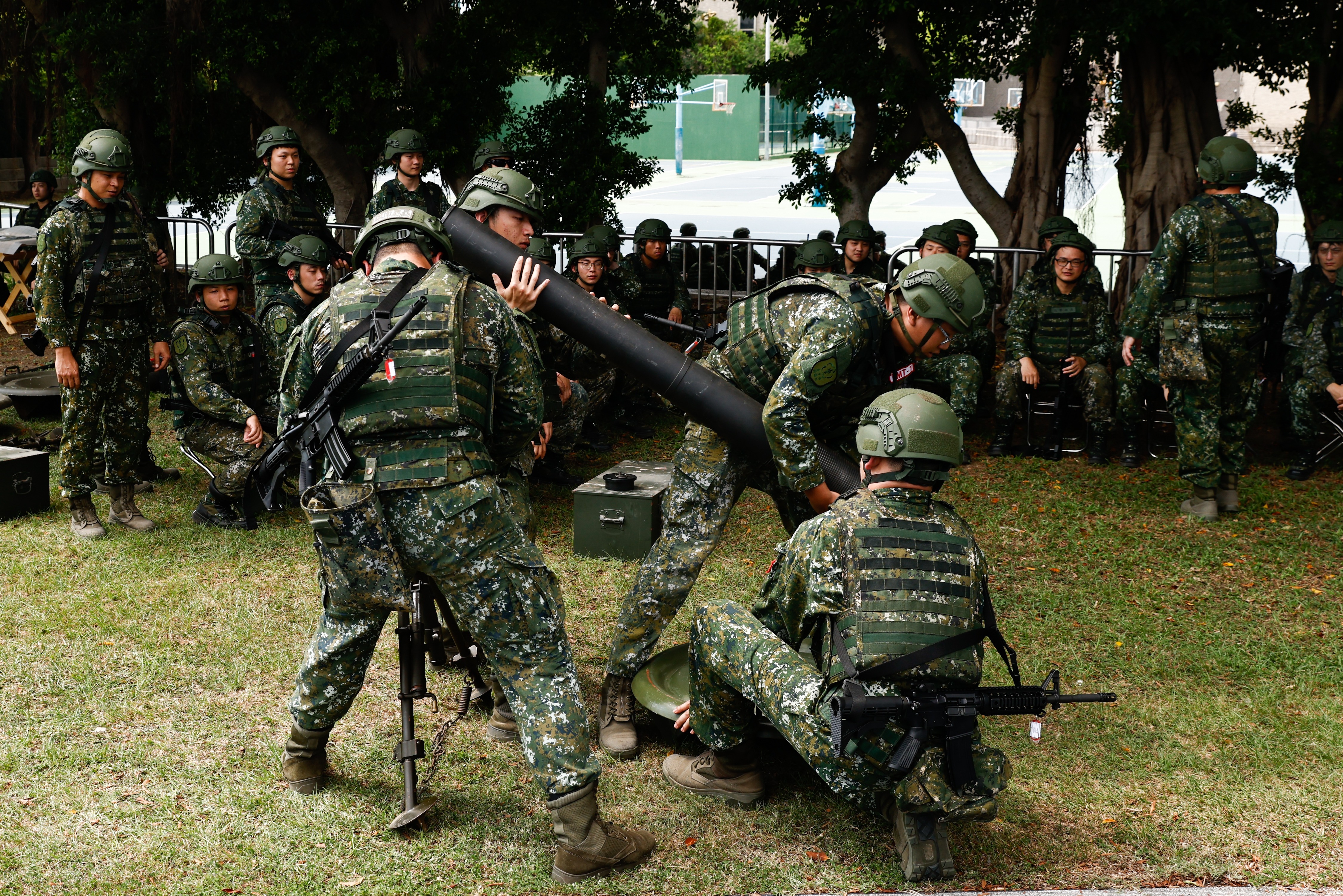
 aiwan military reservists conduct a mortar deployment drill during combat training as part of the Annual Han Kuang military exercises in Taipei, Taiwan, 05 August 2026. The Han Kuang exercises test combat readiness in case of a potential Chinese invasion. EPA/RITCHIE B. TONGO
The 10-day annual Han Kuang exercise began early in the morning after an underground command centre in Taipei issued the drill order, triggering combat-readiness moves that will include fighter jet dispersals and emergency naval deployments, two senior Taiwan officials briefed on the matter told Reuters.
Taiwan will also incorporate for the first time a so-called “backbrief” approach modelled on U.S. military practice, in which junior officers receiving orders restate mission details to commanders — a move aimed at improving coordination, the officials added, requesting anonymity due to the sensitivity of the matter.
The move, one of the officials said, is to “ensure commanders and subordinates are in sync on operational intent.”
The drill will also focus on a key wartime concern: that China, which claims Taiwan as its own despite the island’s objections, would try to paralyse command centres, ports, logistics and defence industry sites early in an attack.
China’s defence ministry did not respond to a request for comment. China has never renounced the use of force to bring Taiwan under its control.
WARTIME RELOCATION
Held annually since 1984, the drills will include for the first time the deliberate slowing of mobile internet speeds to test how civilians would communicate if bandwidth became scarce.
The military will simulate the wartime relocation of a major arsenal, mobilise civilian factories and run escort drills off Taiwan’s Pacific coast, as concern grows that Beijing may be rehearsing how to sever the island’s Pacific supply lines from allies as Chinese military pressure intensifies.
“These are all part of a series of toughening exercises — this is no longer a laboratory-like exercise in a vacuum,” said a third senior official, speaking on condition of anonymity due to the sensitivity of the operation.
“You are entering a real field environment, facing real bottom-line conditions. We hope the final phase of training reaches that state,” the defence official said.
That is part of Taiwan’s ongoing effort to make its exercises more realistic, following past criticism that some drills were too highly staged.
RESILIENCE DRILLS
The effort has included resilience drills testing how local officials would keep the government running during cascading crises, from earthquakes to a Chinese invasion.
“If the situation does not match the original enemy scenario, what should he do? How should he reassess, readjust, and quickly issue orders?” the defence official said, referring to field commanders who will be tested with “unexpected scenarios” during the drills, which end on August 14.
The drills will also mobilise more than 20,000 reservists.
The military will also introduce an “embedded reporter” mechanism to assess wartime frontline news releases and efforts to counter enemy disinformation, the officials said.
“The emphasis will be on how our entire population, the Republic of China as a whole — especially our citizens — should face war,” the defence official said, using Taiwan’s official name.
(Reporting by Yimou Lee; Editing by Lincoln Feast and Kate Mayberry)
Comments
Scroll down to load comments...