




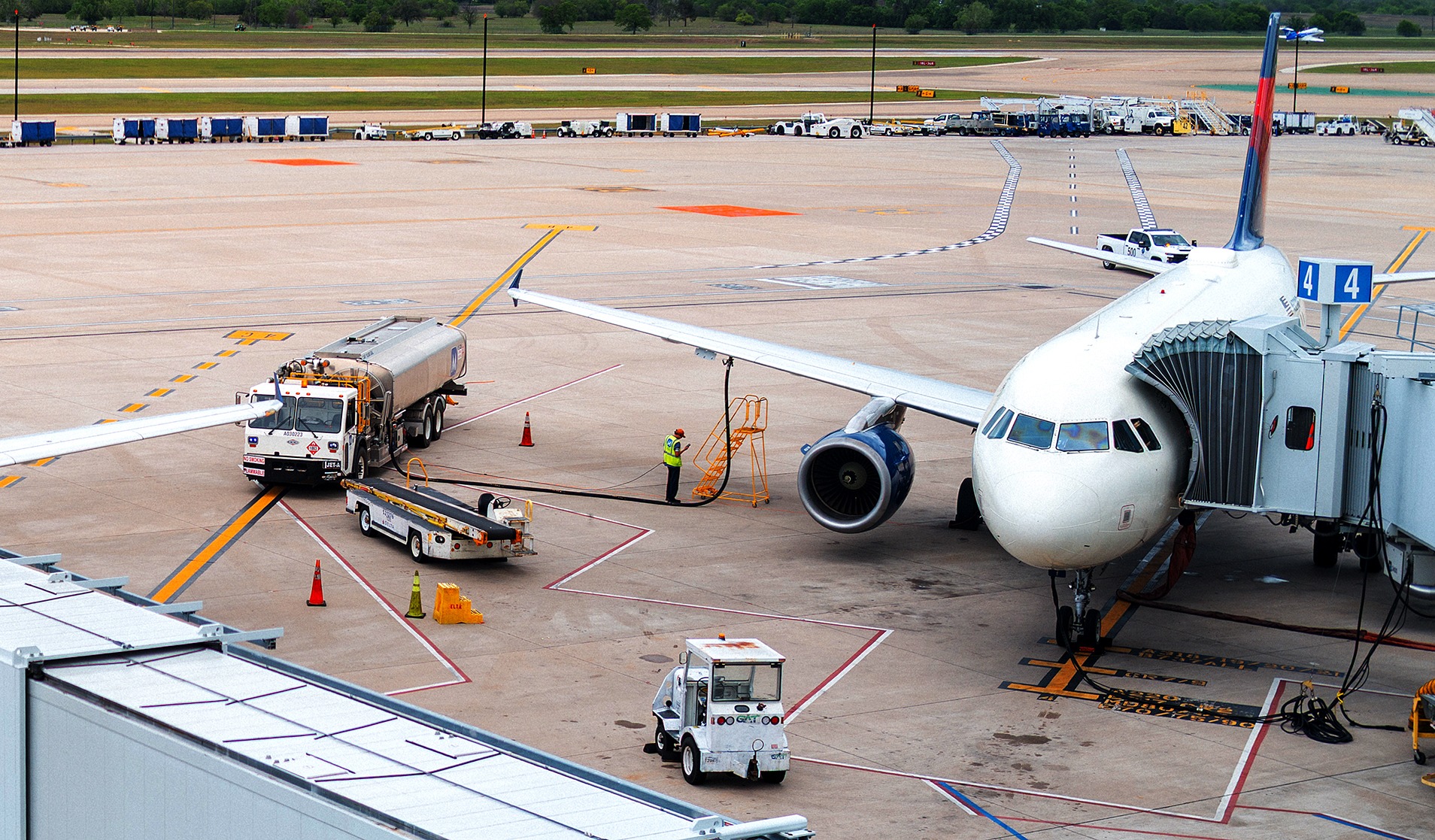
 A technician prepares to refuel a Delta Airlines aircraft at the Austin-Bergrstrom International Airport on 10 April 2026 in Austin, Texas. (Photo: Brandon Bell / Getty Images)
History will remember that FlySafair blinked first with a flight ticket surcharge when the oil market shocks sent jet fuel prices soaring. To be fair to SA’s most on-time airline, before the US and Israel fired the first salvo at Iran, a litre of Jet A-1 was retailing at around R11.14.
In the immediate aftermath of that devastating first weekend of fighting, that price shot to R30 at major airports and up to R38 for aircraft travelling from more remote parts of the country.
Given that about half of the cost of keeping an airline business flying is the fuel, the subsequent price increases (which peaked at an additional R692 per ticket on standard routes and up to R1,400 on the Joburg/Mauritius trip in April) are almost understandable.
And don’t think that FlySafair didn’t take any damage on its balance sheet. Chief marketing officer Kirby Gordon told journalists gathered at a roundtable session in Johannesburg that the expensive tickets triggered a 14% decline in passengers.
There’s nothing that hurts airline economics more than flying with empty seats. Well, outside of sudden fuel shocks.
/file/attachments/2996/Screenshot2026-08-05at171346_249372.png)
Open wide
The difference between the price of the aeroplane flavour of prehistoric plankton juice and our garden-variety lawnmower and road vehicle fuel is called the crack spread. Gordon had a quaint culinary analogy to explain it:
“If crude is flour, petrol and diesel and jet are three different kinds of loaves of bread that will be baked from that flour. And if you close half the bakeries that synthesise or bake one of the kinds of breads, then the demand for that bread doesn’t necessarily change, but the price goes right up.”
In more plain language, the crack spread represents the refining margin – or rather the cost and profit associated with synthesising raw crude into finished petroleum products.
This premium represents a severe market overlay. Historically, the jet fuel crack spread hovered around $25 per barrel in 2025; however, during the height of the 2026 supply disruptions, it peaked at an unprecedented $80 per barrel over and above the price of crude.
Gordon also spoke of the massive structural vulnerability facing South Africa, where the refining landscape collapsed from six operating refineries in 2015 down to just two in 2026.
Consequently, South Africa’s reliance on imported fuel surged from 20%-30% pre-pandemic to 75% in 2026. Of these jet fuel imports, 70% arrive via the Strait of Hormuz, leaving the local market completely exposed to global supply shocks.
And as Daily Maverick learnt on a recent trip to an air transport industry event in Brazil in June, refineries operate as integrated, multi-product chemical systems where product yields are structurally constrained.

Senior vice president of sustainability and chief economist at the International Air Transport Association (Iata) Marie Owens Thomsen said at the recent annual general meeting that transport fuels do not exist in a vacuum, and refineries cannot simply opt to produce only one high-value product.
“Every refinery will produce a number of products... when we’re talking about a barrel of crude oil, we take as an industry, only 10% of the global output of refined fuels as jet fuel... and the refinery makes its money and makes most of the profit from diesel and gasoline. Those are the big money earners for the refinery and jet fuel really has to hang on by the skin of its teeth to still be included in the product mix.”
This yield rigidity means that when refining capacity is lost globally, the supply of minor-yield products such as jet fuel falls disproportionately fast, triggering extreme price spikes.
Hitting the road
While aviation is highly sensitive to ticket price elasticity, diesel remains the fundamental backbone of heavy industry and mining.
During a panel discussion at the African Refiners and Distributors Association conference in Cape Town in April, Michael Osaruyi Obaseki, managing director and country head for Glencore Nigeria, explained that diesel demand was entering a structural expansion phase driven by the global energy transition.
“We see the demand for diesel to climb and fuel oil to be flattish looking down the curve... especially on the smelter side I see demand to rise.”
This non-discretionary diesel demand is anchored in a mining renaissance across Africa. Key mineral extraction and processing operations – such as bauxite in Guinea, smelters in the DRC and Zambia and mining infrastructure in Ghana and Tanzania – are highly energy-intensive and rely entirely on middle distillates.
Standard road freight, freight rail, agriculture, army tanks and mining cannot easily substitute diesel, meaning demand remains the same even when the price spikes.
And then you must factor in pricing anomalies, like the import parity pricing (IPP) formula. Here’s a crazy example: under IPP, Brazilian airlines are forced to pay for jet fuel as if it were entirely imported from the US Gulf Coast, despite 84% of it being sourced locally.
To put a cherry on top of an already chaotic market, the Russian government issued Decree No 954 on 30 July 2026, enacting a temporary ban on the export of commercial gasolines, diesel fuel, marine fuel and other gasoils.
But – and it is a pain to write this – this decision must be understood within Russia’s domestic context.
Ongoing conflicts and refinery disruptions had constrained domestic fuel logistics, raising internal fuel-related inflation and threatening key sectors like transport and agriculture. By banning product exports, Moscow aimed to force products into the domestic market to protect local logistics and food supply chains.
Bringing relief home
Russia also insulated its farmers by passing Decree No 953 (valid until 1 November 2026) to allow exemptions from antitrust rules, ensuring stable and fair petrol and diesel supplies for domestic farmers. This decree allows for direct supply agreements between regional farmers and oil companies to protect the farming sector from global price increases during the important harvest time.
Similarly, on 31 March 2026, Finance Minister Enoch Godongwana and Mineral and Petroleum Resources Minister Gwede Mantashe jointly announced a temporary reduction in the general fuel levy of R3.00 per litre from 1 April to 5 May.
Depending on how you define the price moves (either the actual increase consumers felt at the pump or the potential increase we were shielded from), the R3.00/l tax relief meant government bought back or absorbed an extra 29% or 41% (depending on your definition) on top of the steep price hike we still had to pay.
/file/attachments/2996/sa-fuel-prices-2026_162725.png)
Because global oil prices remained under pressure, the National Treasury stepped in again for May, increasing the diesel relief by another 93 cents to R3.93 per litre (effectively reducing the diesel fuel levy to zero) before halving the relief in June and letting it fully expire on 1 July 2026. This entire three-month intervention cost the government R17.2-billion in foregone tax revenue.
The demand for diesel in heavy industries isn’t going down, and if all these ongoing issues persist, it means that diesel and jet fuel prices are likely to stay high, which is tough for airlines and could destabilise the economies of emerging markets like ours.
But at least we got a nice 50c petrol price drop ahead of what is looking like peace talks in the Middle East. DM
Comments
Scroll down to load comments...