




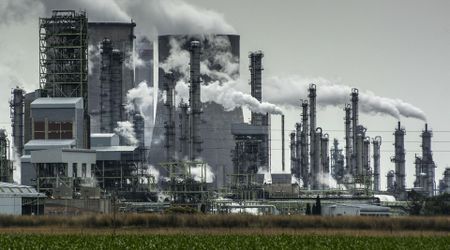
 Emissions rise from towers of the Sasol Secunda coal-to-liquids plant in Mpumalanga. (Photo: Waldo Swiegers / Bloomberg via Getty Images)
Seven years after a whistleblower alleged that Sasol had unlawfully discharged hazardous chemical waste into a river, there was a dramatic turn of events when, during a meeting of the parliamentary committee on forestry, fisheries and the environment on Tuesday, 4 August, the National Prosecuting Authority (NPA) swooped, issuing fresh warrants.
This came as Sasol executives were submitting presentations to the committee at Sasol’s Secunda facility.
It was back in 2019 when Ian Erasmus, a former process controller at Sasol, blew the whistle on the petrochemical giant, alleging that the company unlawfully discharged hazardous chemical waste, including vanadium, diethanolamine and potassium carbonate into the Vaal River system.
The complaint stemmed from a broken chemical sewer valve at Sasol’s Secunda Benfield plant, which then allegedly caused the discharge of chemical waste directly into the Klipspruit River. However, instead of a speedy investigation into the alleged environmental crimes, Erasmus’ complaint was met with regulatory paralysis, legal manoeuvring and systemic institutional delays.
/file/dailymaverick/wp-content/uploads/2024/11/tony-Vaal-crap-1-pic-brendan-cockcroft-Gallo.jpg "Floodwaters spill from the Vaal Dam, the main source of drinking water for Gauteng residents. The Vaal River and Vaal Dam have become increasingly polluted. (Photo: Brendan Cockcroft / Gallo Images)")
On Tuesday, under the Criminal Procedure Act and Cybercrimes Act, investigators seized electronic and documentary evidence to substantiate fresh allegations concerning Benfield Phases 3 and 4 as well as potential charges related to providing false or misleading information to inspectors. After the surprise enforcement, Sasol executives abruptly pulled back from answering detailed parliamentary questions from committee members out of concern for legal risks.
Sasol questioned the timing of the issuing of the warrant. However, Frances Craigie, Chief Directorate of Enforcement at the Department of Forestry, Fisheries and the Environment (DFFE), assured the committee that the timing was purely coincidental.
She said the purpose of the warrants was to collect evidence for criminal proceedings in such a manner that ensured they were admissible in court.
“This investigation is really actively under way as we’re having this particular meeting; we are hoping, together with the prosecutors, to try and finalise this investigation by the end of September,” Craigie said.
She said the matter was now in the NPA’s hands.
Years of DFFE and SAHRC delays
While Erasmus’ complaint is now seeing some movement, that was not always the case. Since the whistleblower made his first protected disclosure to the DFFE and the South African Human Rights Commission (SAHRC) in 2019, investigations moved at a snail’s pace.
While the DFFE’s criminal investigation officially kicked off after the whistleblower approached them in May 2019, a docket was not handed over to the NPA until 10 December 2021.
Speaking to the parliamentary committee, the DFFE’s new minister, David Maynier, attributed the delay to the complexity of Erasmus’ allegations in addition to disruptions caused by the Covid-19 pandemic.
/file/attachments/orphans/ED_592344_107185.jpg "Forestry, Fisheries and Environment Minister David Maynier. (Photo: Gallo Images / Luba Lesolle)")
As a result, the DFFE was unable to collect river samples at the time of the alleged contamination and environmental management inspectors visited the site only after the broken valve had allegedly been fixed.
/file/dailymaverick/wp-content/uploads/2021/06/Roving-riverclean-Main.jpg "Nhlakanipho Zuma, a hydrology and soil science graduate from the University of KwaZulu-Natal, gathers samples from the Willowfontein River to help assess the river’s health. (Photo: Khaya Ngwenya)")
“Which really leads to the additional complexity that even once we started with that criminal investigation, that repair had already been undertaken, which means we could not collect contemporaneous river samples at that discharge point. The investigation therefore has relied on historical river sampling data together with monitoring reports, witness statements and other documentary evidence,” Craigie told the committee.
Sasol was formally summoned to court only in July 2022, and proceedings were further delayed by legal challenges brought forward by Sasol. Just as the trial was scheduled to begin in July 2025, the prosecutor provisionally withdrew all charges on the morning of the trial to evaluate 16 new witness statements provided by the whistleblower and elevate the case to the Mbombela high court.
In the SAHRC’s case, the commission first engaged in 2019. Despite taking testimony and performing initial site visits, its investigation stalled for years.
The rights body said that internal personnel changes and the July 2021 civil unrest diverted its attention from Erasmus’ complaint, resulting in further delays.
Eventually, the SAHRC asked Nsovo Environmental Consulting to perform water testing at the Benfield site. Nsovo reported that vanadium levels were within statutory limits during single-snapshot tests, but explicitly recommended that long-term continuous testing was required. Despite this, the SAHRC closed the case file on 16 August 2023, claiming it could not afford to do seasonal testing.
As a result, the parliamentary committee heard from the Public Protector that it was now actively investigating the SAHRC itself for systemic delays, releasing an ineffective report, and allegedly exposing the whistleblower’s confidential identity during inquiry proceedings.
Sasol denies chemical contamination and whistleblower intimidation
As it has done in the past, Sasol denied Erasmus’ allegations.
Addressing the committee, Sasol executive Vuyo Kahla and company engineers flatly rejected both the environmental and retaliation claims. Sasol argued that its Secunda facility operated on a closed containment framework where contaminated process water was channelled strictly to oily water sewers and API Dams 1 and 2 for recycling, completely separated from clean stormwater dams (API Dams 3 and 4). According to Sasol, even under abnormal valve failure conditions, no physical pathway exists for Benfield waste to enter natural watercourses.
On whistleblower intimidation, Sasol contended that Erasmus’ transfer between operational plants was conducted at his own written request and that his departure in July 2020 was finalised through a voluntary, mutually negotiated separation agreement facilitated by a reputable law firm. The company insisted that internal and external legal investigations found no evidence of occupational detriment under the Protected Disclosures Act.
Frustrated by Sasol’s sudden refusal to answer direct questions about the outcome of testing done in the Klipspruit and Vaal River and other questions related to Erasmus’ allegations following the issuing of the warrants, parliamentary committee chairperson Nqabisa Gantsho granted Sasol a strict 25 August deadline to submit comprehensive written responses to all unanswered parliamentary inquiries.
/file/attachments/orphans/Ms-Nqabisa-Gantsho_417778.jpg "Forestry, Fisheries and Environment committee chairperson Nqabisa Gonsto. (Photo: ANC Parliamentary Caucus / Wikipedia)")
Committee members expressed significant disappointment and confusion over Sasol’s sudden reluctance to answer questions after presenting a confident defence. They viewed it as disingenuous, potentially undermining transparency.
Members of the committee also proposed a formal oversight visit to the Secunda facility to independently verify infrastructure integrity and fence-line community impacts. DM


Comments
Scroll down to load comments...