




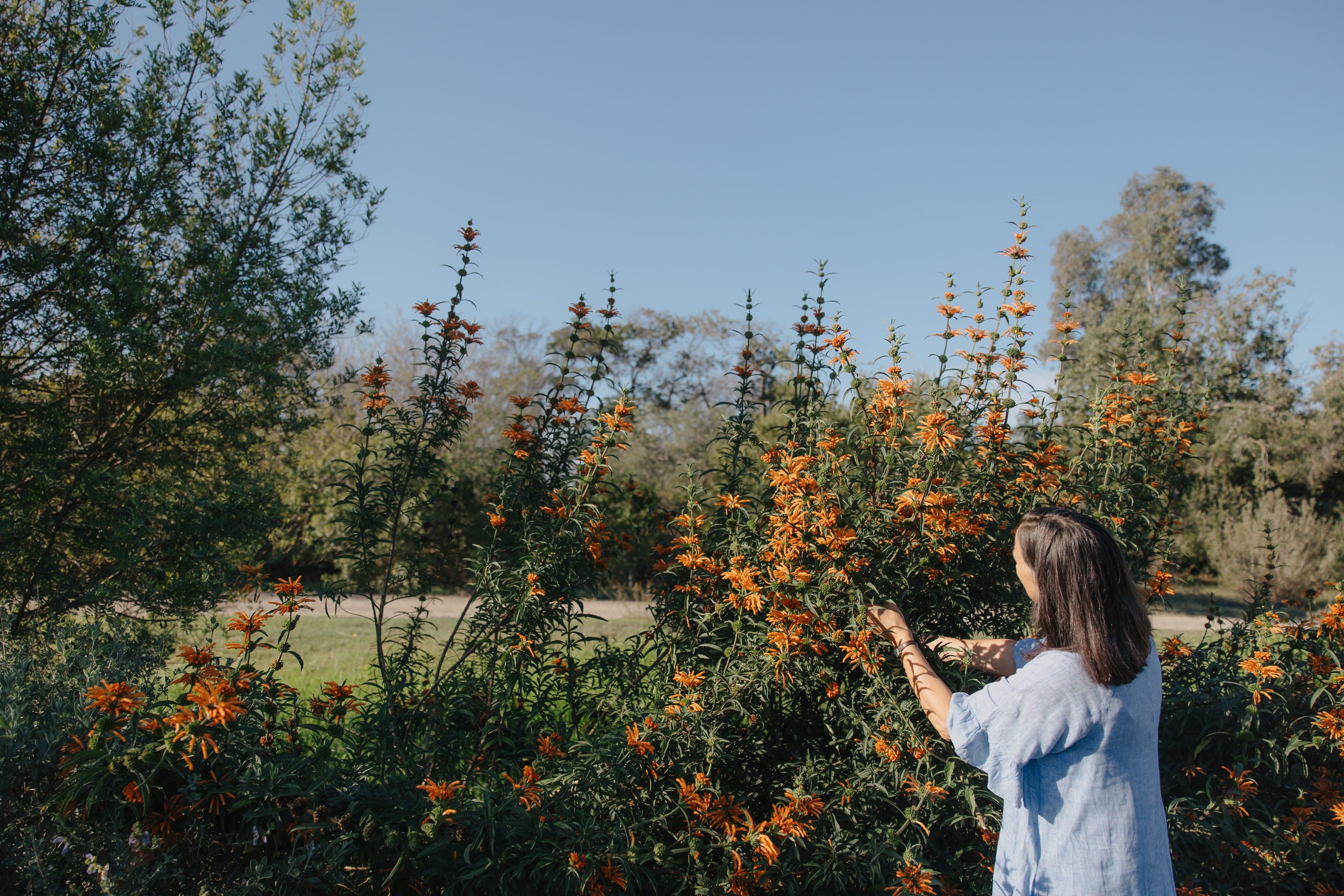
 Dr Caren Hauptfleisch, a registered phytotherapist.
Before it becomes “herbal medicine” it is usually something much simpler: a plant in a garden, a pot of tea or a leaf crushed between fingers.
For Dr Caren Hauptfleisch, a registered phytotherapist, that very simplicity is exactly the point. Healing, she believes, has become overcomplicated with promises of quick fixes and prescriptions when much of it begins in the everyday relationship between people and plants.
“The best medicine is what is growing around you,” she says. “It is not rare or distant. It is often already part of your life in the food that you eat, the plants that grow in your garden and the herbs in your kitchen.”
Working from her practice at Spier Wine Farm, where she also guides the Spier Spa’s use of farm-grown and wild-harvested botanicals, Dr Hauptfleisch’s approach is engrained in regenerative herbalism practices.
“It is less about replacing conventional medicine and more about restoring a forgotten layer of care that includes the use of plants as daily support for the body, not only intervention when things go wrong.”
“In chronic illness, especially, people expect a quick result,” she says. “But herbs don’t work like a pharmaceutical model. They support the body over time. It becomes a process of rebuilding and a journey of restoration.”
/file/attachments/2995/DrCarenHauptfleisch1_440917.jpg "Dr Caren Hauptfleisch at Spier Wine Farm.")
In Dr Hauptfleisch’s view, herbal medicine is often misunderstood because it is oversimplified.
“We live in a world of self-diagnosis and online information,” she says. “People choose herbs without understanding how they work in the body or whether they are even the correct species or preparation.”
“The result is misuse, not because herbs are unsafe but because they are ineffective or possibly dangerous when used incorrectly or without context.”
“In acute situations like infections, herbs can act quickly and effectively,” she says. “But in chronic illness, they support the body systems over time. They help the body regain function rather than just override symptoms.”
For her, wellness is not defined by a single symptom or test result. It is the integration of the body systems, emotional balance and daily wellbeing
“Being well means your body is comfortable. You are digesting, sleeping and interacting with your community. It is physical, emotional and environmental.”
Across the wellness culture, there has been a noticeable shift back to plant-based healing. But for Dr Hauptfleisch, this is less a trend and more a correction.
“It comes from the understanding that wellness is rooted in what we eat and herbs are part of that,” she says.
Many culinary herbs, she points out, are also medicinal such as rosemary, basil, thyme, parsley and mint. These are not exotic interventions but everyday ingredients with therapeutic value.
/file/attachments/2995/SpierSpaCapeHerbalBathHouse1_346720.jpg "Culinary herbs.")
“Our bodies are designed to work with nature,” she says. “We are dependent on plants not only for nutrition but for long-term health maintenance.”
But she is also cautious about what she calls the commercial dilution of herbal quality.
“Mass production can reduce potency. The way a plant is grown, harvested and dried affects its medicinal properties. That is why cultivation and education are so important.”
One of the most compelling aspects of her work is her focus on indigenous and regional plants, many of which are deeply embedded in South African traditional knowledge systems.
The Cape, she explains, is particularly rich in medicinal species.
“Plants such as buchu, wild garlic and African wormwood have long histories of use for urinary health, respiratory support, immune function and infection management. There is an entire pharmacopeia here,” she says. “We do not need to look far.”
She is especially passionate about reintroducing people to everyday healing plants such as:
- Rose-scented geranium (Pelargonium graveolens) - balancing for hormones, skin and the nervous system
- Cape mint (indigenous mint variety) - calming for digestion and stress
- Yarrow - traditionally used to support wound healing and stop bleeding
- Marshmallow root - soothing and supportive for gut and mucosal health
- Calendula - gentle antimicrobial and skin-healing support
“Many herbs are already growing in gardens or hedges, often unnoticed as medicine. I love walking guests through our apothecary garden, where herbs and plants aid in stillness and sensory connection, and sharing the many benefits of plants as we meander through the farm’s gardens.”
“Our guided fynbos tea tastings offer an introduction to the healthy properties of single-herb Cape teas grown on the farm and how to incorporate these in everyday enjoyment at home.”
Dr Hauptfleisch says a key principle in phytotherapy is that herbs are not single-compound interventions.
“Essential oils are only one part of the plant,” Dr Hauptfleisch explains. “Whole plant preparations include tannins, flavonoids and many other compounds that work together.”
“This synergy, sometimes referred to as the “whole plant effect”, is one reason herbal medicine is often described as system-supportive rather than symptom-targeting.”
She also emphasises the body’s interconnected systems, for example, digestion and immunity or the endocrine and nervous system.
/file/attachments/2995/SpierSpaHerbalBathHouse3_374426_565254.jpg)
“The digestive system is central to health. If it is not functioning well, it affects everything else, such as immunity, skin, mood and even chronic disease patterns.”
“Modern lifestyle often places strain on this system through stress, poor diet and environmental factors. Herbal medicine in this context is used to restore balance rather than force change.”
Dr Hauptfleisch is an advocate for making herbal medicine accessible, with caution and education naturally, and offers phytotherapy consultations in her private practice at Spier Wine Farm.
She says one of the simplest entry points is tea.
“Three cups of herbal infusion tea a day can be a gentle way to support the body,” she says. “Start with what you know. Food herbs are often the safest and most effective entry point.”
She also encourages seasonal awareness, using fresh herbs when available and drying small batches for later use. “If you want to harvest enough to dry, pick them on a sunny day when the dew has evaporated. Place them loosely packed in a warm, dark and dry place. They are dry when you can easily crumble the leaves. These dried leaves are best stored in glass containers.”
How to make your own herbal tea: Use culinary herbs like rosemary, thyme, mint or sage. Pick the leaves and chop up enough for a heaped teaspoonful. Place the leaves in a small teapot and cover with hot water. Seep for 10 to 15 minutes and enjoy before meals for optimal absorption.
She says herbal medicine also extends into skin care. “Aloe vera and Bulbine frutescens, both widely grown in South Africa, are used for their soothing and regenerative properties. These plants support the skin’s natural healing process,” she says. “They are gentle but effective.”
A simple ritual: Extract fresh gel from the leaf, mash or blend until smooth. Apply as a thin facial mask and rinse with warm water after 10 minutes or longer if skin is damaged due to acne or scars.
Underlying Dr Hauptfleisch’s work is a broader philosophy: that health is not separate from environment, diet or daily rhythm. Through this work, she has become one of Spier’s champions of a more connected way of thinking, listening to nature and embracing regenerative practices that recognise the relationship between people, plants and place.
“We are not only what we eat,” she says. “We are what we absorb, how we live and how we interact with our environment. From this perspective, herbs are not an alternative to medicine, they are part of a continuum of care that includes nutrition, lifestyle and conventional healthcare.”
Dr Hauptfleisch believes that if used well, herbs support rather than replace.
“Used wisely, they reconnect people to a slower, more observant relationship with their bodies. And perhaps that is the real medicine, not just what the plant does, but what it teaches us about how our bodies heal and function optimally.”
Dr Hauptfleisch was closely involved in conceptualising the Spier Spa Cape Bath House experience, a ritual that fully reflects her philosophy.
/file/attachments/2995/SpierSpaCapeHerbalBathHouse2_877650.jpg "Spier Spa Cape Bath House experience.")
Guests begin with a full-body exfoliation on a granite slab, followed by the bath itself. The water is infused with muslin bags, hand-filled with a blend she formulated consisting of organic rooibos, rose pelargonium, gotu cola and cliffortia odorata. The blend is toning, rejuvenating and calming, and safe for use throughout pregnancy. The ritual incorporates steam, continues with exfoliation using fresh herbs crushed with salt and concludes with a massage before enjoying a cup of Farm Tonic herbal tea.
You can book a private consultation with Dr Hauptfleisch at her Practice of Herbal Medicine at Spier, try one of the farm’s healing teas available from the Picnicker, enjoy a fynbos tea tasting or indulge in a Cape Bathhouse Ritual at the spa. DM