




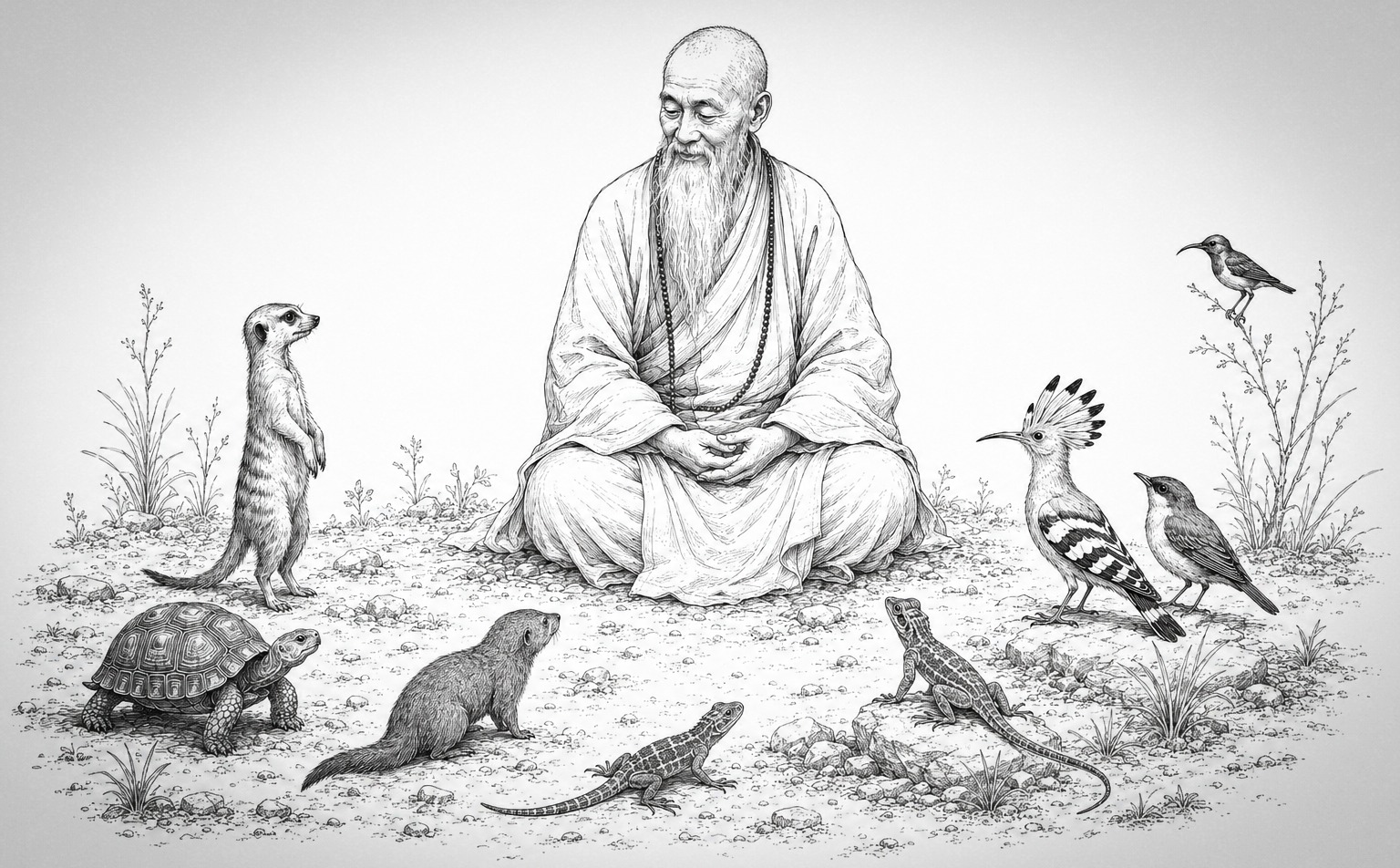
 Laozi left a few thousand characters about the Way, then walked back into the landscape.
(Image: Sketchy)
Laozi left a few thousand characters about the Way, then walked back into the landscape.
(Image: Sketchy)
There’s a story about the writing of the Tao Te Ching around 500 BC. Laozi, tired of the corruption and noise of human society, decides to leave civilisation behind.
He heads towards the mountains, towards obscurity, perhaps towards silence or to die. But at the frontier, a gatekeeper recognises him.
This is no ordinary old man wandering out of town, he realises. This is someone who has understood something essential. So the gatekeeper says he won’t let him pass until he’s written it down.
Laozi does. He leaves behind a text of about five thousand Chinese characters and then vanishes into legend.
It’s a perfect origin story for Taoism.
/file/attachments/orphans/TaoteChingbookcover_638647.jpg "(Cover: Wikipedia)")
The book is not proclaimed from a throne, temple or battlefield, but written at the edge of departure by a sage walking away from human busyness. Its wisdom comes not from conquest, revelation or command, but from withdrawal, observation and refusal.
Laozi’s act is already part of the teaching: step back, stop forcing, listen to the deeper movement of things.
In harmony
This is why Taoism is so compelling as a way to build a relationship with nature. Its claim is that the human problem begins when we imagine ourselves as separate from the natural order and worsens when we try to impose our cleverness upon it.
It asks whether wisdom might mean something more subtle: aligning ourselves with the way the world already unfolds.
At the centre of Taoism is the Tao: the Way. The Tao is not a creator-god standing outside nature, issuing instructions to the universe. It’s closer to the generative pattern of reality itself – the way things arise, change, flourish, decline and return.
The Tao is the movement “by which the ten thousand things come into being” – the growth of grasses, the course of rivers, the opening of flowers, the circling of seasons, the breathing of animals, the birth and decay of forms.
To live wisely, then, is not to escape nature, dominate or improve it. Rather it’s to understand that we are nature. Human beings are not managers sent in from elsewhere. We’re participants in the same unfolding.
Our bodies, desires, societies and thoughts are part of the world’s process. The question is whether we move with that process or against it.
This is where Taoism becomes especially relevant to ecological thought. Much of modern life is built on forcing. We force rivers into channels, force soils into overproduction, force animals into industrial systems, force attention into screens, force bodies into schedules, force cities into endless growth.
We call this development, efficiency or progress. Taoism doesn’t deny that humans must act. But it asks a simple question: are we acting with the grain of things, or against it?
Naturalness
One of the key Taoist concepts is ziran, often translated as naturalness. It means that each thing has its own way of being, its own tendency, its own inner course. A river rivers. A tree trees. A bird birds. Things flourish when allowed to follow their nature. They become distorted when continually impeded, redirected or made to serve purposes alien to them.
Human arrogance often begins in forgetting this. We look at a forest and see timber, carbon stock, real estate or “undeveloped land”. We look at animals and see livestock, pests, mascots, resources or data points. We look at rivers and see water supply, drainage, irrigation, hydroelectric potential.
Taoism doesn’t say these uses are always wrong. It says they’re dangerously incomplete. They mistake a living process for a human inventory.
The Taoist correction is not to abandon action, but to change the quality of action. This is the meaning of wu wei, often badly translated as “non-action”. Wu wei doesn’t mean doing nothing. It means non-forcing: acting in accordance with the situation, rather than imposing ourselves violently on it.
It’s the intelligence of the gardener, sailor, craftsperson, tracker, healer or cook. The gardener doesn’t shout at winter. The sailor doesn’t conquer the wind, or the cook bully an orange into sweetness. Good action pays attention to what is already there.
Applied to nature, wu wei becomes an ethic of restraint and responsiveness. It asks us to intervene lightly, to observe before acting, to work with cycles rather than against them. It prefers regeneration to extraction, adaptation to domination, patience to control. A farmer must plant, a healer must treat, a community must build. But these actions should assist the natural course of things, not crush it beneath an abstract plan.
Wisdom of water
Water is Taoism’s great image of this kind of wisdom. Water is soft, low, yielding and persistent. It doesn’t compete for height. It takes the shape of what contains it. It moves around obstacles. It nourishes without making declarations about its generosity. And yet, over time, it carves valleys and wears away stone.
The valley is powerful because it receives. The vessel is useful because it’s empty. The flexible branch survives the storm that breaks the rigid one. In ecological terms, this is a philosophy of resilience. Systems survive, not by becoming harder and more controlling, but by remaining adaptive, porous and responsive.
The straight, useful trees are cut down. The useless tree grows old, vast and shady. Human beings call things useless when they are useless to us. But usefulness to us is not the measure of existence. The tree has not failed. It has escaped being turned into shelving.
The story exposes the arrogance hidden inside the word “useful”. A wetland is useful if it can be drained. A river is useful if it can be dammed. A species is useful if it can be eaten, sold, photographed or studied. A landscape is useful if it can be developed.
Taoism replies: perhaps the highest value of a thing is not its availability to human purpose. Perhaps the world is not raw material waiting for our cleverness.
This is one of Taoism’s great ecological strengths. We’re not standing outside the world, deciding what it means. We are inside it, breathing it, eating it, made from it, returning to it.
Learning to yield
That makes Taoism deeply appropriate for our present crisis. Ecological collapse is not only a technical problem. It is also a spiritual and imaginative problem. We have developed astonishing powers of intervention without an equally strong discipline of restraint. We know how to extract, accelerate, optimise and expand. We are less good at yielding, waiting, listening and allowing.
Taoism doesn’t give us a modern environmental policy. It gives us something more basic: a way of seeing. Before management, relationship. Before use, attention. Before action, alignment.
At the mountain pass, Laozi writes and disappears. He doesn’t stay to found an institution, announce a doctrine or supervise disciples. He leaves a few thousand characters about the Way, then walks back into the landscape.
It’s hard to imagine a more fitting image. Taoism doesn’t ask us to conquer the world in the name of wisdom. It asks us to rejoin it.
The rivers are rivering. The trees are treeing. The Tao is already at work. Our task is not to master it. Our task is to stop getting in the way. DM
The best translation is by Ursula le Guin. Find the book and Kindle edition here.
/file/attachments/2985/NotesFromaSmallPlanet_Horizontal_Endorsement_960718.jpg)

Comments
Scroll down to load comments...