




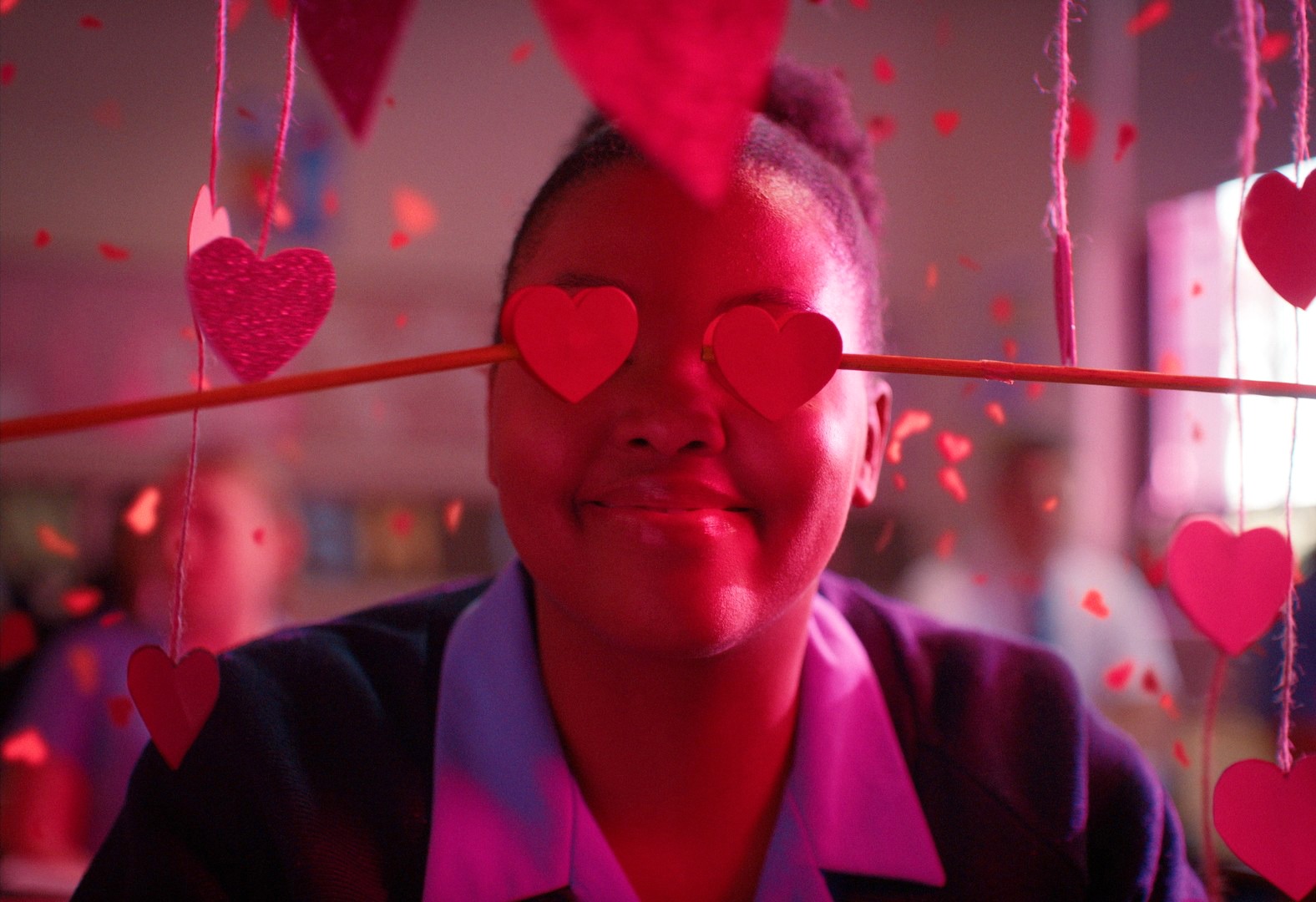
 Black Burns Fast brings a bold playfulness to its genre. (Photo: Indigenous Film)
It takes a special kind of creative voice to situate a film so resolutely within the tropes of a particular genre without losing itself to Hollywood formulas.
With her debut feature film, Black Burn Fast, Sandulela Asanda infuses South African humour, politics and sensibilities into the conventions of the coming-of-age romcom set in a private, religious boarding school.
Although the prestigious high school isn’t a new setting for South African screens (see Netflix’s Blood & Water, for example), Black Burns Fast brings an infectious and bold playfulness to the scene.
In Black Burns Fast, we meet the loveable and studious Luthando (Esihle Ndleleni) whose academic life is shaped by the pressure of being a scholarship student under the watchful eye of her strict mother.
And everything’s going according to plan until Luthando sets eyes on the new girl in class, Ayanda (Muadi Ilung). From then on, it’s all rosy and heart eyes – literally.
Black Burns Fast ticks off many of the all-girl boarding school tropes: from the new girl who’s given the rundown of the dos and don’ts of surviving the school’s social politics and the weird traditions that are best not questioned, all the way down to the thrift-store fashion montage that becomes both a moment of bonding and self-realisation.
But by establishing both aesthetic and narrative distinctiveness, the film never loses sight of its own voice among these conventions.
Stylistically, Black Burns Fast is a hodgepodge of cinematic languages, which sees scenes shot through distorting lenses and characters occasionally breaking the fourth wall. Yet, the movie’s irreverent and self-aware sense of humour pulls together these eclectic forms in a surprisingly persuasive way.
Most delightful is the film’s old-school video game visual effects used to externalise Luthando’s inner turmoil, like switching between different personality “players” or feeling like she has a luminous rainbow sign above her head screaming “lesbian!” as she walks through the school’s hallways.
Despite the story’s contemporary setting, these visual effects are, ironically, the foremost representation of technology in the film, making for a movie that is refreshingly free from being steered by social media or smartphones.
/file/attachments/orphans/BlackBurnsFastusesoldschoolvideogameeffectstoexternaliseLuthandosinnerturmoils_IndigenousFilm_323807.jpg "Black Burns Fast uses old-school video game effects to externalise Luthando’s inner turmoils. (Photo: Indigenous Film)")
This debut feature is the epitome of what writer and director of Rafiki, Wanuri Kahiu, coined as AfroBubbleGum: “A fun, fierce and frivolous representation of Africa.”
It’s kitsch, it’s silly and it’s by no means serious – exactly what storytelling about queer, black characters is in need of.
“I feel the urgency in giving young audiences the images and possibilities I never had,” writer-director Asanda says in a press statement for Indigenous Film.
“While researching this film, it was disheartening to find only two international references with black cast: Rafiki and Pariah. There were no South African stories centred on two black queer girls. That absence is still glaring. [Black Burns Fast] aims to fill that gap by offering a black lesbian love story that’s tender, awkward, joyful and messy, reflecting real adolescence. Instead of trauma, Luthando experiences support, love and belonging.”
Black Burns Fast is brilliantly cast by co-producer Cait Pansegrouw, with Ndleleni carrying the film’s comedic and innocent heart with a believable whimsy balanced with the dramatics of being a high schooler, but without ever overstepping into farce.
/file/attachments/orphans/EsihleNdleleniasLuthandoinBlackBurnsFast_IndigenousFilm_450954.jpg "Esihle Ndleleni as Luthando in Black Burns Fast. (Photo: Indigenous Film)")
Alongside Ndleleni is a cast of Luthando’s peers who deliver a natural chemistry, embodying the quintessentially adolescent quality of teasing and bantering being its own love language.
On the subject of chemistry – the romantic kind, to be exact – Black Burns Fast is far from being a slow-burn romance. In doing so it portrays the whirlwind of teenage romance. Yet this does leave the film’s middle portion susceptible to a loss of momentum, needing to rely on secondary characters to fill the narrative space ahead of the film’s turning point.
Though the movie’s conflict is very quickly resolved, it does so in a way that doesn’t need to be any deeper than it is. Because what is adolescence if not a tumultuous ride that can have you on top of the world at the ringing of the school’s first bell and then in the throes of emotional despair by the end of break time?
Black Burns Faster represents the heart of the adolescent experience: the clashing of friendships, of hormones and of adults who just don’t get it.
It’s the equivalent of a shot of cinematic nostalgia for those of us who grew up with the “chick flicks” of the 2000s – the likes of Mean Girls and Wild Child. Except this time, instead of Americanisms or English accents, we get locally made quotable gems like “Do some breathing, and reflect on the Rainbow Nation, okay?” DM
Black Burns Fast is screening at select cinemas from 31 July.
Comments
Scroll down to load comments...