



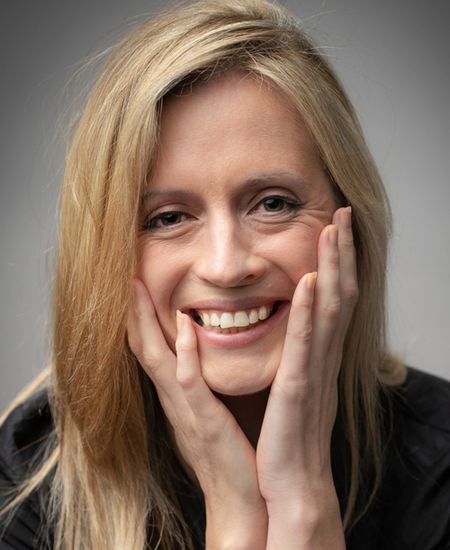
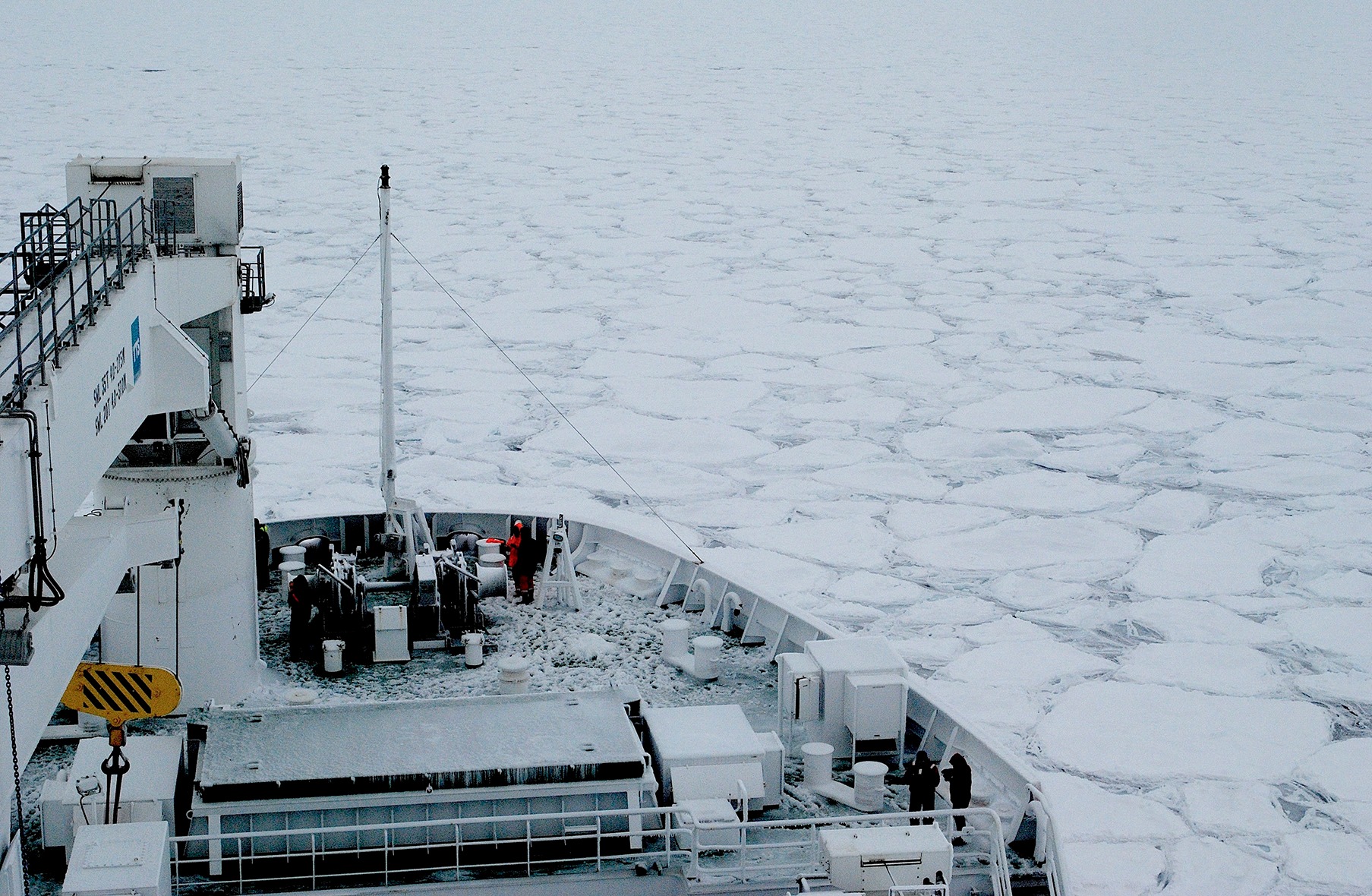
 The SA Agulhas II during the Southern Ocean Seasonal Cycle Experiment (SOSCEx) winter cruise in July 2012. (Photo: Sandy Thomalla)
When Dr Sandy Thomalla first met South African oceanographer Professor Pedro Monteiro aboard the French research vessel Marion Dufresne in 2008, she had no intention of returning to South Africa.
After completing her doctoral studies in the UK, she had become accustomed to working aboard some of Europe’s most advanced research ships. South Africa, by comparison, lacked the infrastructure she had grown used to.
“I was fresh out of my PhD,” recalled Thomalla, who specialises in ocean biogeochemistry. “Pedro offered me a postdoc, which I politely declined: ‘No thanks, cheers. I’m good.’”
By the end of the voyage Monteiro had changed her mind.
“He sat down and shared his vision with me. He explained: ‘This is what I want to build. This is what I’m going to create.’ I was hooked and I’ve never looked back.”
A vision worth coming home for
Nearly two decades later, Thomalla leads the Southern Ocean Carbon-Climate Observatory (Socco), a Department of Science, Technology and Innovation-funded national programme that has evolved into a significant South African scientific success story. Socco is hosted by the CSIR.
From a core team of six permanent scientists, supported by students, engineers and other collaborators, Socco has tackled one of climate science’s biggest unknowns.
That is, how long the Southern Ocean can continue protecting the planet against climate change.
/file/attachments/orphans/SOCCOWaveGlider_186772.jpg "A Socco WaveGlider autonomous robotic platform measures CO2 flux during a sea trial in Table Bay, Cape Town, in 2015. (Photo: Sea Technology Services)")
Though remote, these waters absorb half of the world oceans’ carbon dioxide and 75% of excess greenhouse gas heat.
Scientists still do not know exactly how this vast climate buffer will respond as the planet continues warming, making it one of the greatest uncertainties in climate projections.
Today the programme contributes data to international climate assessments, deploys autonomous ocean robots and develops sensors that are capable of surviving one of Earth’s harshest marine environments. It has also published in high-impact journals such as Science, Nature Climate Change and Nature Reviews Earth & Environment, and has helped train more than 70 postgraduate scientists.
Richard Sanders, a director and biochemist at the Norwegian Research Centre (NORCE), described the programme as “an exemplar” of how autonomous technologies can deliver “high-level contributions to the global carbon budget – our measure of the planet’s ‘carbon accounts’, on which the evolution of climate and our livelihoods depend”.
‘Too cold, too old: The plastic shattered every time the trigger hit the bottle’
Thomalla – who has taken part in more than 25 research expeditions – remembers a very different beginning.
“When we started, we had no equipment, an ageing vessel, no infrastructure and no capacity,” she said.
On an early Antarctic voyage aboard the veteran SA Agulhas I – predecessor to the 2012-launched SA Agulhas II – researchers were forced to improvise to keep the science going.
“I used these ancient Niskin bottles from the 1970s that I got out of a storeroom,” she said. “Every time the trigger hit the bottle the plastic was shattering because they were too cold and too old.”
Even simple repairs required ingenuity.
“We were making new triggers for the bottles out of chopping boards from the kitchen.”
From improvised tools to ocean robots
In 2015, Socco was the first to put autonomous robotic platforms in the Southern Ocean – years before such systems became central to international efforts to understand how the ocean absorbs carbon dioxide.
“The world is now turning towards autonomous platforms as the solution,” Thomalla said. “Socco were the pioneers.”
/file/attachments/orphans/SOCCOSAAgulhasIIsubantarctic_472518.jpg "The SA Agulhas II sails through the subantarctic zone during a relief voyage to South Africa’s Antarctic research station in 2015. (Photo: Sandy Thomalla)")
This experience, the oceanographer noted, is attracting attention from some of the world’s biggest climate research initiatives.
“All these international people are coming to us and saying, ‘Can you work on this? Can you join this project?’” she said. “We’ve got these years of experience.”
Thomalla’s assessment is supported by Professor Juliet Hermes, an oceanographer at the South African Environmental Observation Network and the National Research Foundation.
“Socco’s biggest success has been taking cutting-edge technology like autonomous gliders and bio-floats and using them to do groundbreaking research,” Hermes said, noting that the work had put South African oceanography “on the global map”.
“Giving a new, diverse generation of South African researchers direct access to that kind of technology builds human capacity, and boosts our international reputation,” Hermes said.
The African icebreaker that changed the science
The programme’s evolution has never simply been about publishing scientific papers, Thomalla added.
“First you buy the equipment and set up the facilities, then you have to learn how to use it, and only then do you become leaders in deploying cutting-edge capabilities.”
Since its inception, Thomalla says the programme has established six major research facilities and helped position South African researchers within influential bodies, including the Intergovernmental Panel on Climate Change (IPCC).
/file/attachments/orphans/SOCCOemperorpenguins_273620.jpg "Emperor penguins on Antarctic ice during the Southern Ocean Seasonal Cycle Experiment (SOSCEx) summer cruise, 2013. (Photo: Sandy Thomalla)")
Thomalla herself was recently appointed lead author for the IPCC’s Seventh Assessment Report, following in the footsteps of Monteiro, who served as a coordinating lead author on the previous assessment.
“But if we pretend the six of us are achieving all this on our own, we’d be kidding ourselves,” Thomalla said. “It’s really through the help of our students and our collaborators.”
She is quick to credit Monteiro.
“Anything I’ve achieved is standing on the shoulders of giants,” she said. “He had the vision.”
Monteiro said the idea emerged when he realised South Africa was investing in a new polar research vessel. “It became an opportunity to start an ocean climate programme in a part of the ocean that was on our doorstep,” he said.
Funding under review: ‘A bigger climate footprint for South Africa’?
Around the world, polar research programmes periodically face funding cuts, ageing infrastructure and political uncertainty. Those pressures are neither unique nor permanent.
But the history of Socco appears to challenge a common assumption that internationally competitive science requires the scale or budgets of the world’s largest research nations.
As the programme looks to enter its next phase, it says it hopes to advance climate modelling, develop policy-ready climate tools and expand its internationally recognised robotic systems.
After investing more than R150-million in Socco since 2012/13, the Department of Science, Technology and Innovation told Daily Maverick on Wednesday that the programme’s funding was under review. The outcome would determine “future arrangements”.
Continued support was “not being discounted”, but funding could take “a different form”.
“The review of our existing investments (not only Socco) is crucial considering general stagnation (even reduction in some cases) in fiscal funding across government,” said Leluma Matooane, the department’s earth systems science director.
/file/attachments/orphans/SOCCORosetteSampler_783911.jpeg "Deploying a rosette sampler to collect trace-metal clean water from the aft of the SA Agulhas I in 2009. (Photo: Sandy Thomalla)")
For Thomalla, the programme’s track record over the years speaks for itself.
“We’ve shown what a small team can do,” she said. “With continued, long-term strategic funding I can only see us growing. More policy-relevant science, more capacity building and a bigger footprint for South Africa in global climate research.” DM


Comments
Scroll down to load comments...