




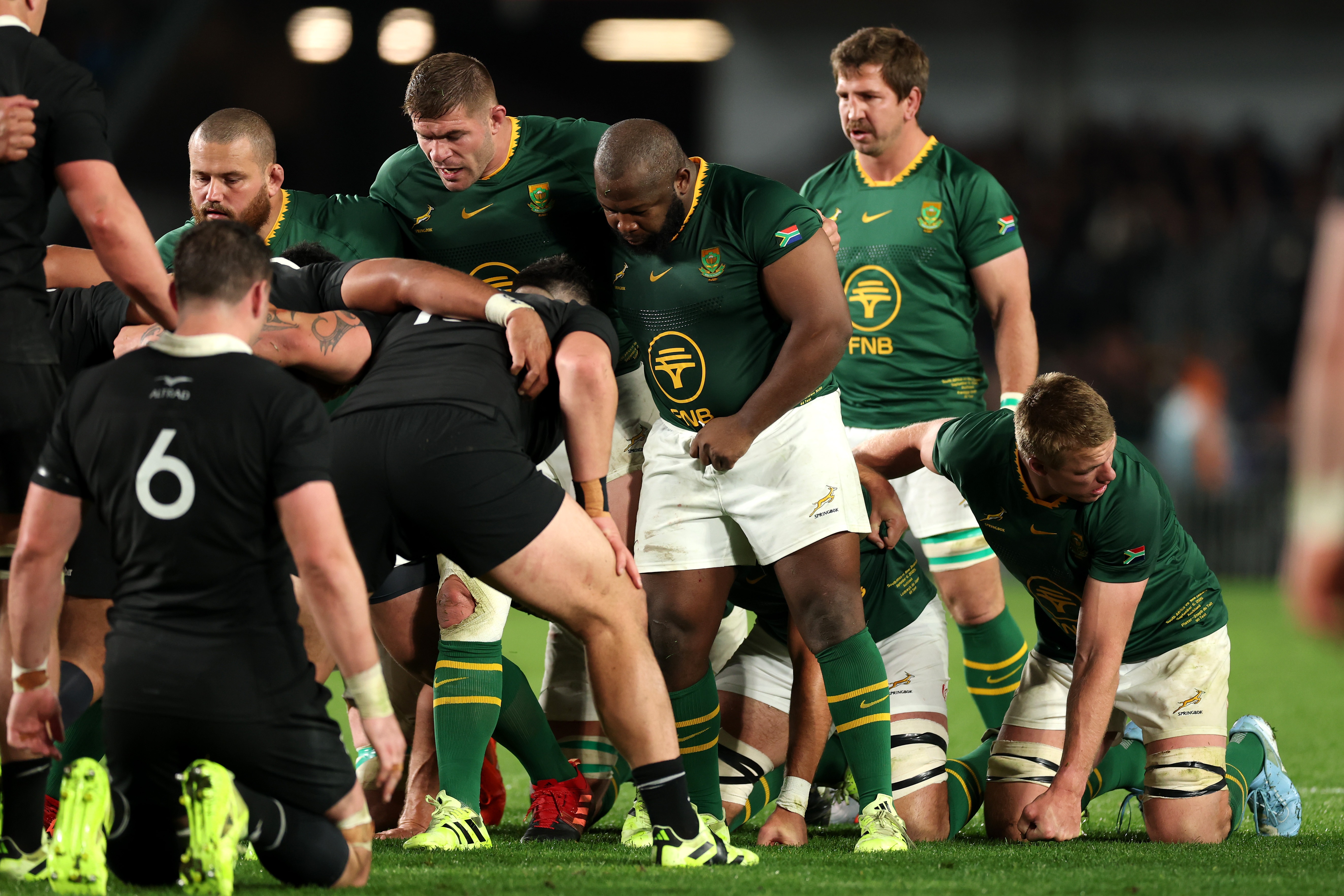
 Rassie Erasmus has built huge depth in the Springbok front row with multiple player combinations available. (Photo: Phil Walter/Getty Images)
History will be made on 7 August, when the All Blacks begin their eight-match tour of South Africa against the Stormers in Cape Town.
The inaugural Rugby’s Greatest Rivalry series includes four matches against the local franchises as well as four consecutive games against the Springboks – and over the next six weeks, the depth of both nations will be tested like never before.
All Blacks coach Dave Rennie has loaded his 44-man squad with versatile forwards with the potential to survive what should be a brutal physical contest. The fact that he’s picked 12 front rankers – essentially four completely different combinations – suggests that the tourists are bracing for an almighty set-piece assault.
Meanwhile, the Boks have added another front ranker – loosehead prop Ntuthuko Mchunu – to their ranks as they prepare for the one-off against Argentina on 8 August and the four-Test series against New Zealand that follows.
While both teams are playing a high-tempo, high-scoring brand of rugby at present, the upcoming scrum battle may shape the war for results.
And given all we’ve seen in recent seasons in terms of development and performance, the Boks will go into that particular battle as favourites.
/file/attachments/orphans/2246126001_322046.jpg "Prop Thomas du Toit, who can operate at loosehead and tighthead, will be a key figure for the Springboks in the series against the All Blacks. (Photo: David Rogers / Getty Images)")
Forty-one different combos
Over the past three seasons, Rassie Erasmus has bolstered the nation’s front-row stocks, with the aim of maintaining the team’s edge at the scrum.
Since the start of 2024, the Bok coach has selected 41 different front-row combinations across 33 matches – and only eight of those combinations have featured more than twice.
The ever-changing Bok pack has continued to force set-piece penalties against various opponents and has laid the platform for an overall record of 29 wins and four losses in the current World Cup cycle.
While those are eye-catching numbers and results, they don’t quite tell the story about the team’s evolution – especially over the past 18 months.
Erasmus has selected 30 different front-row combinations in 20 matches since the start of the 2025 season – and only four of those combinations have been used more than twice.
/file/attachments/orphans/TL_2584502_968378.jpg "Hooker Malcolm Marx is not only a force in the loose, but a huge part of the Boks' immensely powerful scrum. (Photo: Johan Orton / Gallo Images)")
The Boks can’t take 30 combinations to the 2027 World Cup, of course, and if the final was played this weekend, Thomas du Toit, Malcolm Marx and Ox Nché would surely pack down for the starting side, while Wilco Louw, Jan-Hendrik Wessels and Gerhard Steenekamp would lead the Bomb Squad.
And yet, it’s interesting to note how Johan Grobbelaar and Boan Venter have featured in some of the most used combinations over the past two seasons, and that when fit veteran Frans Malherbe has been a regular starter. The double World Cup-winner is currently recovering from a long-term back injury, but may yet return before the next global tournament in Australia. Malherbe is on track for a January 2027 return.
The World Cup final is about 16 months away, but the Boks will face a unique challenge in the coming series when they play four gruelling back-to-back Tests.
Given the quality of the All Blacks, it wouldn’t be an exaggeration to suggest that all four contests will replicate the intensity of a World Cup final, or that both teams will need to be at their best to secure the desired results.
/file/attachments/2995/Frontrowdepth24-26_909599.png "The formidable Springboks’ front row depth chart. (Graphic: Jon Cardinelli)")
Building a weapon to go the distance
Thanks to Erasmus’ long-term development strategy, the Boks are better equipped that the All Blacks to rotate a 44-man group across four matches without losing much in terms of intensity and potency.
Some may find this statement presumptuous and arrogant, but it is made with recent selections and results in mind.
Erasmus used 50 players in 2024 and 2025, and has already used 67 across the matches in 2026. In spite of the ongoing changes in personnel, the Boks have achieved an 87% success rate in Tests during this period.
/file/attachments/orphans/2286887772_175638.jpg "Prop Gerhard Steenekamp has become a valuable member of the Bomb Squad. (Photo: David Rogers / Getty Images)")
Erasmus has picked various combinations across the starting XV and Bomb Squad, and not just in the front row. While he has rotated the locks and loose forwards – who are vital to the team’s scrummaging success – the Boks have maintained high levels of power and accuracy.
Last November, the Boks produced one of the great scrummaging performances against Ireland in Dublin, forcing the hosts to concede a whopping seven penalties and two yellow cards.
The fact that they bulldozed Ireland without World Cup-winners such as Ox Nché, Malherbe, Bongi Mbonambi, Trevor Nyakane and Vincent Koch showed how far the pack has come, and indeed how much depth South African rugby has in those front-row positions. Boan Venter, for example, started against Ireland at loosehead after making his Test debut just four months earlier.
/file/attachments/2995/Scrumpensbymatch_263233.png "The Boks’ scrum power has produced a slew of penalties in recent years. (Graphic: Jon Cardinelli)")
Prior to that tour, the Boks drew the Freedom Cup series in New Zealand and eventually won the Rugby Championship. While the record-breaking 43-10 win against the All Blacks in Wellington will go down in history, few will forget what transpired in Auckland, when the Bok scrum marched the All Blacks backwards and won a heel against the head.
The turnover led to a try for Marx, and while the late score wasn’t enough to win the game, it gave the Boks a much-needed boost before the series decider in Wellington. The forwards might reflect on that explosive set-piece performance at Eden Park when preparing for the next four Tests against their arch-rivals.
/file/attachments/orphans/2284525714_312990.jpg "Prop Ox Nché is in a race to be fit for the first Test against the All Blacks on 22 August, but he should play a role in the series at some stage. (Photo: Steve Haag / Nations Championship via Getty Images)")
War of attrition
Rennie faces a careful balancing act in the lead-up to the Test series.
More than half of the All Blacks’ squad hasn’t played in SA in this World Cup cycle, and the coach may want to expose those players to local conditions sooner rather than later.
At the same time, he may want to give his strongest combinations a decent run before the four-Test block commences on 22 August.
There are bound to be a few injury setbacks over the course of an eight-week tour, but Rennie will be hoping that leading front-rankers such as Tyler Lomax (51 caps), Codie Taylor (109) and Ethan de Groot (43) remain fit.
The All Blacks have some quality in the second tier – hooker Samisoni Taukei’aho will be one to watch – but New Zealand’s third and fourth options don’t boast the same level of experience or achievement as the corresponding South African heavies, as Xavier Numia, George Bell, Ollie Norris and Siale Lauaki have fewer than five caps.
Rennie may need to manage the Lomax-Taylor-De Groot combination carefully across the four Tests to ensure that they don’t succumb to fatigue and ultimately a drop in performance.
Erasmus, of course, has been managing his combinations in this manner for the better part of a decade, and has been developing this particular group of players for a multi-game challenge for three seasons.
/file/attachments/orphans/TL_2587456_731485.jpg "Bok coach Rassie Erasmus has cleverly deployed his front row resources over the years. (Photo: Steve Haag Sports / Gallo Images)")
He used 37 players on the five-match tour of Europe last November, and more recently juggled his resources across the consecutive Tests against England, Scotland and Wales – and by the end of that campaign, the Boks had extended their winning streak to 11 Tests.
With regards to the front-row group, the Boks possess a healthy blend of youth and experience, as well as several players who can contribute in more than one position.
They’re likely to suffer a few injury setbacks in a series of this nature, but as Venter showed against Ireland last year, the Boks’ third-choice option is more than capable of contributing towards a game-shaping scrummaging performance.
And by the end of a taxing tour – which includes a long-haul flight to Baltimore, US, for the fourth and final fixture – these third- and fourth-choice players may hold the fate of the series in their hands. DM
Comments
Scroll down to load comments...