




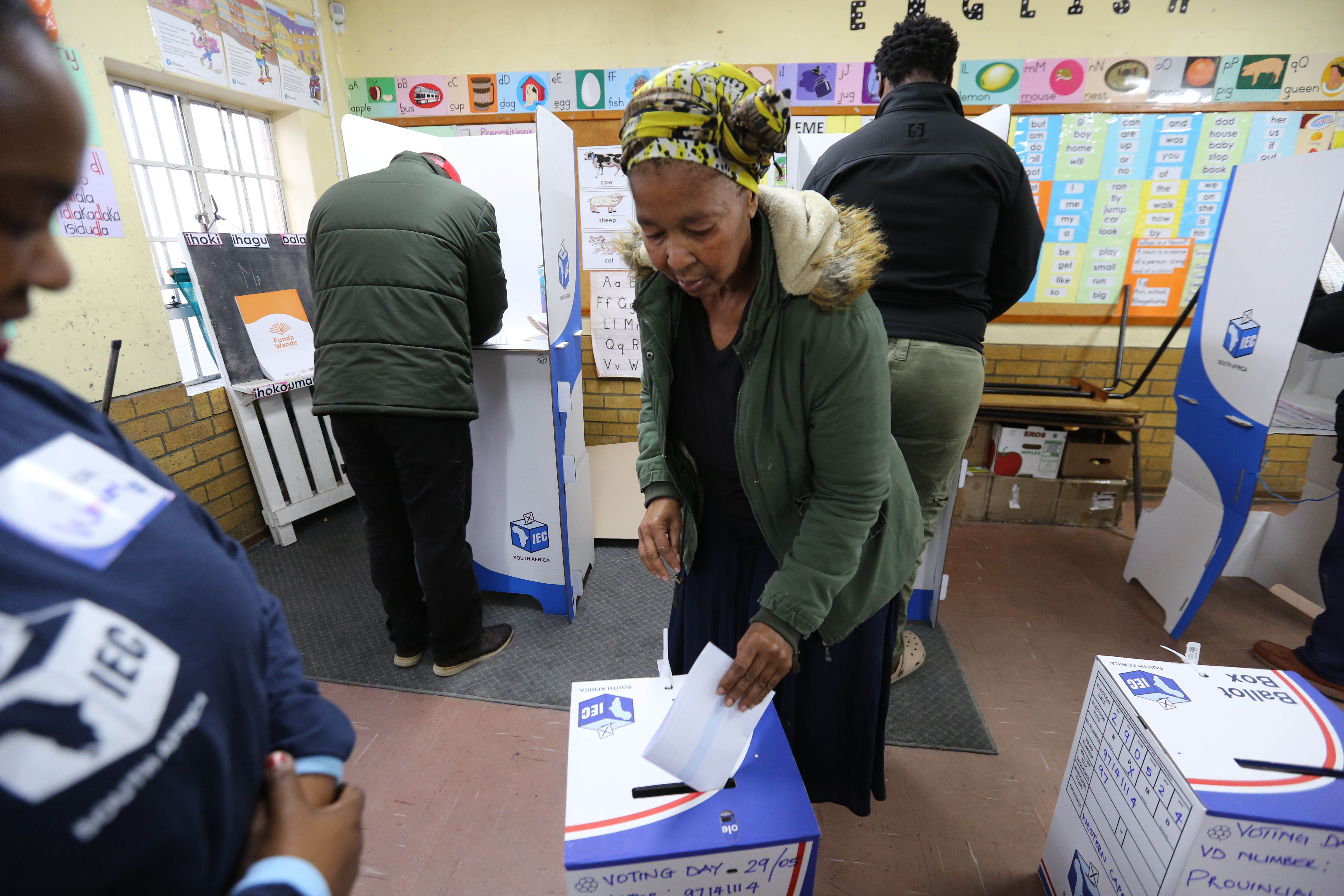
 A voter places her vote in the ballot box at at Sivuyiseni Primary School in Khayelitsha. 29 May 2024. (Photo: Shelley Christians)
Between elections, governments govern, budgets are spent, laws are implemented and public institutions make decisions that shape our everyday lives. Students wait anxiously to hear whether their NSFAS funding has been approved. Commuters absorb another increase in transport costs. Businesses and households adjust to another bout of electricity disruptions. Whistleblowers weigh up whether exposing corruption is worth risking their careers or even their lives.
Most of us experience these as separate frustrations. Yet they are connected by a single question that is seldom asked: “Who is making sure government is doing its job”? Many people would instinctively answer: Parliament. In theory, they would be right. Parliament is often associated with televised debates, fiery exchanges across the chamber and the passing of legislation. Yet those visible moments are only part of its constitutional purpose. Parliament’s most important responsibility is arguably its least understood: holding government to account. It is through oversight – not only legislation – that Parliament protects our democracy. That oversight determines whether departments spend public money responsibly, whether state-owned entities fulfil their mandates, whether ministers answer difficult questions and whether government keeps the promises it makes to citizens. When Parliament performs this role effectively, democratic accountability becomes real. When it does not, the consequences are rarely confined to committee rooms in Cape Town. They are felt in classrooms, hospitals, municipal offices, police stations and homes across the country.
This is where civil society enters the story. Civil society is often described as a collection of non-governmental organisations, advocacy groups and charities. While true, this definition barely captures its constitutional significance. Civil society exists because democracy requires more than elected representatives. It requires citizens who ask questions, organisations that conduct independent research, journalists who investigate, academics who analyse, community groups who organise and institutions willing to challenge decisions that undermine the public interest. Civil society does not exist to replace government. Nor does it exist simply to criticise it. Its purpose is to strengthen democratic governance by ensuring that public power remains accountable to the people from whom it is derived.
This role has become even more important as South Africa enters a new political chapter. Thirty years into constitutional democracy, and following the emergence of coalition politics after the 2024 elections, the country’s institutions are operating in a far more complex political environment. Trust in public institutions has declined, state resources are increasingly constrained, and citizens rightly expect more responsive and transparent government. These conditions demand something more than stronger political parties. They demand stronger democratic institutions. And they demand an active civil society.
The work of organisations such as OUTA illustrates what this looks like in practice. Whether engaging issues surrounding NSFAS and the SETAs, advocating for stronger whistleblower protection, scrutinising transport policy, or promoting accountability within Eskom and other public institutions, the objective has never been opposition for opposition’s sake. The objective has always been better governance. Because every governance failure eventually becomes somebody’s lived experience. A student denied financial aid loses more than funding. They lose opportunity. An unprotected whistleblower loses more than employment. They lose security. Communities affected by failing infrastructure lose more than electricity. They lose economic opportunity, access to healthcare and confidence in public institutions.
Governance failures are ultimately human stories. That is why accountability matters. It is also why Parliament matters. Yet accountability is only possible when citizens can understand how Parliament is performing. Democracy becomes difficult to exercise if parliamentary information is inaccessible, fragmented or incomprehensible. This is where civic innovation is beginning to reshape democratic participation. Technology should never replace representative democracy. But it can strengthen it. Live streamed committee meetings, digital public participation, open parliamentary data and artificial intelligence all offer opportunities to make Parliament more transparent and more accessible than ever before. The challenge is ensuring that technology serves democracy rather than bureaucracy.
That thinking inspired the development of ParliMeter. ParliMeter was never conceived as another website about Parliament. It was designed around a much simpler idea: citizens should be able to understand whether Parliament is fulfilling its constitutional responsibilities. Not simply by measuring how many meetings are held or how many Bills are introduced, but by helping citizens ask a more meaningful question: “Is Parliament improving people’s lives”? That is ultimately the measure that matters. Democracy is not strengthened because more information exists. It is strengthened because more people can use that information to participate, question and hold power accountable. South Africa’s political future will not be determined solely by elections, coalition agreements or changes in political leadership. It will be shaped by whether citizens remain engaged between elections.
Whether Parliament embraces its oversight responsibilities. Whether government accepts accountability as an essential feature of constitutional democracy rather than an inconvenience. And whether civil society continues to serve as one of democracy’s most important conscience keepers.
The strength of a democracy is not measured only by how freely its people can vote. It is measured by how effectively they can hold power to account once the voting is over. DM
Author: Dr Rachel Fischer, Parliamentary Engagement & Research Manager at the Organisation Undoing Tax Abuse (OUTA)
ParliMeter is co-funded by the European Union.