




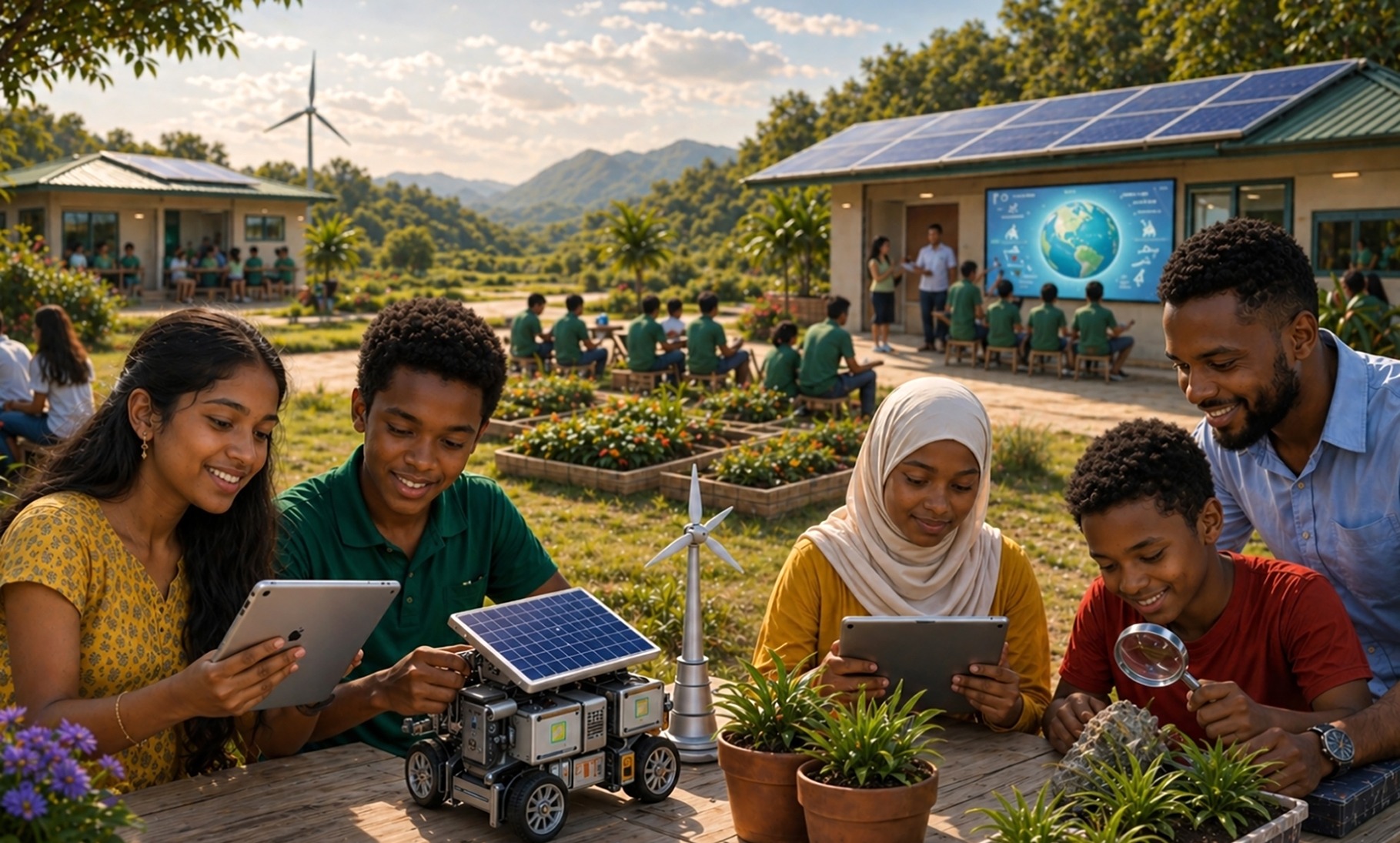
 A group of schoolchildren explore sustainable-energy devices. (Image: Wilderness Foundation Africa)
It’s getting harder to imagine a happy ending.
The planet is heating, species are disappearing and wars flicker continually across our screens. For many people, especially the young, the future no longer feels like a place of possibility.
The understandable response is retreat. We scroll past the bad news, concentrate on the next deadline and hope that someone will sort it out.
The environmental movement doesn’t help much. It’s become exceptionally good at describing what’s being lost, but far less accomplished at showing what success might feel like.
Professor Nicholas King calls this a failure of imagination. An environmental futurist, King is among a growing number of people trying to think and plan their way beyond the clouds of doom. His work begins with a deceptively simple proposition: if the only future we can picture is catastrophe, catastrophe becomes the only destination towards which we know how to travel.
“There isn’t just a single trajectory going forward, which is the way most people live their lives,” he tells me. Businesses and governments generally assume that tomorrow will be a modified version of today. But “the future doesn’t exist”. It is not a fixed country waiting for our arrival.
Futures thinking is not prediction or airy utopianism. King calls it “evidence-based dreaming”: examining trends, noticing weak signals, listening to different experiences and exploring several possible directions.
That diversity is vital: without it, the exercise produces little more than groupthink.
Africa is the world’s youngest continent, yet the decisions shaping 2050 are still largely made by older people who will not live with their full consequences. “Where are those people who are going to inherit the world in 2050?” King asks. “It’s only 25 years away.”
King helped facilitate an African conservation futures workshop for Wilderness Foundation Africa. Its formal report considers the structural work required, including better governance, ecosystem restoration, indigenous knowledge, youth participation and an end to extractive systems.
But one group found another way into the problem. They began making a travel guide to Africa in 2050. They cut pictures from magazines, invented journeys and imagined what visitors would eat and carry.
King says that they became so excited “they wouldn’t stop working”. The resulting Africa Travel Guide 2050 is playful, bright and sensually futuristic. It makes a better future something that can be seen, tasted and travelled through.
/file/attachments/orphans/NoText_COPY4_933124.jpg "Natupia (formerly Kigali in Rwanda) could be one of the most inspiring examples of how cities in Africa could be redesigned to live in harmony with nature. (Image: Wilderness Foundation Africa)")
In its pages, a solar-powered Marula Watch acts as passport, translator, wallet and health monitor. Medical supplies reach remote communities by drone. Travellers use a common currency, the Afro. Restored forests and wetlands protect settlements while supporting livelihoods. Food is local, varied and recognisably African.
On a train through a revived Karoo, passengers look out on herds of springbok instead of exhausted sheep farms. People still live and work in the landscape. Nature has not been saved by removing humans from it.
/file/attachments/orphans/NoText_COPY2_716639.jpg "The Africa Travel Guide 2050 is an invitation to imagine an African-centric future for the peoples and landscapes of the continent. (Image: Wilderness Foundation Africa)")
The details may be invented, but they perform serious work. A fraction of a degree in a climate target is difficult to feel. What people eat for breakfast, a high-speed train journey or a wetland that prevents your neighbourhood flooding is not. “How do we get people really to embrace something that they can feel and they can see?” King asks.
Environmental communication has acquired a familiar palette of fire, smoke, cracked earth and dead vegetation. Its vocabulary is equally bleak: decline, collapse, extinction and crisis. These words describe real conditions. But repeated without a convincing alternative, they can transform urgency into paralysis.
King is particularly impatient with hope when it means waiting. “Hope is almost like: let’s sit back and wait for the knight in shining armour to come and rescue us,” he says. Optimism is different. It can energise people because it gives them something to work towards. Pessimism, when used to excuse inaction, becomes “a form of intellectual laziness”.
This is not a denial of the danger. King argues that humanity has entered a novel ecological context and that many familiar systems must be phased out.
The take, make, and throw-away economy cannot simply be painted green. Extractive industries, disposable plastics and fossil-fuel dependence have to give way to circular manufacturing, urban recycle-mining, ecosystem repair and better public transport.
The transition will cost money, but King says this should be weighed against repeatedly rebuilding after failure. Canalise a river, destroy its wetlands and a flood may wash away a bridge. Rebuild without restoring the wetland, and it may happen again... and again. Paying now to restore the wetland as a water sponge avoids greater losses later.
/file/attachments/orphans/NoText_COPY7_848855.jpg "Flotopia — a floating self-sustaining community anchored along coastlines and waterways. (Image: Wilderness Foundation Africa)")
His vision also rejects an older colonial conservation model: fence off a beautiful place and push people out. The alternative is “mega living landscapes”, a process being stitched into South Africa’s legal framework. Here people are participants and stewards rather than intruders. “We’re part of the environment,” he says. “We need to just change our relationship with the landscapes, with biodiversity, with other species.”
There are already glimpses of this future. In northern Namibia, communities live among lions and desert elephants, protect livestock more carefully and construct water points from where elephants can drink without destroying pipes and pumps. The principle is accommodation rather than separation.
Technology will play a role, he says, though it’s not automatically benign. Drones can collect DNA from the breath of whales without touching them. Artificial intelligence can detect patterns in migration data. The same tools can enable surveillance and exclusion. Who controls the technology, owns its information, and benefits?
/file/attachments/orphans/NoText_COPY5_389455.jpg "Drone delivery could be seamlessly integrated into daily life. (Image: Wilderness Foundation Africa)</p>
<p>")
The future cannot be designed by experts and handed down. King wants municipalities, schools, youth networks, faith groups and local leaders to ask what people want, then backfill the plans to build the future. An example could be asking Cape Town residents whether they’d prefer another road project or a fast train to the airport.
The poet Rainer Maria Rilke wrote that the future must enter into us for a long time before it happens. King’s work gives that idea civic force. Before people can build a different world, they need the time and freedom to picture it.
/file/attachments/orphans/NoText_COPY6_643823.jpg "Eco-conscious restaurants that use locally sourced ingredients and seasonal produce, offering meals that are nourishing and environmentally responsible. (Image: Wilderness Foundation Africa)<br>")
Perhaps what we need is a nostalgia for the future: a longing for a place we have never visited but can describe well enough to miss. The Marula Watches and roaming springbok are not predictions. They’re pieces of mental equipment.
“If we can describe positive futures,” King says, “then there’s something to actually aim at and head towards.”
The future we fear is not inevitable. But neither is the one we want. First we must imagine it. Then comes the harder, more hopeful task of finding a way to make it real. DM


Comments
Scroll down to load comments...