




 MEC Lebogang Maile during the announcement of the 2027 online admissions commencement date and application process at the Gauteng Gambling Board on 27 July 2026 in Johannesburg, South Africa. The MEC outlined the application timeline and other important information to parents, guardians and caregivers so that they can successfully apply for the placement of children who are going to Grades 1 and 8 in 2027 at Gauteng public schools. (Photo: Gallo Images / Lubabalo Lesolle)
The Gauteng Department of Education has confirmed that applications for the 2027 online admissions for Grade 1 and Grade 8 will officially open at 8am on Wednesday, 5 August 2026, and close at midnight on Friday, 4 September.
Gauteng MEC for Education, Sport, Arts, Culture and Recreation, Lebogang Maile, encouraged parents and legal guardians to prepare early by gathering the required supporting documents, verifying their information and familiarising themselves with the application process before the system opens.
He added that the integrity, accuracy and timeliness of each application determined how effectively the government could respond to growing demand for quality public education across Gauteng, which serves more than 2.4 million learners in about 2,100 public schools. Between 2025 and 2026 learner enrolment rose by 2,300, equivalent to demand for roughly 19 additional schools each with capacity for 1,200 learners, reflecting rapid urbanisation, population growth and migration into the province and the consequent pressure on education infrastructure and public resources.
What parents must know before the system opens
Maile said all applications for Grade 1 and Grade 8 admissions must be submitted exclusively through the Gauteng online admissions system during the application period. He also reminded parents that children currently enrolled in Grade R were not automatically promoted to Grade 1 at the same school and must still apply through the online admissions system.
Applicants would need to create new login credentials, as previous usernames and passwords would no longer be valid.
Every applicant must complete the department’s compulsory five-step process by:
- Registering the parent or legal guardian.
- Registering the pupil’s residential address.
- Capturing the student’s personal details.
- Applying to a minimum of three and a maximum of five public schools.
- Uploading or submitting all required supporting documents within seven school days after completing the online application.
Maile stressed that registration alone did not constitute a valid application, as an application would only be regarded as complete once every compulsory step had been successfully concluded.
He encouraged parents to apply to between three and five schools, cautioning that limiting applications to only one or two schools could reduce the likelihood of securing placement if those schools reached capacity.
“Selecting between three and five schools, particularly those located within the learner’s applicable feeder zone, improves placement opportunities while enabling the government to utilise available school capacity more effectively,” he said.
Supporting documents remained critical to the admissions process, particularly proof of residence, which was used to verify feeder zones and confirm learner placement. Other required documentation included identity documents of the parents and the prospective learner’s birth certificate, proof of work address, vaccination card (only for the registration of Grade 1 learners), and the most recent Grade 7 report card (only for the registration of prospective Grade 8 learners).
Maile warned parents against submitting fraudulent proof of residence, falsified identity documents or any other dishonest information, saying this could result in applications being disqualified as well as criminal investigations.
Legal consequences
“The submission of fraudulent proof of residence, falsified identity documents, or any other dishonest information undermines equitable access to education, distorts government planning, and may result in disqualification of the application, criminal investigation, and other legal consequences,” he said.
Maile also cautioned parents against paying individuals or businesses that claimed they could secure school placements.
“No public school place in Gauteng is for sale. The Gauteng Department of Education does not charge any fee for assisting parents with online admissions, and every official support service remains completely free,” he said.
To assist parents and guardians, the department had established 48 decentralised walk-in centres, including all 15 district offices, the Gauteng Department of Education head office and every public school across the province.
Maile advised applicants to use one reliable cellphone number throughout the admissions cycle and not change it unless absolutely necessary, as application confirmations, document verification, reminders and placement offers would be communicated via SMS notifications.
The annual scramble
Introduced in 2015 to replace the manual admissions process that forced parents to queue outside schools for days, the online system has seen annual increases in placements, culminating in about 400,000 Grade 1 and Grade 8 learners being successfully placed in 2025.
Maile said the system continued to improve service delivery by eliminating long queues, promoting transparency, strengthening planning through a centralised database, supporting capacity-based placements and ensuring consistent admissions across the province.
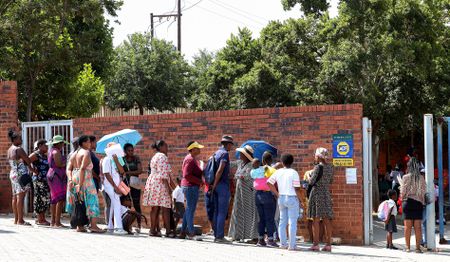
However, the platform has become synonymous with technical glitches, such as websites crashing under peak traffic, login timeouts, failed document uploads, poor communication, including undelivered SMS notifications and vague status updates – resulting in anxious parents who still do not know where their children will go to school, sometimes even after the school year has started. These recurring problems with the Gauteng online admissions system have emerged almost every year since its launch, to the point where many parents now brace themselves for issues as a normal part of the process.
Sergio Isa dos Santos, the DA Gauteng’s spokesperson on education, said the late start to the application window was a concern because it put pressure on parents, the department and schools.
“It’s a real problem when you look and also compare to the other provinces like the Western Cape, which started in March. Normally, [in Gauteng] the late application process starts in December, so does that mean the late application will remain in December until the end of January? Does it move further back?” he questioned.
He explained that earlier this year in the rush to finalise placements, some children were placed 30km, 60km or 90km away from their residences.
According to Maile, the department reviews the system annually with parents, school governing bodies, principals, school administrators, district officials and provincial call-centre agents, and uses their recommendations to make ongoing enhancements so the platform remains efficient, equitable, accessible and responsive to parents and learners.
Dos Santos said he would need to go into the system himself to see whether changes had actually been made. He said he had previously picked up problems such as incorrect geocoding, difficulties uploading documents and lagging in the system, and that these issues were repeatedly raised by parents but did not seem to be fully fixed.
Daily Maverick asked the Gauteng Department of Education how it had strengthened the Grade 1 and 8 admissions system, why this year’s application window opened so late, and whether it had enough time and contingency measures in place to place all learners and avoid the problems of previous years. At the time of publication, no response had been received. DM
Comments
Scroll down to load comments...